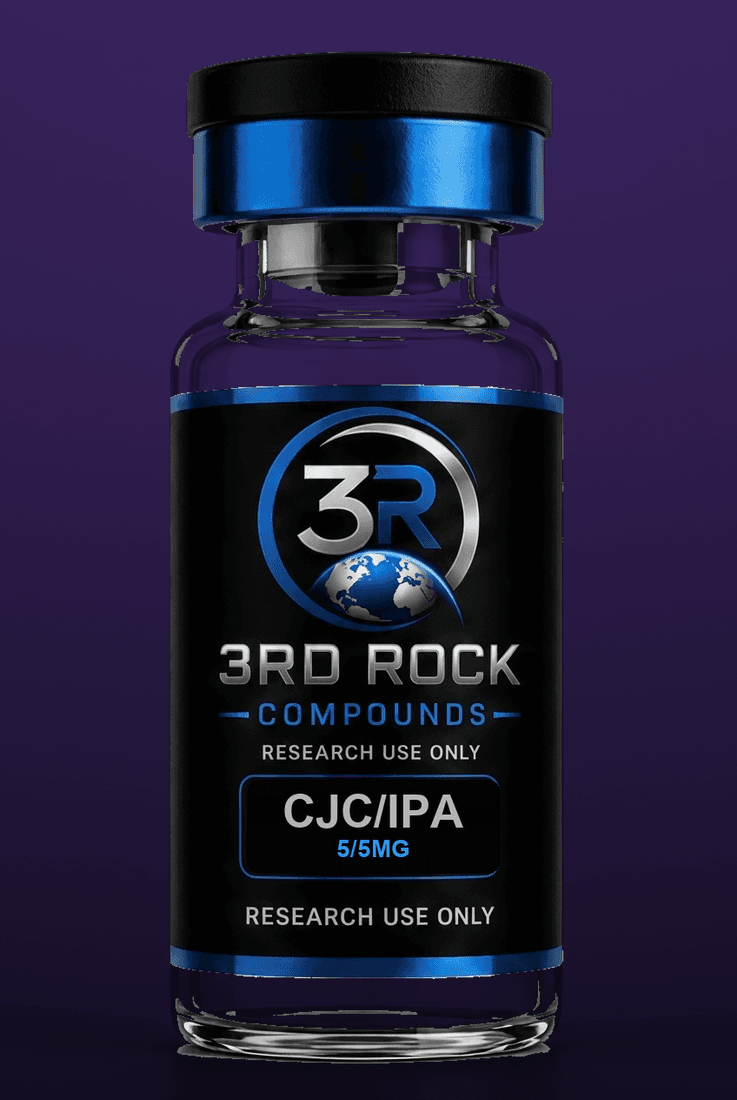
Front label
Growth & Peptide Secretagogues | 99.37% purity
CJC (NO DAC)/IPA 5/5MG
CJC-1295 (also known as DAC:GRF, or Drug Affinity Complex: Growth Hormone-Releasing Factor) is a synthetic, 30-amino acid analogue of growth hormone-releasing hormone (GHRH), engineered by ConjuChem Biotechnologies (Canada) using proprietary Drug Affinity Complex (DAC) technology.
$70
Lot
—
Purity (HPLC-UV/VIS)
99.37%
Reported
06/17/2026
Lab
Kovera Labs
Issued by Kovera Labs. Testing was commissioned by our fulfilment partner on the material we ship; the certificate names that party, not 3rd Rock Compounds.
Quantity
CJC (NO DAC)/IPA 5/5MG
1 vial · $70
- Third-party HPLC tested
- Lot-matched certificate
- Same-day fulfilment before 2pm
- Shipping 2–4 business days
Identifiers
- Molecular formula
- C165H271N47O46S
- Molecular weight
- ~4562 g/mol
Mechanism of Action
The DAC linker on CJC-1295 is an N-ε-3-maleimidopropionyl (MPA) group attached to the ε-amine of Lys29 at the C-terminus. After subcutaneous injection, the maleimide group undergoes a thio-Michael addition with the free thiol of serum albumin Cys-34 (the only free cysteine in circulating albumin), forming a stable, irreversible thioether bond. [1]
| Phase | Mechanism | Result |
|---|---|---|
| 1. In vivo binding | MPA maleimide + albumin Cys-34 → thioether bond | CJC-1295 becomes albumin-conjugated; plasma t½ → 6–8 days |
| 2. Slow release | Albumin-CJC-1295 complex circulates; GHRHr remains accessible | Sustained GHRH receptor stimulation for 9–11 days |
| 3. GHRHr activation | GHRHr → Gs → adenylyl cyclase → cAMP ↑ | PKA activation → GH gene transcription in somatotrophs |
| 4. GH secretion | GH released from anterior pituitary → circulation | GH → liver IGF-1 production; peripheral anabolic effects |
2. GHRHr Signaling Cascade
CJC-1295 engages the GHRH receptor (GHRHr), a class B G protein-coupled receptor expressed on anterior pituitary somatotroph cells: [2]
- Gs/cAMP pathway: GHRHr → Gs → adenylyl cyclase → cAMP ↑ → PKA activation → phosphorylation of CREB → GH gene transcription
- IP3/Ca²⁺ pathway: Secondary Gq coupling → PLC → IP3 → intracellular Ca²⁺ mobilization → GH vesicle exocytosis
- IGF-1 loop: GH → liver → IGF-1 production → peripheral tissues (muscle, bone, adipose) → anabolic signaling
- Negative feedback: Rising IGF-1 and somatostatin suppress further GH release — preserving physiological regulation
3. CJC-1295 with DAC vs. No-DAC vs. Native GHRH
| Property | Native GHRH(1-44) | No-DAC (Mod GRF 1-29) | CJC-1295 with DAC |
|---|---|---|---|
| Half-life | ~7 min | ~30 min | 6–8 days |
| GH pattern | Pulsatile | Pulsatile | Tonic/continuous |
| Clinical trials | Yes (approved) | None (FDA Dec 2024) | Phase I/II (Teichman 2006) |
| IGF-1 elevation duration | Minutes | Hours | 9–11 days |
| Albumin binding | No | No | Yes (irreversible) |
4. DNA Damage Considerations
Preclinical research (Ben-Shlomo et al., 2020) has raised the hypothesis that sustained, continuous GH stimulation via long-acting GHRH analogues may promote DNA damage in pituitary somatotroph cells — a potential concern with tonic GH elevation unlike the physiological pulsatile pattern. [6] This remains an active area of mechanistic research and is not yet established as a clinical safety signal from human trial data.
Preclinical Research Findings
CJC-1295 has been investigated as an alternative to daily rhGH injections for adults with GHD or age-related somatopause. Phase I data (Teichman et al., 2006) in healthy adults (n=64) demonstrated that a single SC injection produced dose-dependent GH increases (1.5 to 3-fold above baseline) lasting 9–11 days, with IGF-1 increases of 1.3 to 1.9-fold sustained for 9–11 days. [3] This durability profile positions CJC-1295 with DAC as a potential once-weekly or biweekly pituitary secretagogue in GHD research models.
🔬 Body Composition Research
GH and IGF-1 regulate body composition by stimulating lipolysis (fat breakdown) and protein synthesis (muscle anabolism). Preclinical studies in rodent models demonstrate that sustained GHRH receptor activation increases lean body mass and reduces adipose tissue — effects mediated via IGF-1 signaling in muscle and fat tissue. [5] CJC-1295 with DAC produces continuous IGF-1 elevation that may amplify these body composition effects compared to pulsatile delivery approaches.
🔬 Metabolic Research — HIV-Associated Lipodystrophy
Phase II trials in adults with HIV-associated lipodystrophy (fat redistribution syndrome) were initiated by ConjuChem before the company's closure. This population was selected because HIV antiretroviral therapy causes peripheral fat loss and central fat accumulation, with secondary GH axis suppression. CJC-1295 with DAC was hypothesized to restore GH/IGF-1 physiology and normalize fat distribution — a clinically meaningful endpoint in this population. [4] Development was discontinued without publication of Phase II results.
🔬 Pediatric GHD (Preclinical Model)
Alba et al. (2006) studied GRF analogues in GH-deficient rat models, establishing the preclinical basis for dosing regimens translatable to pediatric GHD research. CJC-1295 with DAC showed dose-dependent normalization of growth parameters in hypophysectomized rodents — the standard in vivo model for GHD. [7]
🔬 Pituitary Biology and GH Axis Research
CJC-1295 with DAC serves as a pharmacological tool compound for studying tonic vs. pulsatile GH axis stimulation. Because it provides continuous, week-long GHRHr activation, it enables researchers to decouple the effects of GH pulse frequency from GH pulse amplitude — questions relevant to optimizing GH replacement therapy dosing regimens. [2]
| Research Domain | Evidence Level | Key Finding |
|---|---|---|
| GHD/Somatopause | Phase I clinical | GH ↑ 1.5–3× for 9–11 days per injection |
| Body composition | Preclinical | Lean mass ↑, fat mass ↓ in rodent models |
| HIV lipodystrophy | Phase II initiated | Development discontinued; results unpublished |
| Pediatric GHD | Preclinical | Growth normalization in hypophysectomized rats |
| Pituitary biology | Preclinical/in vitro | Tool compound for tonic vs. pulsatile GH research |
Safety Profile
Findings summarised above derive from in-vitro and animal studies. No safety profile for human use is established or implied, and none is offered here.
Handle as a laboratory reagent: avoid inhalation and contact, reconstitute under aseptic conditions, and observe the storage conditions below.
For research use only. Not for human consumption.
Shipping and Storage
- Supplied as lyophilised powder in a sealed vial.
- Store at 2–8°C (36–46°F). Protect from light.
- Same-day fulfilment on orders before 2pm; shipping 2–4 business days.
- For research use only. Not for human consumption.
References
- [1]Jetté L, et al. (2005). Human growth hormone-releasing factor (hGRF)1-29-albumin bioconjugates activate the GRF receptor on the anterior pituitary in rats: identification of CJC-1295 as a long-lasting GRF analog. Endocrinology, 146(7):3052–3058.
- [2]Ionescu M, Frohman LA. (2006). Pulsatile secretion of growth hormone (GH) persists during continuous stimulation by CJC-1295, a long-acting GH-releasing hormone analog. J Clin Endocrinol Metab, 91(12):4792–4797. DOI →
- [3]Teichman SL, et al. (2006). Prolonged stimulation of growth hormone (GH) and insulin-like growth factor I secretion by CJC-1295, a long-acting analog of GH-releasing hormone, in healthy adults. J Clin Endocrinol Metab, 91(3):799–805. DOI →
- [4]Alba M, et al. (2006). Once-monthly administration of CJC-1295, a long-acting growth hormone-releasing hormone (GHRH) analog, normalizes growth in the GHRH-deficient dwarf rat. Am J Physiol Endocrinol Metab, 291(6):E1290–E1294. DOI →
- [5]Walker RF. (2006). Sermorelin: a better approach to management of adult-onset growth hormone insufficiency? Clin Interv Aging, 1(4):307–308. DOI →
- [6]Ben-Shlomo A, et al. (2020). Growth hormone-releasing hormone (GHRH) and its analogues: from bench to bedside. Neuroendocrinology, 110(3–4):192–199.
- [7]Gahete MD, et al. (2009). In vivo and in vitro evidence for the importance of growth hormone-releasing hormone in the regulation of GH secretion. Mol Cell Endocrinol, 309(1–2):40–47.
- [8]FDA. (2024). Bulk Drug Substances Under Evaluation for Use in Compounding Under Section 503A: Category 2. Docket FDA-2013-N-1525. Federal Register, Dec 2024.
- [9]WADA. (2024). List of Prohibited Substances and Methods. S2: Peptide Hormones, Growth Factors, Related Substances, and Mimetics. World Anti-Doping Agency. wada-ama.org →
- [10]Frohman LA, Jansson JO. (1986). Growth hormone-releasing hormone. Endocr Rev, 7(3):223–253. DOI →
Entries without a link have no DOI or PubMed identifier in the source record. The reference is reproduced as given; every link that does appear has been checked and resolves to the work it names.
2 references carry an identifier in our record that resolves to a different paper. We have withheld those links rather than send you to the wrong work, and we do not substitute one we cannot verify.