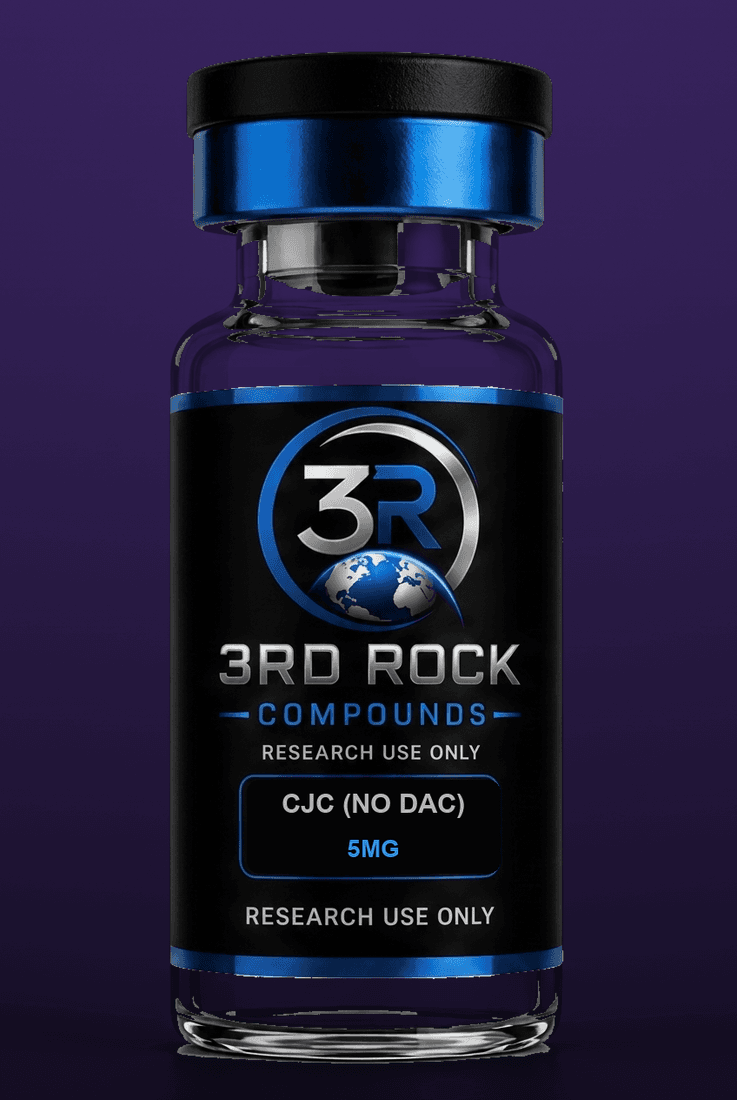
Front label
Growth & Peptide Secretagogues | Research use only
CJC (NO DAC) 5MG
CJC-1295 (no DAC), also known as Modified GRF (1-29) or Mod GRF 1-29, is a synthetic 29-amino acid peptide analog of endogenous growth hormone-releasing hormone (GHRH).
$70
Certificate of analysis available on request
We have not yet published a third-party certificate for this compound. Contact us for the current lot's documentation before ordering.
Quantity
CJC (NO DAC) 5MG
1 vial · $70
- Third-party HPLC tested
- Lot-matched certificate
- Same-day fulfilment before 2pm
- Shipping 2–4 business days
Identifiers
- CAS number
- 863288-34-0
- Molecular formula
- C₁₅₂H₂₅₂N₄₄O₄₂
- Molecular weight
- 3367.95 g/mol
- PubChem CID
- 56841945
- Sequence
- Y-a-D-A-I-F-T-Q-S-Y-R-K-V-L-A-Q-L-S-A-R-K-L-L-Q-D-I-L-S-R-NH₂ (a = D-Alanine)
Mechanism of Action
CJC-1295 (no DAC) functions as a selective GHRH receptor agonist that binds to growth hormone-releasing hormone receptors (GHRHr) on somatotroph cells in the anterior pituitary gland, initiating a cAMP-dependent signaling cascade that stimulates growth hormone (GH) gene transcription, synthesis, and pulsatile secretion.[7][8]
Primary Receptor Target & Binding Characteristics
| Property | Detail | Evidence |
|---|---|---|
| Primary Target | Growth Hormone-Releasing Hormone Receptor (GHRHr) on anterior pituitary somatotrophs | Teichman et al. (2006); Alba et al. (2006)[8] |
| Receptor Class | Class B1 (secretin family) G protein-coupled receptor (GPCR) | Established GHRH receptor pharmacology[7] |
| Binding Affinity | High affinity; mimics native GHRH structure with enhanced stability from tetrasubstitution | Jetté et al. (2005)[4] |
| Binding Reversibility | Reversible binding; crucial for maintaining physiological balance and preventing GH axis overstimulation | Pharmacokinetic profile[5] |
| Half-Life | ~30 minutes (vs. minutes for native GHRH; vs. 6–8 days for CJC-1295 with DAC) | Soule et al. (1994); Henninge et al. (2010)[2][1] |
| Selectivity | Highly selective for GHRHr on pituitary somatotrophs; possible low-level cross-reactivity within the secretin receptor family | 86% homology with endogenous GHRH[7] |
| DPP-4 Resistance | D-Alanine at position 2 prevents dipeptidyl peptidase-4 cleavage that rapidly degrades native GHRH | Jetté et al. (2005); Soule et al. (1994)[4][2] |
Downstream Signaling Cascade
| Step | Event | Molecular Detail |
|---|---|---|
| 1. Receptor Binding | CJC-1295 (no DAC) binds GHRHr on somatotroph cell surface | High-affinity, reversible "lock-and-key" interaction mimicking native GHRH[7] |
| 2. G-Protein Activation | Ligand-receptor interaction activates stimulatory G-proteins (Gs) | Gsα subunit dissociates and activates downstream effectors[7] |
| 3. cAMP Production | Gs activates adenylyl cyclase; ATP is converted to cyclic AMP (cAMP) | Intracellular cAMP levels increase significantly (dose-dependent)[7][14] |
| 4. PKA Activation | Elevated cAMP activates Protein Kinase A (PKA) phosphorylation cascades | PKA phosphorylates transcription factors including CREB[7] |
| 5. GH Gene Transcription | PKA cascade stimulates GH gene transcription and protein synthesis in somatotrophs | Increased GH mRNA and total pituitary RNA[7][8] |
| 6. Pulsatile GH Secretion | GH is released in a physiological pulse from anterior pituitary | ~30 min half-life produces pulsatile (not continuous) GH release[5][6] |
| 7. IGF-1 Stimulation | Released GH stimulates the liver to produce Insulin-like Growth Factor-1 (IGF-1) | GH/IGF-1 axis activation drives downstream anabolic effects[8] |
Alternative Signaling Pathways
While the Gs/cAMP/PKA cascade is the primary signaling pathway, CJC-1295 (no DAC) may also engage the MAPK (mitogen-activated protein kinase) and PI3K/Akt pathways, which contribute to anabolic effects (protein synthesis via mTOR), anti-apoptotic signaling, and cellular proliferation.[7]
Cellular and Tissue-Level Effects
| Effect | Detail | Evidence |
|---|---|---|
| Somatotroph Proliferation | Stimulates proliferation of pituitary somatotroph cells; increases total pituitary RNA and GH mRNA | Alba et al. (2006) (DAC variant)[8] |
| GH/IGF-1 Axis | Stimulates pulsatile GH release; liver produces IGF-1; dose-dependent GH and IGF-1 elevation | Teichman et al. (2006) (DAC variant)[8] |
| Lipolysis | GH promotes fat breakdown via hormone-sensitive lipase activation; inhibits lipogenesis | GH/IGF-1 axis pharmacology[7] |
| Protein Synthesis | Enhances muscle protein synthesis via mTOR pathway activation downstream of GH/IGF-1 | GH secretagogue literature[12] |
| Tissue Repair | Accelerates wound healing and connective tissue repair through collagen synthesis stimulation | GH/IGF-1 axis regenerative properties[12] |
| DNA Damage (Pituitary) | Intense cAMP stimulation by CJC-1295 in mouse pituitary cells induced DNA damage (H2AX phosphorylation and comet assays) | Ben-Shlomo et al. (2020) (likely DAC variant)[14] |
Comparison: CJC-1295 No DAC vs. Related Compounds
| Parameter | CJC-1295 No DAC (Mod GRF 1-29) | CJC-1295 With DAC | Native GHRH(1-29) / Sermorelin |
|---|---|---|---|
| Half-Life | ~30 minutes | 6–8 days | Minutes |
| GH Release Pattern | Pulsatile (physiological) | Continuous (non-physiological) | Pulsatile (very brief) |
| DPP-4 Resistance | Yes (D-Ala² substitution) | Yes (D-Ala² substitution) | No (rapidly cleaved) |
| Albumin Binding | None | Covalent (via MPA-Lys linker) | None |
| Receptor Desensitization Risk | Low (pulsatile clearance) | Higher (chronic stimulation) | Low (too brief to cause) |
| Clinical Trials | None identified for this specific compound | Phase I/II completed (Teichman 2006; Ionescu 2006) | FDA-approved (as Sermorelin, discontinued) |
Preclinical Research Findings
CJC-1295 (no DAC) is utilized in laboratory research to investigate the effects of pulsatile GHRH receptor stimulation on the GH/IGF-1 axis across 5+ research domains. It is important to note that the FDA has identified no published clinical trials or preclinical efficacy studies specific to CJC-1295 without DAC; the research applications below reflect the broader GHRH analog literature and the known pharmacology of the GH/IGF-1 axis.[9]
Application Areas
- Body Composition & Muscle Hypertrophy — Research indicates that GHRH analog-stimulated GH release promotes protein synthesis and increases lean muscle mass through IGF-1 stimulation. CJC-1295 (no DAC) is frequently studied in the context of sarcopenia (age-related muscle loss) to determine if pulsatile GHRH stimulation can preserve muscle tissue and strength in aging populations.[6][12]
- Lipid Metabolism & Weight Management — Studies suggest that upregulation of GH secretion facilitates lipolysis (fat breakdown) and inhibits lipogenesis. Researchers investigate the utility of GHRH analogs in models of obesity and metabolic syndrome, focusing on improved energy expenditure and reduction of visceral adipose tissue.[6][12]
- Tissue Repair & Injury Recovery — Due to the regenerative properties of the GH/IGF-1 axis, this peptide is researched for its potential to accelerate the healing of connective tissues, including tendons and ligaments. It is hypothesized to enhance collagen synthesis and cellular repair mechanisms following acute injury or surgery.[6]
- Sleep Physiology — Growth hormone secretion is intimately linked with slow-wave sleep (SWS). Research explores the potential of GHRH analogs to deepen sleep cycles and improve restorative sleep states, as GHRH activity is necessary to initiate and maintain the deepest stages of non-REM sleep.[6]
- Anti-Aging & Cellular Function — Investigational uses focus on the peptide's ability to restore "youthful" GH pulsatility in aging populations, potentially mitigating physiological declines associated with the somatopause, including reduced skin elasticity, bone mineral density loss, and cognitive function decline.[6][12]
Evidence Summary by Application
| Application | Mechanism | Evidence Level | Key References |
|---|---|---|---|
| Muscle Hypertrophy / Sarcopenia | GH → IGF-1 → mTOR → protein synthesis | Preclinical (DAC variant); theoretical for no-DAC | Sinha et al. (2020)[12] |
| Lipid Metabolism / Obesity | GH → hormone-sensitive lipase → lipolysis; inhibited lipogenesis | Preclinical (DAC variant); theoretical for no-DAC | Sigalos & Pastuszak (2018)[7] |
| Tissue Repair / Connective Tissue | GH/IGF-1 → collagen synthesis stimulation | Theoretical; based on GH/IGF-1 axis physiology | GH axis pharmacology[6] |
| Sleep Enhancement | GHRH signaling → slow-wave sleep induction and maintenance | Theoretical; based on GHRH/SWS relationship | GHRH sleep physiology literature[6] |
| Anti-Aging / Somatopause | Restoration of pulsatile GH secretion; IGF-1 normalization | Theoretical; based on age-related GH decline | Sinha et al. (2020)[12] |
| Pituitary Biology / DNA Damage | cAMP stimulation → H2AX phosphorylation → DNA damage in somatotrophs | Preclinical in vitro/in vivo (likely DAC variant) | Ben-Shlomo et al. (2020)[14] |
Synergistic Combination Research
CJC-1295 (no DAC) is frequently studied in combination with Ipamorelin, a selective growth hormone secretagogue that acts on the ghrelin/GHS receptor (a complementary pathway to GHRH). The rationale is that simultaneous GHRH receptor activation (via CJC-1295 no DAC) and GHS receptor activation (via Ipamorelin) produce a synergistic amplification of GH release beyond what either compound achieves alone.[12]
Analytical & Forensic Applications
CJC-1295 (no DAC) has been a subject of forensic and anti-doping research. Henninge et al. (2010) and Hartvig et al. (2014) developed LC-MS/MS methods to identify Modified GRF 1-29 in seized pharmaceutical preparations, confirming its widespread distribution in the grey market. These analytical methods also serve as the basis for WADA anti-doping testing protocols.[1][3][13]
Safety Profile
Findings summarised above derive from in-vitro and animal studies. No safety profile for human use is established or implied, and none is offered here.
Handle as a laboratory reagent: avoid inhalation and contact, reconstitute under aseptic conditions, and observe the storage conditions below.
For research use only. Not for human consumption.
Shipping and Storage
- Supplied as lyophilised powder in a sealed vial.
- Store at 2–8°C (36–46°F). Protect from light.
- Same-day fulfilment on orders before 2pm; shipping 2–4 business days.
- For research use only. Not for human consumption.
References
- [1]Henninge J, Pepaj M, Hullstein I, Hemmersbach P. Identification of CJC-1295, a growth-hormone-releasing peptide, in an unknown pharmaceutical preparation. Drug Testing and Analysis, 2(11-12), 647-650, 2010. DOI →
- [2]Soule S, King JA, Millar RP. Incorporation of D-Ala2 in growth hormone-releasing hormone-(1-29)-NH2 increases the half-life and decreases metabolic clearance in normal men. The Journal of Clinical Endocrinology and Metabolism, 79(4), 1208-1211, 1994. DOI →
- [3]Hartvig RA, Holm NB, Dalsgaard PW, Reitzel LA, Müller IB, Linnet K. Identification of peptide and protein doping related drug compounds confiscated in Denmark between 2007-2013. Scandinavian Journal of Forensic Science, 20(2), 42-49, 2014. DOI →
- [4]Jetté L, et al. Human Growth Hormone-Releasing Factor (hGRF)1-29-Albumin Bioconjugates Activate the GRF Receptor on the Anterior Pituitary in Rats: Identification of CJC-1295 as a Long-Lasting GRF Analog. Endocrinology, 146(7), 3052-3058, 2005. DOI →
- [5]Lance VA, Murphy WA, Sueiras-Diaz J, Coy DH. Super-active analogs of growth hormone-releasing factor (1-29)-amide. Biochemical and Biophysical Research Communications, 119(1), 265-272, 1984. DOI →
- [6]Van Hout MC, Hearne E. Netnography of Female Use of the Synthetic Growth Hormone CJC-1295: Pulses and Potions. Substance Use & Misuse, 51(1), 73-84, 2016. PubMed →
- [7]Sigalos JT, Pastuszak AW. The Safety and Efficacy of Growth Hormone Secretagogues. Sexual Medicine Reviews, 6(1), 45-53, 2018.
- [8]Teichman SL, Neale A, Lawrence B, Gagnon C, Castaigne JP, Frohman LA. Prolonged stimulation of growth hormone (GH) and insulin-like growth factor I secretion by CJC-1295, a long-acting analog of GH-releasing hormone, in healthy adults. The Journal of Clinical Endocrinology & Metabolism, 91(3), 799-805, 2006. DOI →
- [9]Food and Drug Administration. FDA Evaluation of CJC-1295 Related Bulk Drug Substances. FDA Briefing Document: Pharmacy Compounding Advisory Committee (PCAC) Meeting, December 4, 2024. fda.gov →
- [10]Food and Drug Administration. Final Summary Minutes of the Pharmacy Compounding Advisory Committee Meeting. Center for Drug Evaluation and Research, December 4, 2024. fda.gov →
- [11]World Anti-Doping Agency. The 2024 Prohibited List: International Standard. World Anti-Doping Code, 2024. wada-ama.org →
- [12]Sinha DK, Balasubramanian A, Tatem AJ, Kovac JR, Pastuszak AW, Lipshultz LI. Beyond the androgen receptor: the role of growth hormone secretagogues in the modern management of body composition in hypogonadal males. Translational Andrology and Urology, 9(Suppl 2), S149-S159, 2020. PubMed →
- [13]Fabresse N, Grassin-Delyle S, Etting I, Alvarez JC. Identification of a GHRH peptide analogue, the CJC-1295, using LC-HRMS/MS. Toxicologie Analytique et Clinique, 29(2), 205-211, 2017.
- [14]Ben-Shlomo A, et al. DNA damage and growth hormone hypersecretion in pituitary somatotroph adenomas. The Journal of Clinical Investigation, 130(11), 5738-5755, 2020. PMC →
- [15]Ionescu M, Frohman LA. Pulsatile secretion of growth hormone (GH) persists during continuous stimulation by CJC-1295, a long-acting GH-releasing hormone analog. The Journal of Clinical Endocrinology & Metabolism, 91(12), 4792-4797, 2006. DOI →
- [16]Memdouh S, Gavrilović I, Ng K, Cowan D, Abbate V. Advances in the detection of growth hormone releasing hormone synthetic analogs. Drug Testing and Analysis, 13(11-12), 1871-1887, 2021. DOI →
Entries without a link have no DOI or PubMed identifier in the source record. The reference is reproduced as given; every link that does appear has been checked and resolves to the work it names.
1 reference carries an identifier in our record that resolves to a different paper. We have withheld those links rather than send you to the wrong work, and we do not substitute one we cannot verify.