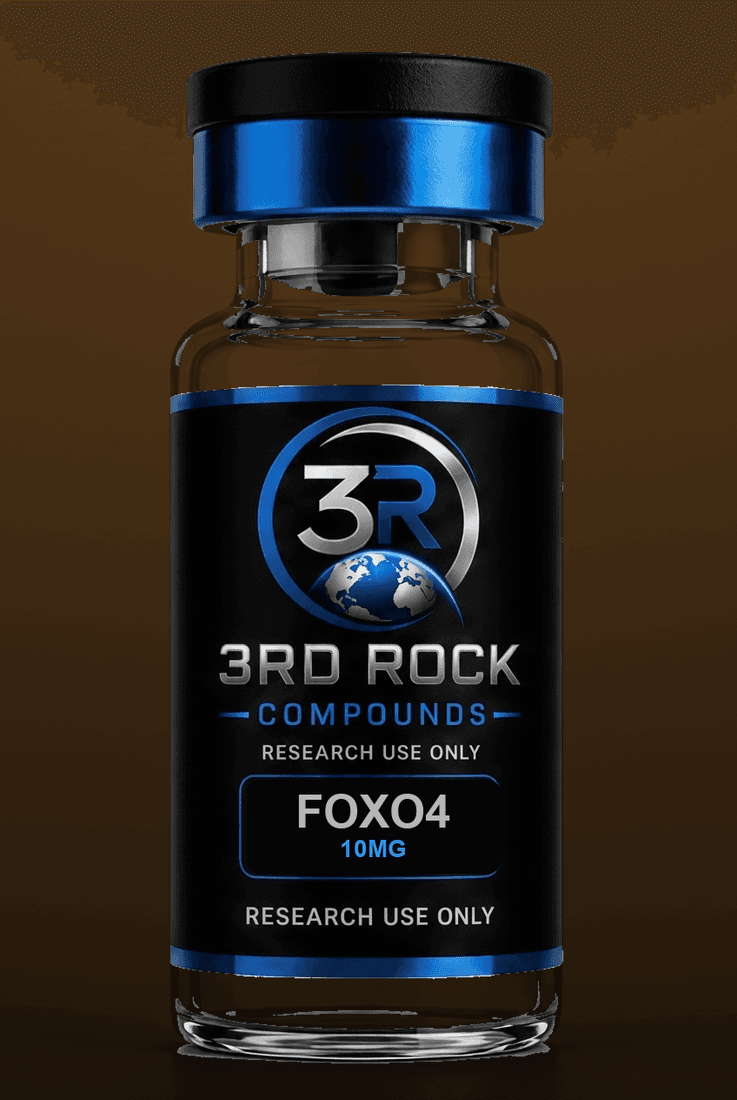
Front label
Cellular Research | >99.80% purity
FOXO4 10MG
FOXO4-DRI (Forkhead box O4 D-Retro-Inverso), also known as Proxofim, is a synthetic, cell-permeable D-retro-inverso peptide designed to selectively target and eliminate senescent cells through a mechanism termed Targeted Apoptosis of Senescent Cells (TASC).
$225
Lot
F26C351
Purity (HPLC-UV/VIS)
>99.80%
Reported
3/2/2026
Lab
Vanguard Laboratory
Issued by Vanguard Laboratory, A2LA #6377.01.01. Testing was commissioned by our fulfilment partner on the material we ship; the certificate names that party, not 3rd Rock Compounds.
Quantity
FOXO4 10MG
1 vial · $225
- Third-party HPLC tested
- Lot-matched certificate
- Same-day fulfilment before 2pm
- Shipping 2–4 business days
Identifiers
- CAS number
- 2460055-10-9
- Molecular formula
- C₂₂₈H₃₈₈N₈₆O₆₄
- Molecular weight
- 5358.05 Da
- PubChem CID
- 167312269
- Sequence
- H-ltlrkepaseiaqsileaysqngwanrrsggkrppprrrqrrkkrg-OH (all D-amino acids)
Mechanism of Action
FOXO4-DRI functions as a competitive peptide antagonist that disrupts the critical survival interaction between FOXO4 and p53 in senescent cells, triggering a process called Targeted Apoptosis of Senescent Cells (TASC).[1]
Primary Target & Binding Characteristics
| Property | Detail | Evidence |
|---|---|---|
| Primary Target | FOXO4-p53 protein-protein interaction interface | Baar et al. (2017)[1] |
| Specific Binding Site on p53 | Transactivation Domain 2 (TAD2) of p53 | Bourgeois et al. (2025) NMR structure[2] |
| Binding Dynamics | Both FOXO4-DRI and p53 TAD2 are intrinsically disordered; fold synergistically upon binding to form a transiently folded complex | Bourgeois et al. (2025)[2] |
| Affinity Modulation | Phosphorylation of p53 at Ser46 and Thr55 significantly enhances FOXO4-DRI binding affinity | Bourgeois et al. (2025)[2] |
| HIV-TAT Contribution | Cationic HIV-TAT residues contribute additional contacts with p53 TAD2, stabilizing the interaction | Bourgeois et al. (2025)[2] |
| Cell Penetration | Intracellular uptake within 2–4 hours; detectable for ≥72 hours | Baar et al. (2017)[1] |
The Senescence Lock (Pre-Treatment State)
In senescent cells, FOXO4 is upregulated and physically interacts with p53 within the nucleus, specifically localizing to PML bodies (Promyelocytic Leukemia bodies) and DNA-SCARS (DNA Segments with Chromatin Alterations Reinforcing Senescence). This binding sequesters p53 in the nucleus, preventing it from initiating pro-apoptotic functions — effectively keeping the senescent cell in a suspended "zombie" state.[1][3]
Downstream Signaling Cascade (TASC Pathway)
| Step | Event | Molecular Detail |
|---|---|---|
| 1. Competitive Inhibition | FOXO4-DRI competes with endogenous FOXO4 for p53 binding | Binds p53 TAD2 with high affinity, displacing endogenous FOXO4[1][2] |
| 2. Nuclear Exclusion | Liberated p53 is excluded from the nucleus | p53 released from PML bodies / DNA-SCARS[1] |
| 3. Mitochondrial Translocation | Active, mono-ubiquitinated p53 translocates to mitochondria | Transcription-independent apoptosis pathway[1] |
| 4. BAX/BAK Activation | p53 interacts with BAX and BAK (pro-apoptotic Bcl-2 family members) | Mitochondrial outer membrane permeabilization (MOMP)[1][5] |
| 5. Cytochrome C Release | BAX/BAK pores release Cytochrome C into the cytosol | Initiates the intrinsic apoptosis cascade[1] |
| 6. Caspase Activation | Cytochrome C triggers cleavage of Caspase-3 and Caspase-7 | Terminal effector caspases execute apoptosis[1][5] |
| 7. Selective Senolysis | Senescent cell undergoes intrinsic apoptosis and is eliminated | Non-senescent cells unaffected (low FOXO4, no dependency on FOXO4-p53 axis)[1] |
Cellular & Tissue-Level Effects
| Effect | Detail | Evidence |
|---|---|---|
| Senolysis | Selective elimination of senescent fibroblasts (IMR90), chondrocytes, and Leydig cells; 11.73-fold selectivity over non-senescent cells | Baar et al. (2017); Huang et al. (2021)[1][6] |
| SASP Suppression | Downregulation of IL-6, IL-1β, TNF-α, TGF-β, and other pro-inflammatory cytokines | Zhang et al. (2020); Hu et al. (2026)[4][5] |
| Marker Modulation | Decreased p16 and p21 expression; increased Ki-67 (proliferation marker) and Lamin B1 (nuclear envelope marker) | Hu et al. (2026)[5] |
| Renal Restoration | Normalized plasma urea and creatinine; reduced tubular senescence markers | Baar et al. (2017)[1] |
| Testosterone Restoration | Selective apoptosis of senescent Leydig cells; improved testicular microenvironment; restored testosterone secretion | Zhang et al. (2020)[4] |
| Vascular Health | Reduced aortic wall thickness, reduced ROS levels, improved endothelial-dependent vasodilation, reduced Pulse Wave Velocity | Hu et al. (2026)[5] |
Selectivity vs. Related Compounds
| Comparison | FOXO4-DRI | Comparator |
|---|---|---|
| vs. ABT-737 / Navitoclax (BCL-2 inhibitors) | No thrombocytopenia; targets p53/FOXO4 axis specifically | Causes low platelet counts by affecting non-senescent cells[1] |
| vs. Dasatinib + Quercetin | Peptide-based; single-target mechanism (FOXO4-p53); DRI stability | Small molecule combination; multi-target kinase inhibition |
| vs. CL04183 (4th-generation) | Original compound; shorter half-life; narrower therapeutic window at high doses | Enhanced binding affinity; improved liver enzyme stability; broader therapeutic window[2] |
| vs. Endogenous FOXO4 | Antagonist: competes for p53 to trigger apoptosis; protease-resistant DRI form | Agonist of senescence maintenance: sequesters p53 to keep senescent cells alive[1] |
FOXO Family Specificity: The peptide design focused on a region of FOXO4 that differs from FOXO1 and FOXO3 to minimize cross-reactivity with these essential transcription factors. Cross-species conservation of the binding domain allows direct translational studies between mice and humans.[1]
Preclinical Research Findings
FOXO4-DRI is utilized in preclinical research to study the effects of clearing senescent cells (senolysis) across 9+ research domains:
- General Aging & Frailty — FOXO4-DRI restores tissue homeostasis in naturally aged mice (104–130 weeks). Benefits include improved fur density, increased physical activity (running wheel activity), improved responsiveness, and reduced p16-driven bioluminescence (senescence burden). Treatment of XpdTTD/TTD fast-aging mice yielded fur insulation restoration (approaching wildtype levels) and increased running from 1.37 km/day to near-wildtype levels.[1]
- Chemotherapy-Induced Toxicity — In Doxorubicin-treated C57BL/6J mice, FOXO4-DRI (5 mg/kg i.v., 3 doses) neutralized chemotherapy-induced liver toxicity (normalized plasma AST), prevented body weight loss, and reduced IL-6 and FOXO4 foci in liver tissue.[1]
- Renal Function Decline — In both fast-aging and naturally aged mice, FOXO4-DRI normalizes plasma urea and creatinine levels, restoring kidney filtering capacity and reducing tubular senescence markers. Significant reductions observed 30 days after 3 i.p. injections.[1]
- Male Hypogonadism / Testosterone Deficiency — In aged male mice (20–24 months), FOXO4-DRI selectively induces apoptosis in senescent Leydig cells, reducing SASP factors (IL-1β, IL-6, TGF-β), improving the testicular microenvironment, and significantly restoring serum testosterone levels (p<0.05).[4]
- Cardiovascular Aging & Endothelial Dysfunction — FOXO4-DRI reduces reactive oxygen species (ROS) in the aorta, suppresses vascular aging markers (p16, p21), thins the aortic wall, lowers Pulse Wave Velocity (improved elasticity), and improves endothelial-dependent vasodilation in both naturally aged and D-galactose progeroid mice.[5]
- Pulmonary Fibrosis — FOXO4-DRI ameliorates bleomycin-induced pulmonary fibrosis by targeting senescent myofibroblasts, downregulating extracellular matrix receptor interaction pathways, attenuating collagen deposition, and increasing Type 2 alveolar epithelial cells (AEC2).[8][9]
- Osteoarthritis & Cartilage Regeneration — In expanded human chondrocytes, FOXO4-DRI (25 µM, 5 days) selectively removed >50% of senescent cells (PDL9), reduced SA-β-gal to <5%, and decreased expression of SASP factors (IL-6, IL-8) in engineered cartilage tissue.[6]
- Cancer & Metastasis — FOXO4-DRI is being explored against therapy-resistant and metastatic cancers (triple-negative breast cancer, metastatic colon cancer) by targeting "scarred" cancer cells that share features with senescent cells, and for radiosensitizing non-small cell lung cancer.[10][11]
- Liver Fibrosis — FOXO4-DRI and optimized variants (CL04183) counter the CD44-high dedifferentiation state in hepatocytes driven by senescence, restoring liver function markers in fibrosis models.[10]
Safety Profile
Findings summarised above derive from in-vitro and animal studies. No safety profile for human use is established or implied, and none is offered here.
Handle as a laboratory reagent: avoid inhalation and contact, reconstitute under aseptic conditions, and observe the storage conditions below.
For research use only. Not for human consumption.
Shipping and Storage
- Supplied as lyophilised powder in a sealed vial.
- Store at 2–8°C (36–46°F). Protect from light.
- Same-day fulfilment on orders before 2pm; shipping 2–4 business days.
- For research use only. Not for human consumption.
References
- [1]Baar MP, et al. Targeted Apoptosis of Senescent Cells Restores Tissue Homeostasis in Response to Chemotoxicity and Aging. Cell, 169(1), 132-147.e16, 2017. PubMed →
- [2]Bourgeois B, et al. The disordered p53 transactivation domain is the target of FOXO4 and the senolytic compound FOXO4-DRI. Nature Communications, 16(1), 5672, 2025.
- [3]Bourgeois B, Madl T. Regulation of cellular senescence via the FOXO4-p53 axis. FEBS Letters, 592(12), 2083-2097, 2018.
- [4]Zhang C, et al. FOXO4-DRI alleviates age-related testosterone secretion insufficiency by targeting senescent Leydig cells in aged mice. Aging, 12(2), 1272-1284, 2020.
- [5]Hu Z, et al. FOXO4-DRI regulates endothelial cell senescence via the P53 signaling pathway. Frontiers in Bioengineering and Biotechnology, 13, 1729166, 2026.
- [6]Huang Y, et al. Senolytic Peptide FOXO4-DRI Selectively Removes Senescent Cells From in vitro Expanded Human Chondrocytes. Frontiers in Bioengineering and Biotechnology, 9, 677576, 2021.
- [7]Li Y, et al. FOXO4-DRI improves spermatogenesis in aged mice through reducing senescence-associated secretory phenotype secretion from Leydig cells. Experimental Gerontology, 195, 112522, 2024.
- [8]Han X, et al. FOXO4 peptide targets myofibroblast ameliorates bleomycin-induced pulmonary fibrosis in mice through ECM-receptor interaction pathway. Journal of Cellular and Molecular Medicine, 26(11), 3269-3280, 2022.
- [9]Liu Y, et al. FOXO4-D-Retro-Inverso targets extracellular matrix production in fibroblasts and ameliorates bleomycin-induced pulmonary fibrosis in mice. Naunyn-Schmiedeberg's Archives of Pharmacology, 396(10), 2393-2403, 2023.
- [10]Putavet DA, et al. Abstract IA002: Targeting senescence heterogeneity against cancer therapy-resistance and metastases. Cancer Research, 81(5_Supplement), IA002, 2021.
- [11]Meng J, et al. Targeting senescence-like fibroblasts radiosensitizes non-small cell lung cancer and reduces radiation-induced pulmonary fibrosis. JCI Insight, 6(23), e146334, 2021.
- [12]Krimpenfort P, Berns A. Rejuvenation by Therapeutic Elimination of Senescent Cells. Cell, 169(1), 3-5, 2017.
- [13]Mandal R, et al. FOXO4 interacts with p53 TAD and CRD and inhibits its binding to DNA. Protein Science, 31(5), e4287, 2022.
- [14]Kong YX, et al. FOXO4-DRI induces keloid senescent fibroblast apoptosis by promoting nuclear exclusion of upregulated p53-serine 15 phosphorylation. Communications Biology, 8(1), 299, 2025.
- [15]van Willigenburg H, de Keizer PLJ, de Bruin RWF. Cellular senescence as a therapeutic target to improve renal transplantation outcome. Pharmacological Research, 130, 322-330, 2018.
- [16]Putavet D, et al. Abstract P1-19-02: Repurposing the FOXO4 senolytic against triple-negative breast cancer. Cancer Research, 82(4_Supplement), P1-19-02, 2022.
- [17]Nwankwo N, Okafor I. Bioinformatics procedure for investigating senolytic (anti-aging) agents: A digital signal processing technique. Aging Medicine, 6(4), 338-346, 2024.
- [18]Timucin E, et al. Novel Senolytic Peptides. United States Patent Application, US20200255489A1, 2020. patents.google.com →
Entries without a link have no DOI or PubMed identifier in the source record. The reference is reproduced as given; every link that does appear has been checked and resolves to the work it names.
8 references carry an identifier in our record that resolves to a different paper. We have withheld those links rather than send you to the wrong work, and we do not substitute one we cannot verify.