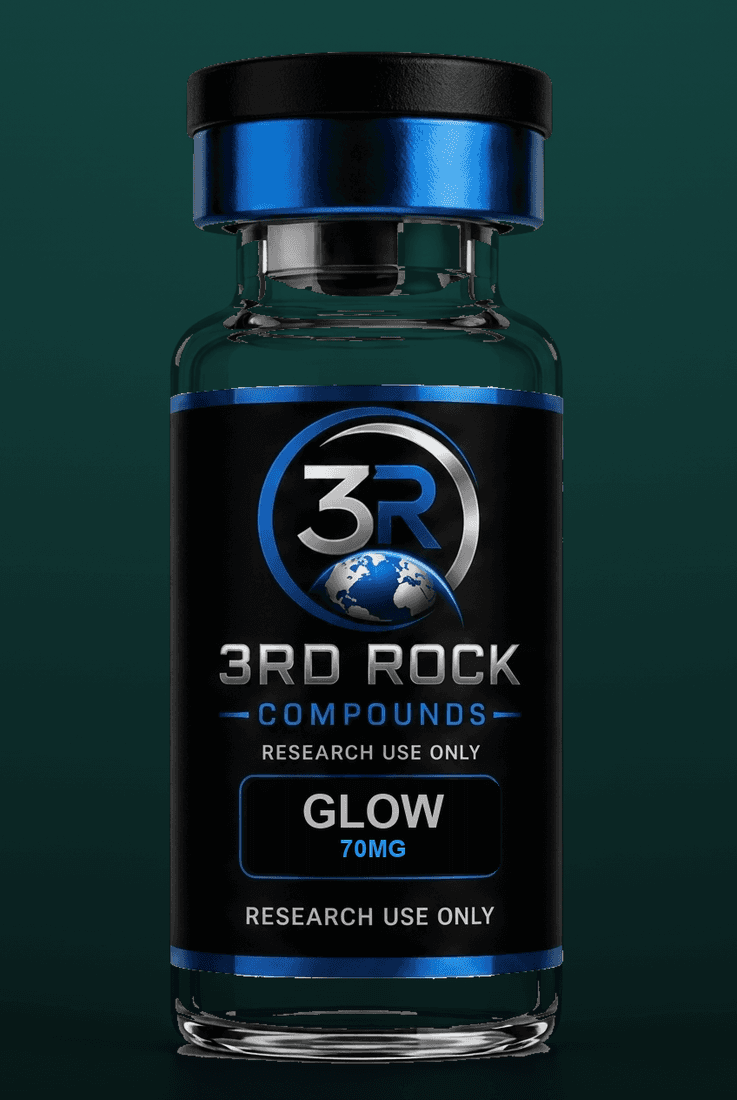
Front label
Repair & Recovery | 99.57% purity
GLOW 70MG
GLOW Blend is a co-lyophilized research peptide complex combining three of the most extensively studied tissue-remodeling peptides in preclinical literature: 50 mg GHK-Cu (Copper Tripeptide-1), 10 mg BPC-157, and 10 mg TB-500 (Ac-LKKTETQ, the actin-binding fragment of Thymosin β4 ) — totaling 70 mg per vial.
$120
Lot
20260303GLO
Purity (HPLC-UV/VIS)
99.57%
Reported
—
Lab
Freedom Diagnostics
Issued by Freedom Diagnostics. Testing was commissioned by our fulfilment partner on the material we ship; the certificate names that party, not 3rd Rock Compounds.
Quantity
GLOW 70MG
1 vial · $120
- Third-party HPLC tested
- Lot-matched certificate
- Same-day fulfilment before 2pm
- Shipping 2–4 business days
Identifiers
Mechanism of Action
1. GHK-Cu (50 mg, 71.4% of mass) — Copper Delivery & Gene Modulation
The largest component, GHK-Cu, is the endogenous tripeptide Gly-His-Lys chelated to a Cu(II) ion. It "redox silences" copper to prevent Fenton-reaction toxicity while delivering Cu into cells for use by lysyl oxidase (collagen crosslinking) and Cu/Zn-SOD. Connectivity Map analysis confirmed GHK modulates >4,000 genes, suppressing inflammatory/metastatic signatures and activating repair programs.[9][10] Stimulates collagen I/III, elastin, GAGs, and decorin synthesis with biphasic dose-response peaking near 10⁻⁹ M.[11]
2. BPC-157 (10 mg, 14.3% of mass) — VEGFR2-Akt-eNOS Angiogenic Cascade
BPC-157 binds and internalizes VEGFR2 on endothelial cells, triggering Akt phosphorylation and eNOS activation, yielding nitric oxide production essential for vascular repair (129–152% increased angiogenesis in chick chorioallantoic membrane and rat hind-limb ischemia models).[5] BPC-157 also activates the FAK-paxillin pathway and upregulates growth-hormone-receptor expression on tendon fibroblasts.[13]
3. TB-500 (10 mg, 14.3% of mass) — G-Actin Sequestration & Cell Migration
The LKKTETQ motif binds monomeric G-actin in a 1:1 complex, regulating polymerization into filamentous actin and enabling cytoskeletal reorganization required for cell motility.[6] TB-500 also engages F1-F0 ATP synthase on endothelial cells (KD ≈ 12 nM), forms a complex with integrin-linked kinase (ILK) and PINCH that activates Akt2, and upregulates MMP-2/MMP-9 to facilitate basement-membrane remodeling during angiogenesis.[14][15] Note: TB-500 lacks the N-terminal Ac-SDKP tetrapeptide of full-length Tβ4 and therefore does not contribute the anti-fibrotic TGF-β-modulating activity of the parent molecule.[16]
Combined Mechanistic Rationale
| Repair Axis | Primary Driver | Molecular Target |
|---|---|---|
| ECM synthesis & gene reset | GHK-Cu | Cu(II) delivery; ~31% genome modulated |
| Angiogenesis & NO signaling | BPC-157 | VEGFR2 → Akt → eNOS |
| Cell migration & cytoskeleton | TB-500 | G-actin 1:1 binding; ILK-PINCH-Akt2 |
| Antioxidant defense | GHK-Cu, TB-500 | Nrf2/Keap1; SOD upregulation |
| Anti-inflammatory | All three | NF-κB p65 phosphorylation blockade |
No published peer-reviewed pharmacokinetic or pharmacodynamic studies have evaluated the 50/10/10 blend as a single co-administered formulation. All mechanistic content is extrapolated from individual-component literature.
Preclinical Research Findings
Laboratory studies using the GLOW combination — or the individual components in parallel — have explored:
- Dermal Wound Healing & Re-Epithelialization — GHK-Cu (collagen/elastin synthesis), BPC-157 (granulation tissue formation), and TB-500/Tβ4 (keratinocyte migration) each independently accelerate full-thickness wound closure in rodent models.[11][17][18]
- Tendon, Ligament & Skeletal Muscle Repair — BPC-157 has been shown to accelerate Achilles transection healing; TB-500 supports myoblast and tenocyte migration; GHK-Cu modulates MMP/TIMP balance for connective-tissue remodeling.[19][20]
- Angiogenesis Models — BPC-157 (VEGFR2-driven) and TB-500/Tβ4 (epicardial progenitor mobilization) have both been documented to enlarge collateral vessel networks in ischemia paradigms.[5][21]
- Dermatology & Hair Follicle Research — GHK-Cu enlarges follicle size and prolongs anagen phase in preclinical models; the actin-binding region of Tβ4 (the TB-500 fragment) has been identified as an active site for hair-growth signaling.[22][23]
- Anti-Inflammatory & Antioxidant Models — All three components suppress NF-κB activation; GHK-Cu and TB-500 upregulate SOD/catalase; BPC-157 and TB-500 attenuate liver fibrosis in CCl₄/ethanol models.[24][25]
- Corneal & Ocular Surface Repair — BPC-157 and the Tβ4-derived peptides have independently demonstrated accelerated corneal epithelial repair in preclinical studies.[26]
Important: every cited study above used individual peptides, not the GLOW combination. Researchers using the blend should design experiments accordingly and not assume that the sum of single-agent effects has been validated in combination.
Safety Profile
Findings summarised above derive from in-vitro and animal studies. No safety profile for human use is established or implied, and none is offered here.
Handle as a laboratory reagent: avoid inhalation and contact, reconstitute under aseptic conditions, and observe the storage conditions below.
For research use only. Not for human consumption.
Shipping and Storage
- Supplied as lyophilised powder in a sealed vial.
- Store at 2–8°C (36–46°F). Protect from light.
- Same-day fulfilment on orders before 2pm; shipping 2–4 business days.
- For research use only. Not for human consumption.
References
- [1]Pickart L, Margolina A. Regenerative and Protective Actions of the GHK-Cu Peptide in the Light of the New Gene Data. International Journal of Molecular Sciences. 2018;19(7):1987. DOI →
- [2]Sikiric P, et al. Stable Gastric Pentadecapeptide BPC 157, Robert's Stomach Cytoprotection. Current Pharmaceutical Design. 2020;26(25):3024-3044.
- [3]Goldstein AL, Hannappel E, Sosne G, Kleinman HK. Thymosin β4: a multi-functional regenerative peptide. Expert Opinion on Biological Therapy. 2012;12(1):37-51. DOI →
- [4]Pickart L, Vasquez-Soltero JM, Margolina A. GHK-Cu may Prevent Oxidative Stress in Skin. Cosmetics. 2015;2(3):236-247. DOI →
- [5]Hsieh MJ, et al. Therapeutic potential of pro-angiogenic BPC157 is associated with VEGFR2 activation. Journal of Molecular Medicine. 2017;95(3):323-333. DOI →
- [6]Xing Y, Ye Y, Zuo H, Li Y. Progress on the Function and Application of Thymosin β4. Frontiers in Endocrinology. 2021;12:767785. DOI →
- [7]U.S. Food and Drug Administration. Certain Bulk Drug Substances for Use in Compounding. FDA.gov. Updated 2023. fda.gov →
- [8]World Anti-Doping Agency. The 2025 Prohibited List. WADA. January 1, 2025. wada-ama.org →
- [9]Pickart L, Vasquez-Soltero JM, Margolina A. GHK and DNA: Resetting the human genome to health. BioMed Research International. 2014;2014:151479. DOI →
- [10]Pickart L, Vasquez-Soltero JM, Margolina A. GHK Peptide as a Natural Modulator of Multiple Cellular Pathways. BioMed Research International. 2015;2015:648108. DOI →
- [11]Maquart FX, Pickart L, et al. Stimulation of collagen synthesis by GHK-Cu. FEBS Letters. 1988;238(2):343-346. DOI →
- [12]Schlosser N. BPC-157: A Polyproline II Helix Engages SH3 Domains of Src Family Kinases. 2025.
- [13]Chang CH, et al. BPC 157 Enhances the Growth Hormone Receptor Expression in Tendon Fibroblasts. Molecules. 2014;19(12):19066-19077. DOI →
- [14]Bock-Marquette I, et al. Thymosin beta4 activates integrin-linked kinase and promotes cardiac cell migration. Nature. 2004;432(7016):466-472. DOI →
- [15]Sosne G, Qiu P, Goldstein AL, Wheater M. Biological activities of thymosin beta 4. The FASEB Journal. 2010;24(7):2144-2151. DOI →
- [16]Bock-Marquette I, et al. Thymosin beta-4 denotes new directions for anti-aging therapies. International Immunopharmacology. 2023;116:109741. DOI →
- [17]Canapp SO Jr, et al. Topical tripeptide-copper complex on healing of ischemic open wounds. Veterinary Surgery. 2003;32(6):515-523. DOI →
- [18]Philp D, et al. Thymosin β4 and a synthetic peptide containing its actin-binding domain promote dermal wound repair. Wound Repair and Regeneration. 2003;11(1):19-24. DOI →
- [19]Staresinic M, et al. BPC 157 accelerates healing of transected rat Achilles tendon. Journal of Orthopaedic Research. 2003;21(6):976-983. DOI →
- [20]Badenhorst T, et al. Effects of GHK-Cu on MMP and TIMP Expression. Journal of Aging Science. 2016;4(3):166. DOI →
- [21]Smart N, et al. Thymosin β4 induces adult epicardial progenitor mobilization and neovascularization. Nature. 2007;445(7124):177-182. DOI →
- [22]Kuceki G, et al. Enhanced hair regrowth with minoxidil-dutasteride-copper peptides for androgenetic alopecia. JAAD International. 2025;20:38-40. DOI →
- [23]Goldstein AL, et al. Thymosin β4: actin-sequestering protein moonlights to repair injured tissues. Trends in Molecular Medicine. 2005;11(9):421-429. DOI →
- [24]Sever M, et al. BPC 157 counteracts liver fibrosis. Journal of Physiology and Pharmacology. 2019;70(3):391-400.
- [25]Shah R, et al. Thymosin β4 Prevents Oxidative Stress, Inflammation, and Fibrosis in Liver Injury. Oxidative Medicine and Cellular Longevity. 2018;2018:9630175. DOI →
- [26]Sosne G, Dunn SP, Kim C. Thymosin β4 Improves Severe Dry Eye in a Phase 2 Randomized Trial. Cornea. 2015;34(5):491-496. DOI →
Entries without a link have no DOI or PubMed identifier in the source record. The reference is reproduced as given; every link that does appear has been checked and resolves to the work it names.