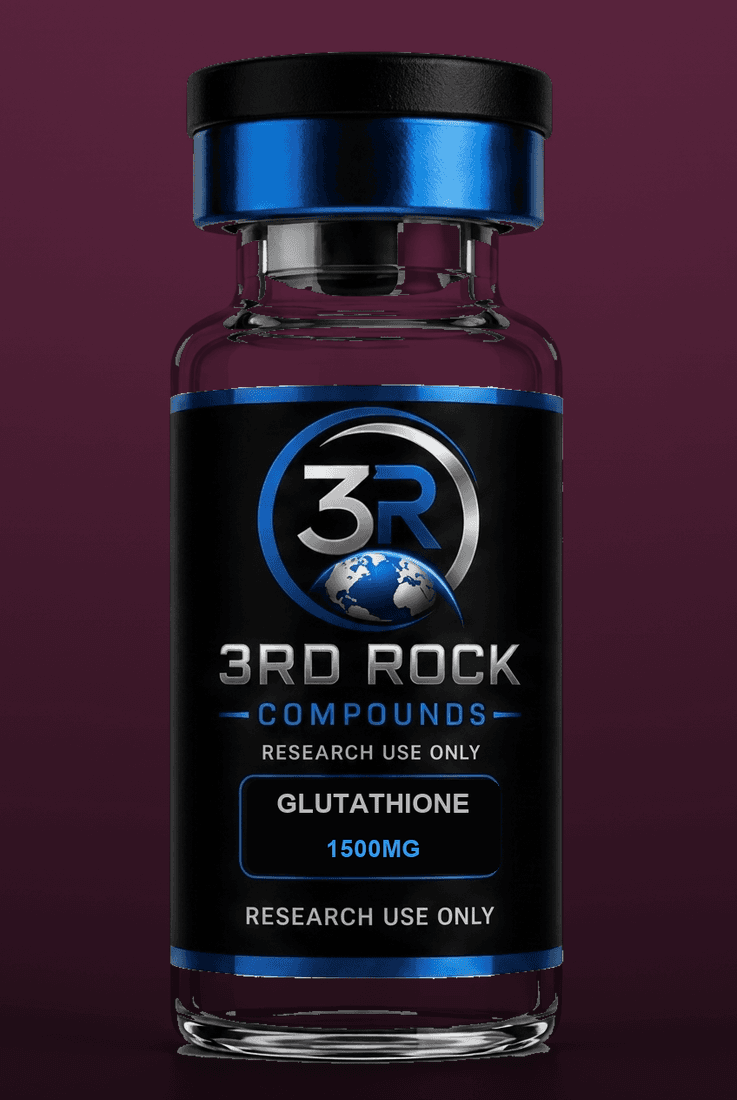
Front label
Cosmetic & Other | 99.18% purity
GLUTATHIONE 1500MG
Glutathione (GSH), also known as L-Glutathione or -L-glutamyl-L-cysteinyl-glycine, is a naturally occurring, water-soluble tripeptide composed of three amino acids: L-glutamate, L-cysteine, and glycine.
$80
Lot
—
Purity (HPLC-UV/VIS)
99.18%
Reported
—
Lab
Kovera Labs
Issued by Kovera Labs. Testing was commissioned by our fulfilment partner on the material we ship; the certificate names that party, not 3rd Rock Compounds.
Quantity
GLUTATHIONE 1500MG
1 vial · $80
- Third-party HPLC tested
- Lot-matched certificate
- Same-day fulfilment before 2pm
- Shipping 2–4 business days
Identifiers
- CAS number
- 70-18-8
- Molecular formula
- C₁₀H₁₇N₃O₆S
- Molecular weight
- 307.32 g/mol
- PubChem CID
- 124886
- Sequence
- γ-E-C-G
Mechanism of Action
Glutathione (GSH) does not function through a single classical receptor-ligand interaction. Instead, it acts as a pervasive biochemical modulator of cellular redox state, enzymatic cofactor, and signaling regulator via post-translational protein modification.[3]
Primary Biochemical Targets & Binding Characteristics
| Target / Mechanism | Detail | Evidence |
|---|---|---|
| S-Glutathionylation | Reversible post-translational modification; GSH forms mixed disulfide bonds with reactive cysteine residues on target proteins (protein-SSG), acting as a redox "on/off" switch for regulatory, structural, and metabolic proteins | Ballatori et al. (2009)[3] |
| Glutathione Peroxidases (GPx) | GSH serves as the essential electron donor for GPx-catalyzed reduction of H2O2 and lipid hydroperoxides to water/alcohols, oxidizing GSH to GSSG | Ballatori et al. (2009)[3] |
| Glutathione S-Transferases (GSTs) | GSH conjugates with electrophilic xenobiotics, heavy metals (Hg, Pb), and endogenous toxins (Phase II detoxification), rendering them water-soluble for excretion | Ballatori et al. (2009)[3] |
| Metal Chelation | Six coordination sites for metal ions; thiol group has high affinity for Cu, Zn, Hg, and Pb, forming stable mercaptide complexes for mobilization and transport | Ballatori et al. (2009)[3] |
| NMDA Receptor Modulation | GSH modulates the N-methyl-D-aspartate (NMDA) receptor, regulating calcium influx in cerebellar granule cells | Ballatori et al. (2009)[3] |
| Bcl-2 Binding | GSH binds the Bcl-2 BH3-domain groove at the mitochondria, contributing to anti-apoptotic antioxidant function | Ballatori et al. (2009)[3] |
| γ-Peptide Bond Stability | Unusual γ-carboxyl linkage between glutamate and cysteine protects from intracellular peptidase hydrolysis; only cleaved by ectoenzyme γ-glutamyl transpeptidase (GGT) on external cell surfaces | Ballatori et al. (2009)[3] |
Downstream Signaling Cascades
| Pathway | Mechanism | Outcome |
|---|---|---|
| Keap1-Nrf2-ARE | Oxidative stress or electrophiles modify Keap1 cysteines, preventing Nrf2 degradation; stabilized Nrf2 translocates to nucleus and binds Antioxidant Response Element (ARE); modulated by ERK and p38 MAPK kinases | Transcription of GSH synthesis genes (GCLC, GCLM) and detoxification enzymes (GSTs)[3] |
| NF-κB Signaling | S-glutathionylation of the p50 subunit of NF-κB inhibits its DNA binding; GSH depletion activates NF-κB via ROS-mediated IκB degradation | GSH suppresses pro-inflammatory gene transcription (TNF-α, IL-1β, IL-6); depletion drives inflammation[3] |
| MAPK Pathway | Severe GSH depletion oxidizes MAPK phosphatases (MKPs), causing sustained JNK and p38 MAPK activation; GST-pi monomers bind JNK (inhibition), but dimerize under oxidative stress to release JNK | Cytochrome c release and caspase activation leading to apoptosis[3] |
| Nitric Oxide (NO) Signaling | GSH buffers NO; depletion increases free NO causing protein nitration and DNA damage; activates p53, which induces PGC-1α for antioxidant response | Modulation of NO-mediated signaling and protection against nitrosative stress[3] |
Cellular & Tissue-Level Effects
| System | Effect | Detail |
|---|---|---|
| Mitochondria | Critical for neutralizing H2O2 from electron transport chain | Transported via dicarboxylate and 2-oxoglutarate carriers; prevents mPTP opening[3] |
| Skin (Antimelanogenic) | Inhibits tyrosinase by chelating copper at active site | Shifts melanogenesis from eumelanin (dark) to pheomelanin (light); reduces melanin index, wrinkles, increases elasticity[19] |
| Nervous System | Astrocytes synthesize and release GSH for neuronal uptake | Protects dopaminergic neurons from oxidative damage; preserves mitochondrial Complex I activity[5] |
| Immune System | Essential for T-cell metabolic reprogramming and clonal expansion | GSH:GSSG ratio modulates Th1/Th2 balance; depletion favors Th2 (chronic inflammation)[14] |
| Cardiovascular | Restores endothelium-dependent vasorelaxation in aging | Increases H2S levels and mtNOS activity; inhibits mPTP opening in aged heart tissue[3] |
| Hepatoprotective | Reduces ALT and oxidative damage markers in liver tissue | Significant benefit in NAFLD and NASH models[8] |
Comparison with Related Compounds
| Compound | Relationship to GSH | Key Difference |
|---|---|---|
| L-Cysteine | Rate-limiting precursor substrate for GSH synthesis | Neurotoxic at high extracellular concentrations; GSH is the non-toxic storage form[3] |
| N-Acetylcysteine (NAC) | Deacetylated precursor used to replenish intracellular GSH | Better oral bioavailability than GSH; widely used clinically as GSH booster[7] |
| GSSG (Oxidized Glutathione) | Disulfide dimer formed when GSH is oxidized | Accumulation is toxic; cells maintain GSH:GSSG ratio >100:1 via Glutathione Reductase + NADPH[3] |
| Liposomal Glutathione | GSH encapsulated in phospholipid vesicles | Enhanced oral absorption bypassing GGT degradation; elevates body stores and immune markers[14] |
| Glutathione Monoethyl Ester (GEE) | Synthetic analog designed for enhanced cell penetration | Bypasses transport limitations; crosses blood-brain barrier more effectively than native GSH[3] |
Preclinical Research Findings
Glutathione is investigated across a broad spectrum of research domains, with evidence spanning preclinical animal models to randomized controlled clinical trials:
1. Neurodegenerative Diseases (Parkinson's, Alzheimer's)
GSH depletion in the substantia nigra is one of the earliest biochemical changes in Parkinson's disease, preceding mitochondrial Complex I dysfunction and dopaminergic neuron loss. Intranasal GSH (200–600 mg/day) demonstrated significant improvement in UPDRS Total scores (-4.6 points, P = 0.0025) in a Phase IIb RCT, and a single 200 mg intranasal dose increased brain GSH levels >200% within 45 minutes (P < 0.001) as measured by magnetic resonance spectroscopy.[11][5][13]
2. Hepatoprotection (NAFLD, NASH, Cirrhosis)
GSH is extensively studied for its hepatoprotective effects. Oral GSH (300 mg/day for 4 months) significantly reduced ALT levels (p < 0.05) in NAFLD subjects. In NASH subjects, 300 mg/day for 3 months decreased both ALT and 8-OHdG (DNA oxidative damage marker) significantly. However, 500 mg/day GSH for 12 weeks showed no significant effect in liver cirrhosis.[8]
3. Dermatology & Skin Research
| Study | Intervention | Key Result | Ref |
|---|---|---|---|
| Weschawalit et al. (2017) | 250 mg oral GSH or GSSG/day, 12 weeks | Significant wrinkle reduction (P = 0.006); increased skin elasticity; melanin index reduction in >40 year group | [19] |
| Arjinpathana et al. (2012) | 500 mg oral GSH/day, 4 weeks | Significant melanin index reduction in sun-exposed areas (face/wrists) vs placebo | [2] |
| Watanabe et al. (2014) | 2% GSSG lotion, twice daily, 10 weeks | Significant reduction in melanin index (p < 0.05), TEWL (p < 0.05), and wrinkles (p < 0.01) | [18] |
4. Diabetes & Metabolic Syndrome
Research highlights a correlation between GSH insufficiency and T2DM complications. Oral GSH (1000 mg/day, 3 weeks) significantly increased whole-body insulin sensitivity in obese males with and without T2DM (NCT02948673). In a larger trial (n=360), 500 mg/day for 6 months as adjunct therapy significantly decreased oxidative damage markers and improved HbA1c in subjects >55 years.[16]
5. Oncology & Chemotherapy Support
IV glutathione (1.5 g/m²) administered before cisplatin chemotherapy demonstrated neuroprotective effects in randomized trials of advanced gastric cancer and ovarian cancer, reducing neurotoxicity and nephrotoxicity without compromising antineoplastic efficacy.[4][15]
6. Respiratory Conditions (Cystic Fibrosis, IPF)
Inhaled/aerosolized glutathione (600 mg BID) is investigated for replenishing GSH in the epithelial lining fluid of the lungs. Oral reduced L-glutathione improved growth in pediatric cystic fibrosis subjects. Results on FEV1 improvement have been mixed across studies.[17]
7. Viral Infections & Immune Function
GSH depletion is linked to impaired host immune responses and severe outcomes in HIV and COVID-19. Liposomal glutathione supplementation elevated body stores of GSH and markers of immune function (including natural killer cell activity) in healthy adults.[14]
8. Male Infertility
Intramuscular GSH (600 mg) was studied in a placebo-controlled, double-blind crossover trial for male infertility, targeting oxidative stress in seminal plasma that damages sperm DNA and motility.[10]
9. Cardiovascular Aging
In aged Wistar rats, intraperitoneal GSH (52 mg/kg) increased total heart glutathione by 40% (p = 0.0027), reduced superoxide generation 2.5-fold, and restored endothelium-dependent vasorelaxation, demonstrating significant cardiovascular rejuvenation potential.[3]
Safety Profile
Findings summarised above derive from in-vitro and animal studies. No safety profile for human use is established or implied, and none is offered here.
Handle as a laboratory reagent: avoid inhalation and contact, reconstitute under aseptic conditions, and observe the storage conditions below.
For research use only. Not for human consumption.
Shipping and Storage
- Supplied as lyophilised powder in a sealed vial.
- Store at 2–8°C (36–46°F). Protect from light.
- Same-day fulfilment on orders before 2pm; shipping 2–4 business days.
- For research use only. Not for human consumption.
References
- [1]Allen J, Bradley RD. Effects of oral glutathione supplementation on systemic oxidative stress biomarkers in human volunteers. Journal of Alternative and Complementary Medicine, 17(9), 827-833, 2011. PubMed →
- [2]Arjinpathana N, Asawanonda P. Glutathione as an oral whitening agent: a randomized, double-blind, placebo-controlled study. Journal of Dermatological Treatment, 23(2), 97-102, 2012. PubMed →
- [3]Ballatori N, Krance SM, Notenboom S, Shi S, Tieu K, Hammond CL. Glutathione dysregulation and the etiology and progression of human diseases. Biological Chemistry, 390(3), 191-214, 2009. PubMed →
- [4]Cascinu S, Cordella L, Del Ferro E, et al. Neuroprotective effect of reduced glutathione on cisplatin-based chemotherapy in advanced gastric cancer: a randomized, double-blind, placebo-controlled trial. Journal of Clinical Oncology, 13(1), 26-32, 1995.
- [5]Chinta SJ, Kumar MJ, Hsu M, et al. Inducible alterations of glutathione levels in adult dopaminergic midbrain neurons result in nigrostriatal degeneration. Journal of Neuroscience, 27(51), 13997-14006, 2007. PubMed →
- [6]Handog EB, Datuin MS, Singzon IA. An open-label, single-arm trial of the safety and efficacy of a novel preparation of glutathione as a skin-lightening agent in Filipino women. International Journal of Dermatology, 55(2), 153-157, 2016.
- [7]Holmay MJ, Terpstra M, Coles LD, et al. N-Acetylcysteine boosts brain and blood glutathione in Gaucher and Parkinson diseases. Clinical Neuropharmacology, 36(4), 103-106, 2013. PubMed →
- [8]Honda Y, Kessoku T, Sumida Y, et al. Efficacy of glutathione for the treatment of nonalcoholic fatty liver disease: an open-label, single-arm, multicenter, pilot study. BMC Gastroenterology, 17(1), 96, 2017. PubMed →
- [9]Kovacs-Nolan J, Rupa P, Matsui T, et al. In vitro and ex vivo uptake of glutathione (GSH) across the intestinal epithelium and fate of oral GSH after in vivo supplementation. Journal of Agricultural and Food Chemistry, 62(39), 9499-9506, 2014. PubMed →
- [10]Lenzi A, Culasso F, Gandini L, Lombardo F, Dondero F. Placebo-controlled, double-blind, cross-over trial of glutathione therapy in male infertility. Human Reproduction, 8(10), 1657-62, 1993.
- [11]Mischley LK, Leverenz JB, Lau RC, et al. A randomized, double-blind phase I/IIa study of intranasal glutathione in Parkinson's disease. Movement Disorders, 30(12), 1696-1701, 2015.
- [12]Richie JP, Nichenametla S, Neidig W, et al. Randomized controlled trial of oral glutathione supplementation on body stores of glutathione. European Journal of Nutrition, 54(2), 251-263, 2015. PubMed →
- [13]Sechi G, Deledda MG, Bua G, et al. Reduced intravenous glutathione in the treatment of early Parkinson's disease. Progress in Neuro-Psychopharmacology and Biological Psychiatry, 20(7), 1159-1170, 1996. PubMed →
- [14]Sinha R, Sinha I, Calcagnotto A, et al. Oral supplementation with liposomal glutathione elevates body stores of glutathione and markers of immune function. European Journal of Clinical Nutrition, 72(1), 105-111, 2018. PubMed →
- [15]Smyth JF, Bowman A, Perren T, et al. Glutathione reduces the toxicity and improves quality of life of women diagnosed with ovarian cancer treated with cisplatin: results of a double-blind, randomised trial. Annals of Oncology, 8(6), 569-73, 1997.
- [16]Søndergård SD, Cintin I, Kuhlman AB, et al. The effects of 3 weeks of oral glutathione supplementation on whole body insulin sensitivity in obese males with and without type 2 diabetes: a randomized trial. Applied Physiology, Nutrition, and Metabolism, 46(9), 1133-1142, 2021.
- [17]Visca A, Bishop CT, Hilton S, Hudson VM. Oral reduced L-glutathione improves growth in pediatric cystic fibrosis patients. Journal of Pediatric Gastroenterology and Nutrition, 60(6), 802-810, 2015.
- [18]Watanabe F, Hashizume E, Chan GP, Kamimura A. Skin-whitening and skin-condition-improving effects of topical oxidized glutathione: a double-blind and placebo-controlled clinical trial in healthy women. Clinical, Cosmetic and Investigational Dermatology, 7, 267-274, 2014. PubMed →
- [19]Weschawalit S, Thongthip S, Phutrakool P, Asawanonda P. Glutathione and its antiaging and antimelanogenic effects. Clinical, Cosmetic and Investigational Dermatology, 10, 147-153, 2017. PubMed →
- [20]Witschi A, Reddy S, Stofer B, Lauterburg BH. The systemic availability of oral glutathione. European Journal of Clinical Pharmacology, 43(6), 667-669, 1992. PubMed →
Entries without a link have no DOI or PubMed identifier in the source record. The reference is reproduced as given; every link that does appear has been checked and resolves to the work it names.
7 references carry an identifier in our record that resolves to a different paper. We have withheld those links rather than send you to the wrong work, and we do not substitute one we cannot verify.