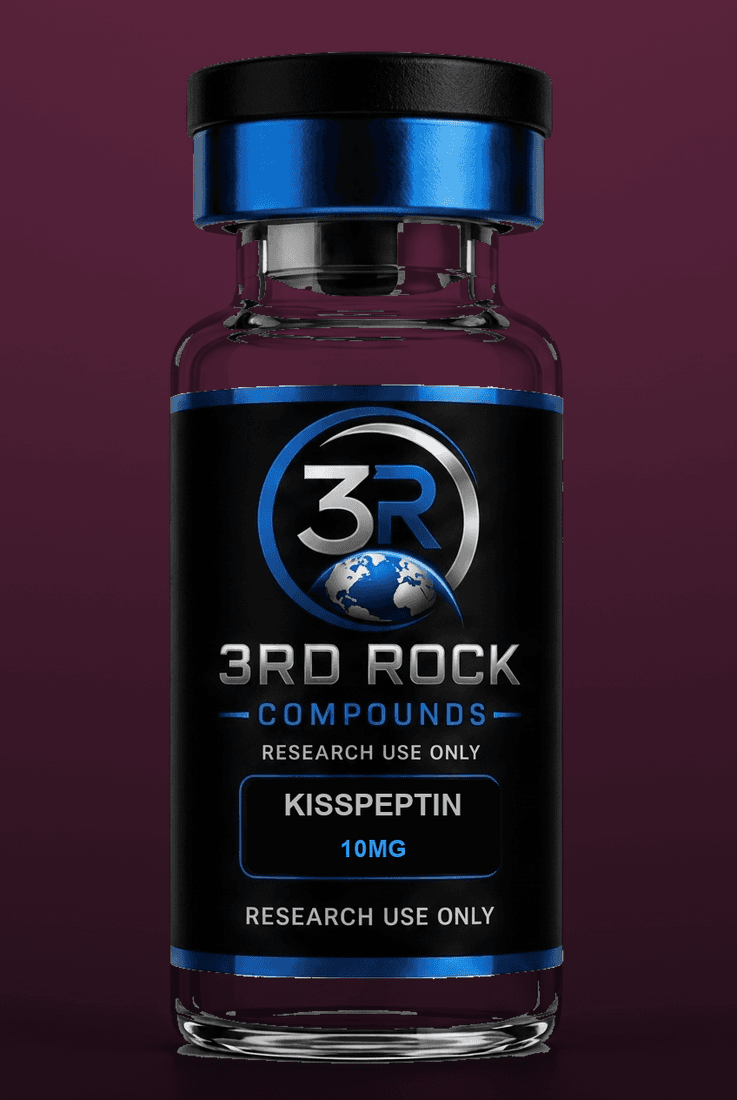
Front label
Cosmetic & Other | 99.70% purity
KISSPEPTIN 10MG
- Metastin
- KiSS-1-derived peptide
- Kp-54
- Kp-14
- Kp-13
Kisspeptin refers to a family of neuropeptides encoded by the KISS1 gene (chromosome 1q32), originally identified in 1996 as a melanoma metastasis suppressor ("metastin").
Format
$70
Lot
K26C457
Purity (HPLC-UV/VIS)
99.70%
Reported
2/19/2026
Lab
Vanguard Laboratory
Issued by Vanguard Laboratory, A2LA #6377.01.01. Testing was commissioned by our fulfilment partner on the material we ship; the certificate names that party, not 3rd Rock Compounds.
Quantity
KISSPEPTIN 10MG
1 vial · $70
- Third-party HPLC tested
- Lot-matched certificate
- Same-day fulfilment before 2pm
- Shipping 2–4 business days
Identifiers
Mechanism of Action
KISS1R (GPR54) Receptor Binding
Kisspeptin acts by binding KISS1R (GPR54/AXOR12), a rhodopsin-like Class A GPCR sharing ~45% identity with galanin receptors (but does not bind galanin). The essential pharmacophore is the C-terminal RF-amide motif; key residues Phe-6 and Arg-9 (Kp-10 numbering) are critical for binding. Cryo-EM studies reveal an orthosteric pocket spanning TM2–7 plus ECL1–3.[2][3]
Primary Gαq/11–PLC–Ca²⁺ Pathway
KISS1R couples primarily to Gαq/11, activating phospholipase C beta (PLCβ), which hydrolyzes PIP₂ into IP₃ and DAG. IP₃ triggers biphasic intracellular Ca²⁺ release from the endoplasmic reticulum; DAG + Ca²⁺ activates PKC.[8]
MAPK and Additional Cascades
Downstream signaling involves robust, sustained ERK1/2 phosphorylation (via PKC-dependent and β-arrestin pathways), p38 MAPK activation, arachidonic acid release, and PI3K/Akt signaling.[8]
GnRH Neuronal Excitation
In GnRH neurons, kisspeptin activates TRPC channels (cation influx) and simultaneously closes Kir channels (preventing K⁺ efflux), causing sustained depolarization and increased action potential firing → pulsatile GnRH secretion → LH/FSH release.[8]
Desensitization (β-Arrestin–Mediated)
Continuous kisspeptin exposure recruits β-arrestin 1/2, causing receptor internalization via clathrin-coated pits → paradoxical HPG axis suppression. This is exploited therapeutically: TAK-448 continuous exposure suppresses testosterone to castrate levels for prostate cancer research.[9][14]
Isoform Pharmacokinetic Comparison
| Isoform | Half-Life | Route | Notes |
|---|---|---|---|
| Kp-54 | ~27.6 min | IV | Major circulating form; SC extends to ~1.7h |
| Kp-10 | ~4 min | IV | Full intrinsic bioactivity; highly conserved |
| MVT-602 (TAK-448) | Peak at ~21h | SC | MMP-resistant; >4x AUC vs Kp-54 |
KNDy Neuron Network and Pulse Generation
Kisspeptin-expressing neurons in the arcuate nucleus co-express neurokinin B and dynorphin (the so-called KNDy neurons), forming an interconnected pulse-generating network. Research investigations use kisspeptin agonists and KISS1R-specific antagonists in animal models to dissect how this KNDy network sets GnRH pulse frequency, with downstream readouts including LH-pulse amplitude, follicular dynamics, and steady-state gonadal steroid output. This makes kisspeptin a foundational research tool for mapping the central architecture of mammalian reproductive cycles.[8]
Limbic-Cortical Connectivity Investigation
Functional MRI research in human volunteer cohorts has documented that systemic kisspeptin administration enhances activation of amygdala, hippocampus, anterior cingulate, and orbitofrontal cortices in response to sexual and bonding stimuli. This makes kisspeptin a research tool for investigating extra-hypothalamic actions of an HPG-axis peptide and its potential role in limbic-cortical processing of social and reward information.[16]
Preclinical Research Findings
Kisspeptin is one of the most extensively studied reproductive neuropeptides, with >1,000 human subjects across Phase 1/2 clinical trials:
- IVF Oocyte Maturation Trigger — SC Kp-54 (3.2–12.8 nmol/kg) triggers oocyte maturation with 95% mature oocytes, 45.1% live birth rate, and no clinically significant OHSS (vs high OHSS risk with hCG).[10][11]
- Hypothalamic Amenorrhea — Restores LH pulsatility; twice-weekly dosing sustains LH ~9 IU/L over 8 weeks without complete desensitization. Intranasal delivery validated in HA women.[12][13][19]
- PCOS — IV KP-10 infusion (4 µg/kg/h × 7h) increases LH from 5.2 to 7.8 IU/L and estradiol levels in women with polycystic ovary syndrome.[15]
- Psychosexual Disorders (HSDD) — Enhances limbic brain processing (amygdala, hippocampus) for sexual/bonding stimuli; increases penile tumescence up to 55% in men; modulates sexual desire regions in women.[16][17]
- Metabolic / Fatty Liver Disease — TAK-448 reduces hepatic triglycerides, serum FFA, and ALT in MASLD models via AMPK→SREBP-1c→CIDEA downregulation.[18]
- Cancer Metastasis Suppression — Originally identified as melanoma/breast cancer metastasis suppressor ("metastin"); inhibits MMP-9 via NF-κB pathway suppression.[1]
- Prostate Cancer (Androgen Deprivation) — Continuous TAK-448/MVT-602 exposure → receptor desensitization → testosterone suppression to castrate levels (Phase 1 data).[14]
- Pregnancy Biomarker — Kisspeptin rises 7,000-fold during healthy pregnancy; low levels predict miscarriage/preeclampsia by assessing trophoblast invasion.[20]
- Bone Health — Promotes osteoblast differentiation, inhibits osteoclast activity; acute Kp-54 increases osteocalcin ~24% in men.[21]
- Puberty Disorders — Activating/inactivating KISS1/KISS1R mutations linked to precocious/delayed puberty; kisspeptin challenge tests used diagnostically.[4]
- Intranasal Delivery — First human trial: 12.8 nmol/kg intranasal Kp-54 → rapid LH increase (4.4 IU/L in men); no AEs — validating non-invasive delivery.[19]
- Metabolic Insulin Signaling — IV Kp-54 increases glucose-stimulated insulin secretion ~35% in healthy men.[22]
Safety Profile
Findings summarised above derive from in-vitro and animal studies. No safety profile for human use is established or implied, and none is offered here.
Handle as a laboratory reagent: avoid inhalation and contact, reconstitute under aseptic conditions, and observe the storage conditions below.
For research use only. Not for human consumption.
Shipping and Storage
- Supplied as lyophilised powder in a sealed vial.
- Store at 2–8°C (36–46°F). Protect from light.
- Same-day fulfilment on orders before 2pm; shipping 2–4 business days.
- For research use only. Not for human consumption.
References
- [1]Lee JH, Miele ME, Hicks DJ, Phillips KK, Trent JM, Weissman BE, Welch DR. KiSS-1, a novel human malignant melanoma metastasis-suppressor gene. Journal of the National Cancer Institute. 1996;88(23):1731-1737. DOI →
- [2]Ohtaki T, Shintani Y, Honda S, et al. Metastasis suppressor gene KiSS-1 encodes peptide ligand of a G-protein-coupled receptor. Nature. 2001;411(6837):613-617. DOI →
- [3]Kotani M, Detheux M, Vandenbogaerde A, et al. The metastasis suppressor gene KiSS-1 encodes kisspeptins, the natural ligands of the orphan G protein-coupled receptor GPR54. Journal of Biological Chemistry. 2001;276(37):34631-34636. DOI →
- [4]Seminara SB, Messager S, Chatzidaki EE, et al. The GPR54 gene as a regulator of puberty. New England Journal of Medicine. 2003;349(17):1614-1627. DOI →
- [5]Dhillo WS, Chaudhri OB, Patterson M, et al. Kisspeptin-54 stimulates the hypothalamic-pituitary gonadal axis in human males. Journal of Clinical Endocrinology & Metabolism. 2005;90(12):6609-6615. DOI →
- [6]Dhillo WS, Chaudhri OB, Thompson EL, et al. Kisspeptin-54 stimulates gonadotropin release most potently during the preovulatory phase of the menstrual cycle in women. Journal of Clinical Endocrinology & Metabolism. 2007;92(10):3958-3966. DOI →
- [7]World Anti-Doping Agency. The Prohibited List. S2 Peptide Hormones, Growth Factors, Related Substances, and Mimetics. WADA. Updated 2025. wada-ama.org →
- [8]de Roux N, Genin E, Carel JC, Matsuda F, Chaussain JL, Milgrom E. Hypogonadotropic hypogonadism due to loss of function of the KiSS1-derived peptide receptor GPR54. Proceedings of the National Academy of Sciences. 2003;100(19):10972-10976. DOI →
- [9]Abbara A, Eng PC, Phylactou M, et al. Kisspeptin receptor agonist has therapeutic potential for female reproductive disorders. Journal of Clinical Investigation. 2020;130(12):6739-6753. DOI →
- [10]Abbara A, Jayasena CN, Christopoulos G, et al. Efficacy of kisspeptin-54 to trigger oocyte maturation in women at high risk of OHSS during IVF therapy. Journal of Clinical Endocrinology & Metabolism. 2015;100(9):3322-3331. DOI →
- [11]Abbara A, Clarke S, Islam R, et al. A second dose of kisspeptin-54 improves oocyte maturation in women at high risk of OHSS: a phase 2 randomized controlled trial. Human Reproduction. 2017;32(9):1915-1924. DOI →
- [12]Jayasena CN, Nijher GM, Chaudhri OB, et al. Subcutaneous injection of kisspeptin-54 acutely stimulates gonadotropin secretion in women with hypothalamic amenorrhea, but chronic administration causes tachyphylaxis. Journal of Clinical Endocrinology & Metabolism. 2009;94(11):4315-4323. DOI →
- [13]Jayasena CN, Nijher GM, Abbara A, et al. Twice-weekly administration of kisspeptin-54 for 8 weeks stimulates release of reproductive hormones in women with hypothalamic amenorrhea. Clinical Pharmacology & Therapeutics. 2010;88(6):840-847. DOI →
- [14]MacLean DB, Matsui H, Suri A, Neuwirth R, Colombel M. Sustained exposure to the investigational kisspeptin analog, TAK-448, down-regulates testosterone into the castration range in healthy males and in patients with prostate cancer. Journal of Clinical Endocrinology & Metabolism. 2014;99(8):E1445-E1453. DOI →
- [15]Skorupskaite K, et al. KP-10 infusion in PCOS women. Human Reproduction. 2020.
- [16]Comninos AN, Wall MB, Demetriou L, et al. Kisspeptin modulates sexual and emotional brain processing in humans. Journal of Clinical Investigation. 2017;127(2):709-719. DOI →
- [17]Mills EG, et al. HSDD in men — kisspeptin increases penile tumescence and sexual brain processing. JAMA Network Open. 2023.
- [18]Izarraras L, et al. Kisspeptin agonist reduces hepatic de novo lipogenesis in MASLD via AMPK-SREBP-1c-CIDEA. 2025.
- [19]Mills EG, et al. Intranasal kisspeptin-54 rapidly stimulates gonadotropin release in humans: a non-invasive delivery route. eBioMedicine. 2025.
- [20]Jayasena CN, Abbara A, et al. Kisspeptin-54 triggers egg maturation in women undergoing in vitro fertilization. Journal of Clinical Investigation. 2014;124(8):3667-3677. DOI →
- [21]Comninos AN, et al. Acute kisspeptin administration increases osteocalcin in healthy men. Journal of Clinical Endocrinology & Metabolism. 2022.
- [22]Izzi-Engbeaya C, et al. Kisspeptin increases glucose-stimulated insulin secretion in healthy men. Diabetes, Obesity and Metabolism. 2018.
- [23]Seminara SB, et al. Continuous human metastin 45-54 infusion desensitizes GPR54-induced GnRH release in juvenile male rhesus monkeys. 2006.
- [24]Terse PS, et al. Kisspeptin-10 toxicology studies in dogs — NOAEL at 1000 µg/kg IV × 14 days. 2021.
- [25]Thompson EL, et al. Chronic subcutaneous administration of kisspeptin-54 causes testicular degeneration in adult male rats. 2006.
- [26]Dinh TO, et al. Kisspeptin-13 exacerbates chronic kidney disease and uremic cardiomyopathy in rats. 2023.
- [27]George JT, Veldhuis JD, Roseweir AK, et al. Kisspeptin-10 is a potent stimulator of LH and increases pulse frequency in men. Journal of Clinical Endocrinology & Metabolism. 2011;96(8):E1228-E1236. DOI →
- [28]Thurston L, et al. Kisspeptin modulates brain activity in sexual desire regions in women with HSDD. JAMA Network Open. 2022.
- [29]Nishizawa N, Takatsu Y, et al. Design and synthesis of TAK-448, an investigational nonapeptide KISS1R agonist. Journal of Medicinal Chemistry. 2016;59(19):8804-8811.
- [30]Chan YM, Butler JP, Pinnell NE, et al. Kisspeptin resets the hypothalamic GnRH clock in men. Journal of Clinical Endocrinology & Metabolism. 2011;96(6):E908-E915. DOI →
Entries without a link have no DOI or PubMed identifier in the source record. The reference is reproduced as given; every link that does appear has been checked and resolves to the work it names.
1 reference carries an identifier in our record that resolves to a different paper. We have withheld those links rather than send you to the wrong work, and we do not substitute one we cannot verify.