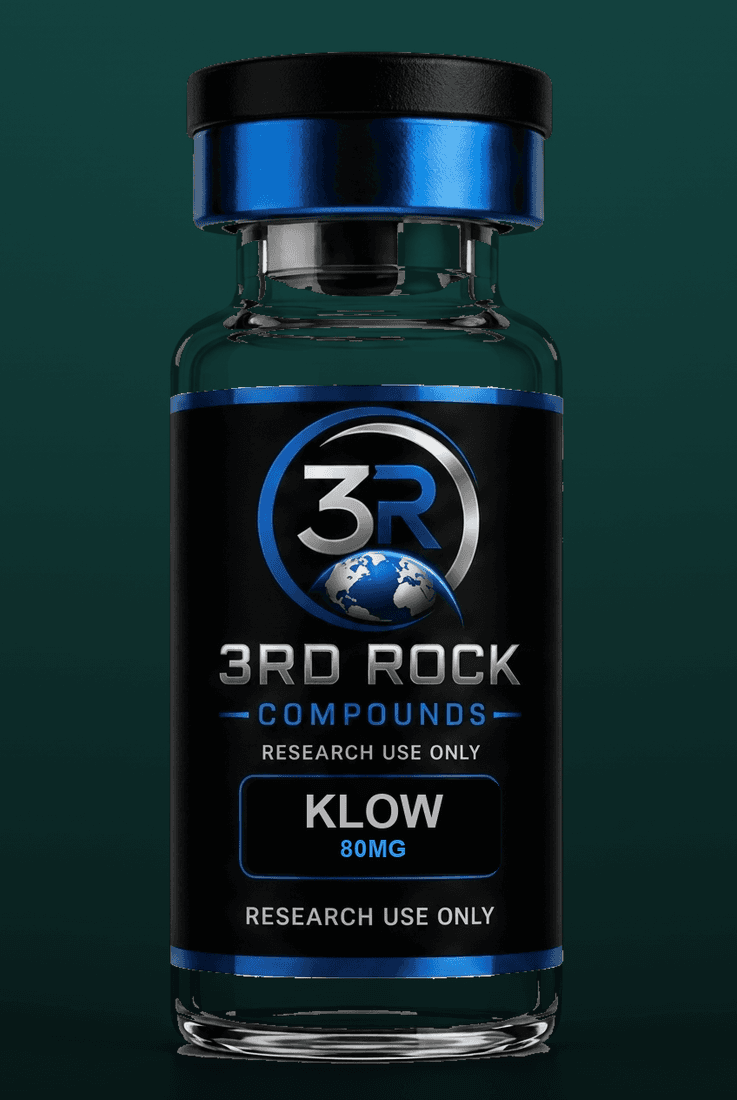
Front label
Repair & Recovery | >99.50% purity
KLOW 80MG
KLOW is an 80 mg multi-peptide research blend that pairs the three-peptide GLOW stack — GHK-Cu (50 mg), BPC-157 (10 mg), and TB-500 (10 mg) — with the α-MSH -derived anti-inflammatory tripeptide KPV (10 mg).
$135
Lot
K26C213
Purity (HPLC-UV/VIS)
>99.50%
Reported
2/27/2026
Lab
Vanguard Laboratory
Issued by Vanguard Laboratory, A2LA #6377.01.01. Testing was commissioned by our fulfilment partner on the material we ship; the certificate names that party, not 3rd Rock Compounds.
Quantity
KLOW 80MG
1 vial · $135
- Third-party HPLC tested
- Lot-matched certificate
- Same-day fulfilment before 2pm
- Shipping 2–4 business days
Identifiers
Mechanism of Action
GHK-Cu (50 mg) — Copper Delivery & Gene Modulation
GHK-Cu (Gly-His-Lys-Cu²⁺, ~401.9 Da) is a redox-silenced copper-tripeptide complex that delivers Cu(II) intracellularly without driving Fenton-reaction toxicity, supplying copper to enzymes such as lysyl oxidase (collagen crosslinking) and Cu/Zn-SOD (antioxidant defense).[1] Connectivity Map analysis links GHK-Cu to >50% expression changes in ~31% of human genes, biasing toward ECM synthesis (collagen I/III, elastin, decorin, GAGs), Nrf2/Keap1-driven HO-1 transcription, and suppression of NF-κB p65 / p38-MAPK phosphorylation.[2][10] Collagen-synthesis dose response is biphasic, peaking at ~10⁻⁹ M.
BPC-157 (10 mg) — Angiogenic / Cytoprotective Pentadecapeptide
BPC-157 (sequence GEPPPGKPADDAGLV, 1419 Da) is a partial sequence of a gastric body-protective compound, exceptionally stable in human gastric juice (>24 h) and active across oral, parenteral and topical routes in preclinical models.[3] Reported mechanisms include VEGFR2 internalization and Src-Caveolin-1-eNOS coupling driving NO release and angiogenesis; FAK-paxillin activation supporting fibroblast migration; homeostatic buffering of the L-NAME / L-arginine NO axis; and modulation of dopaminergic and serotonergic systems without direct receptor binding.[6][11] Tissue coverage in animal models spans tendon-to-bone reattachment, GI mucosal repair, and CNS injury.
TB-500 (10 mg) — Thymosin β4 Actin-Binding Fragment
TB-500 (Ac-LKKTETQ, ~889 Da) is a synthetic acetylated heptapeptide corresponding to the actin-binding region (residues 17–23) of full-length Thymosin β4. It interacts with G-actin sequestration and cytoskeletal dynamics that underlie cell migration, re-epithelialization and angiogenesis, with hair-follicle and corneal/dermal wound-healing read-outs in preclinical literature.[7][8] Recent metabolite work (Rahaman et al., 2024) suggests the in-vitro wound-healing signal may be carried by the metabolite Ac-LKKTE rather than the parent peptide, an important caveat when interpreting blend-level data.[12]
KPV (10 mg) — α-MSH(11–13) NF-κB Suppressor
KPV (Lys-Pro-Val, 342.4 Da) is the C-terminal tripeptide of α-MSH and operates through a melanocortin-receptor-independent pathway. It is taken up by the proton-coupled PepT1 (SLC15A1) oligopeptide transporter (Kₘ ~160 µM in Caco2-BBE intestinal epithelia), then binds Importin-α3 at armadillo domains 7–8, physically blocking nuclear import of NF-κB p65/RelA while stabilizing IκBα.[4][9] KPV additionally inhibits ERK1/2, JNK and p38 MAP kinases and has shown activity at concentrations as low as 10 nM, with antimicrobial activity against S. aureus and C. albicans across picomolar–micromolar ranges.[13]
Preclinical Research Findings
KLOW combines four peptides whose individual literatures span tissue repair, angiogenesis, gene modulation, and direct anti-inflammatory signaling. Investigators using the blend explore:
- Inflammatory Bowel Disease Models — KPV has been evaluated in murine DSS-colitis and TNBS-colitis models for PepT1-mediated reduction in NF-κB transcription; combined with BPC-157's mucosal cytoprotection, the blend is investigated for additive intestinal-barrier preservation.[13][14]
- Wound Healing & Skin Research — GHK-Cu (collagen/elastin synthesis), BPC-157 (granulation tissue), TB-500 (keratinocyte migration), KPV (anti-inflammatory) — each independently accelerate wound closure in preclinical models. The 4-peptide combination is investigated for whether the layered mechanisms produce additive closure rates beyond any single component.
- Recovery / Connective Tissue Models — BPC-157 and TB-500 each accelerate Achilles transection healing; GHK-Cu modulates MMP/TIMP balance; KPV reduces TNF-α and IL-1β. Combined administration is studied for connective-tissue repair models with concurrent inflammation.
- NF-κB / Cytokine Pathway Studies — All four peptides converge on NF-κB modulation through different mechanisms: KPV via Importin-α3 blockade, GHK-Cu via p65 phosphorylation suppression, BPC-157 via NO-axis modulation, TB-500 via RelA/p65 nuclear translocation interruption.[9]
- Antioxidant Defense Research — GHK-Cu and TB-500 upregulate Cu/Zn-SOD, Mn-SOD, and catalase. The blend is investigated for layered antioxidant capacity in oxidative-stress models.
Important: cited studies used individual peptides, not the KLOW four-peptide combination. No published peer-reviewed studies have evaluated the 50/10/10/10 blend itself.
Safety Profile
Findings summarised above derive from in-vitro and animal studies. No safety profile for human use is established or implied, and none is offered here.
Handle as a laboratory reagent: avoid inhalation and contact, reconstitute under aseptic conditions, and observe the storage conditions below.
For research use only. Not for human consumption.
Shipping and Storage
- Supplied as lyophilised powder in a sealed vial.
- Store at 2–8°C (36–46°F). Protect from light.
- Same-day fulfilment on orders before 2pm; shipping 2–4 business days.
- For research use only. Not for human consumption.
References
- [1]Pickart L, Margolina A. Regenerative and Protective Actions of the GHK-Cu Peptide. International Journal of Molecular Sciences. 2018;19(7):1987. DOI →
- [2]Pickart L, Vasquez-Soltero JM, Margolina A. GHK Peptide as a Natural Modulator of Multiple Cellular Pathways. BioMed Research International. 2015;2015:648108. DOI →
- [3]Sikiric P, et al. Stable gastric pentadecapeptide BPC 157: novel therapy in gastrointestinal tract. Current Pharmaceutical Design. 2011;17(16):1612-1632. DOI →
- [4]Dalmasso G, et al. PepT1-Mediated Tripeptide KPV Uptake Reduces Intestinal Inflammation. Gastroenterology. 2008;134(1):166-178. DOI →
- [5]U.S. Food and Drug Administration. Certain Bulk Drug Substances for Use in Compounding. FDA.gov. Updated 2023. fda.gov →
- [6]Hsieh MJ, et al. Therapeutic potential of pro-angiogenic BPC157 is associated with VEGFR2 activation. Journal of Molecular Medicine. 2017;95(3):323-333. DOI →
- [7]Goldstein AL, et al. Thymosin β4: a multi-functional regenerative peptide. Expert Opinion on Biological Therapy. 2012;12(1):37-51. DOI →
- [8]Philp D, Goldstein AL, Kleinman HK. Thymosin beta4 promotes angiogenesis, wound healing, and hair follicle development. Mechanisms of Ageing and Development. 2004;125(2):113-115. DOI →
- [9]Brzoska T, et al. α-Melanocyte-Stimulating Hormone and Related Tripeptides. Endocrine Reviews. 2008;29(5):581-602. DOI →
- [10]Park JR, et al. The tri-peptide GHK-Cu complex ameliorates lipopolysaccharide-induced acute lung injury. Oncotarget. 2016;7(36):58405-58417. DOI →
- [11]Sikiric P, et al. Brain-gut axis and pentadecapeptide BPC 157. Current Neuropharmacology. 2016;14(8):857-865. DOI →
- [12]Rahaman KA, et al. Simultaneous quantification of TB-500 and its metabolites. Journal of Chromatography B. 2024;1235:124033. DOI →
- [13]Kannengiesser K, et al. KPV has anti-inflammatory potential in murine IBD models. Inflammatory Bowel Diseases. 2008;14(3):324-331. DOI →
- [14]Xiao B, et al. Orally Targeted Delivery of Tripeptide KPV via Hyaluronic Acid-Functionalized Nanoparticles. Molecular Therapy. 2017;25(7):1628-1640. DOI →