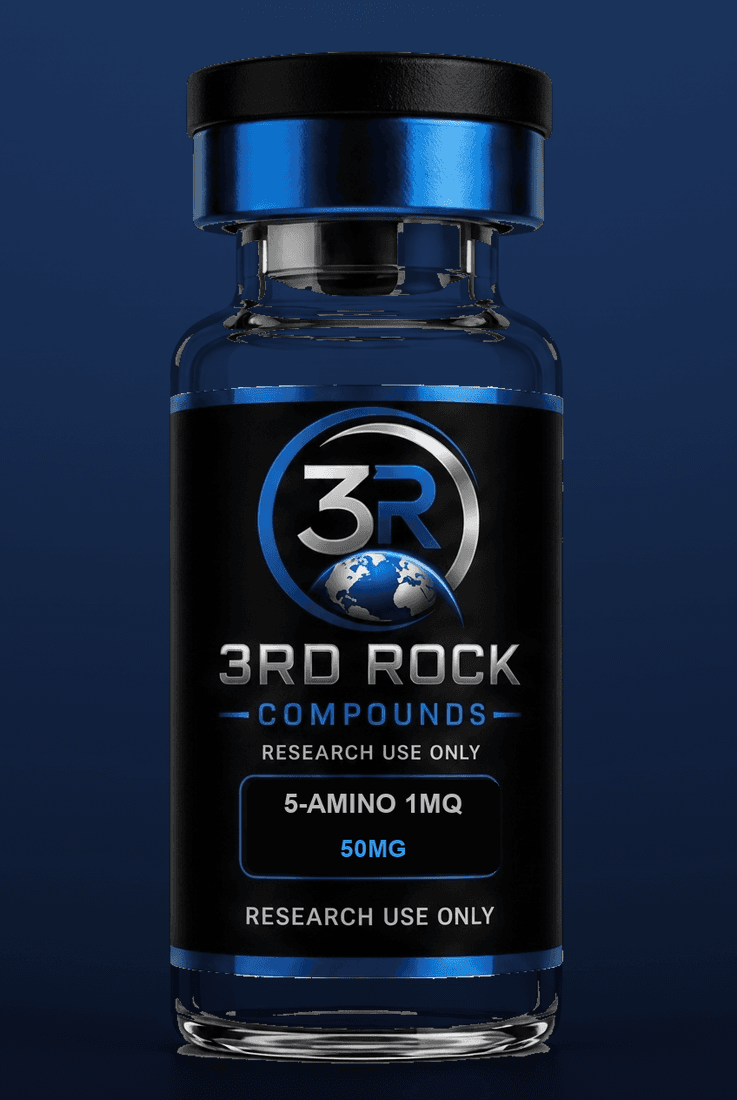
Front label
Metabolic | >99.80% purity
5-AMINO 1MQ 50MG
- 5-Amino 1MQ
- 5-AMQ
- 5A-1MQ
- NNMTi
- 5-amino-1-methylquinolinium
⚠️ Note: 5-Amino 1MQ is a small molecule (methylquinolinium derivative), not a peptide.
$75
Lot
5A26C427
Purity (HPLC-UV/VIS)
>99.80%
Reported
2/27/2026
Lab
Vanguard Laboratory
Issued by Vanguard Laboratory, A2LA #6377.01.01. Testing was commissioned by our fulfilment partner on the material we ship; the certificate names that party, not 3rd Rock Compounds.
Quantity
5-AMINO 1MQ 50MG
1 vial · $75
- Third-party HPLC tested
- Lot-matched certificate
- Same-day fulfilment before 2pm
- Shipping 2–4 business days
Identifiers
- CAS number
- 42464-96-0
- Molecular formula
- C₁₀H₁₁IN₂ (iodide salt)
- Molecular weight
- 286.11 g/mol
- PubChem CID
- 160243
Mechanism of Action
The molecular target of 5-Amino 1MQ is the cytosolic enzyme nicotinamide N-methyltransferase (NNMT), a metabolic regulator highly expressed in adipose tissue, liver, and skeletal muscle — particularly in obesity and type 2 diabetes. [2]
Binding Mechanism: 5-Amino 1MQ is a substrate-competitive inhibitor. It competes with nicotinamide (NAM) for the active binding site of NNMT, preventing the enzyme from catalyzing the transfer of a methyl group from SAM to NAM. This blockade prevents formation of 1-methylnicotinamide (1-MNA) and S-adenosyl-L-homocysteine (SAH). [3]
Potency:
- IC₅₀: ~1.0–1.2 µM for NNMT inhibition [1]
- EC₅₀: 2.3 ± 1.1 µM (reduction of intracellular 1-MNA levels) [1]
- Lipogenesis Inhibition: 30 µM reduced lipogenesis by 50%; 60 µM by 70%
2. Downstream Cascade A — NAD+ Salvage and SIRT1 Activation
NNMT normally acts as a “sink” for nicotinamide, permanently removing it from the NAD+ salvage pathway by methylating it into 1-MNA (which is then excreted). By inhibiting NNMT, 5-Amino 1MQ preserves the intracellular NAM pool, shunting it back into the NAD+ salvage pathway and significantly increasing intracellular NAD+ levels. [4]
Elevated NAD+ acts as a co-substrate for sirtuins, specifically activating SIRT1 — often called the “longevity gene.” SIRT1 activation drives increased mitochondrial biogenesis and metabolic rate. [8]
3. Downstream Cascade B — Methionine-SAM Cycle and Epigenetic Regulation
NNMT consumes SAM (the universal methyl donor) during NAM methylation. 5-Amino 1MQ prevents this consumption, increasing intracellular SAM levels and reducing SAH (a methylation inhibitor). This alters the cell’s epigenetic methylation potential, influencing histone and DNA methylation states that regulate gene expression for adipogenesis and metabolism. [4] [9]
4. Downstream Cascade C — Exercise Mimicry (Muscle-Specific)
In skeletal muscle, 5-Amino 1MQ triggers unique signaling: [10]
- Ribosomal Biogenesis: Upregulates proteins involved in ribosomal RNA biogenesis and aminoacyl-tRNA ligase activity, mimicking the protein translation signaling normally induced by exercise.
- Transsulfuration Pathway: Uniquely upregulates the transsulfuration pathway (via cystathionine β-synthase), enhancing protection against reactive oxygen species (ROS) via glutathione synthesis.
- AMPK Activation: Shifts the metabolome of sedentary muscle toward an exercised state via increased AMP, driving AMPK activation — a critical energy sensor promoting muscle hypertrophy and protein translation.
5. Receptor Selectivity
5-Amino 1MQ demonstrates high selectivity for NNMT, avoiding off-target effects: [3]
- Does NOT inhibit structurally related SAM-dependent methyltransferases: DNMT1, PRMT3, COMT
- Does NOT inhibit NAD+ pathway enzymes: NAMPT, SIRT1
This confirms that NAD+ and SAM increases result solely from preventing their degradation by NNMT, not from interfering with their synthesis or utilization enzymes.
6. Cellular and Tissue-Level Effects
Adipose Tissue (White Fat):
- Suppresses lipogenesis (fat creation) in adipocytes [1]
- Reduces white adipocyte size by >30% and WAT mass by ~35% [2]
- Produces a unique metabolomic signature (increased ketogenic amino acids)
- No alteration in food intake [2]
Skeletal Muscle:
- Activates senescent muscle stem cells (MuSCs), promoting proliferation and myofiber repair [11]
- Nearly 2-fold increase in myofiber cross-sectional area; ~70% increase in peak torque
- Sustained running capacity without fatigue taper [10]
Liver:
- Reverses hepatic steatosis (fatty liver) and normalizes ALT/AST [12]
- Reduces total plasma cholesterol by ~30% [2]
7. Pharmacokinetics
| Parameter | Rat (Oral) | Rat (IV) |
|---|---|---|
| Oral Bioavailability | 38.4% | — |
| Half-Life (T½) | 6.9 ± 1.2 h | 3.8 ± 1.1 h |
| Cmax | 2,252 ng/mL | — |
| Membrane Permeability | High (passive + active transport) | |
| Tissue Distribution | Adipose, muscle, liver; no 24h accumulation in heart/kidney/brain | |
Source: Awosemo/Neelakantan et al., J. Pharm. Biomed. Anal., 2021 [7]
Preclinical Research Findings
In diet-induced obese (DIO) mice, 5-Amino 1MQ (20 mg/kg SC, 3× daily, 11 days) reduced body weight by 5.1%, decreased epididymal white adipose tissue (WAT) mass by ~35% (P<0.001), and reduced adipocyte size by >30%, all without altering food intake. Plasma total cholesterol decreased ~30% (P<0.05). [2] In a longer study (32 mg/kg daily, 7 weeks), fat mass decreased by 29.3%, normalizing body composition to levels indistinguishable from age-matched lean controls. [9]
See also: AOD-9604 for related fat metabolism research.
💊 Type 2 Diabetes & Metabolic Syndrome
5-Amino 1MQ improved oral glucose tolerance and suppressed hyperinsulinemia in obese mouse models. It addresses the underlying metabolic dysfunction in white adipose tissue that drives insulin resistance. [12]
See also: Tirzepatide for related metabolic research.
💪 Muscle Regeneration & Sarcopenia
In aged (22-month) mice, 5-Amino 1MQ (10 mg/kg daily, 8 weeks) mimicked exercise effects: sedentary treated mice showed ~40% greater grip strength than untreated controls (P<0.001). Combined with exercise, grip strength increased by ~60%. Treated mice maintained a 1.8 km/day running increase at week 8, while untreated mice tapered off (P=0.0039). Intramyocellular lipid content decreased >30%. [10]
In aged (24-month) mice with acute muscle injury, treated animals showed nearly 2× greater myofiber cross-sectional area and ~70% increased peak torque (P<0.05), with enhanced muscle stem cell (MuSC) proliferation and fusion. [11]
🫁 Liver Disease (NAFLD/NASH)
Combined diet switch + 5-Amino 1MQ research application (28 days) normalized ALT and AST liver enzyme levels, reduced liver weight/size and triglyceride content, attenuated hepatic steatosis and macrophage infiltration. [12]
🧬 Duchenne Muscular Dystrophy (DMD)
Preclinical studies indicate that NNMT inhibition can improve muscle regeneration and function in DMD models by enhancing mitochondrial bioenergetics and reactivating dysfunctional muscle stem cells. [11]
🪸 Chronic Kidney Disease (CKD)
Research targeting NNMT inhibition shows potential in reducing renal fibrosis and tubular senescence, with improved kidney function and slowed disease progression in CKD models. [13]
🎯 Cancer (NNMT Overexpression)
NNMT is overexpressed in aggressive cancers including glioblastoma, ovarian cancer, and gastric cancer, driving metabolic and epigenetic remodeling that supports tumor growth. 5-Amino 1MQ is being investigated for its potential to suppress tumorigenesis, metastasis, and chemoresistance. [14]
⏳ Longevity & Anti-Aging
By elevating intracellular NAD+ levels and activating SIRT1, 5-Amino 1MQ is explored as a experimental to delay cellular aging, improve mitochondrial health, and prevent age-related physiological decline. [8]
Safety Profile
Findings summarised above derive from in-vitro and animal studies. No safety profile for human use is established or implied, and none is offered here.
Handle as a laboratory reagent: avoid inhalation and contact, reconstitute under aseptic conditions, and observe the storage conditions below.
For research use only. Not for human consumption.
Shipping and Storage
- Supplied as lyophilised powder in a sealed vial.
- Store at 2–8°C (36–46°F). Protect from light.
- Same-day fulfilment on orders before 2pm; shipping 2–4 business days.
- For research use only. Not for human consumption.
References
- [1]Neelakantan H, Wang HY, Vance V, et al. Structure-Activity Relationship for Small Molecule Inhibitors of Nicotinamide N-Methyltransferase. J Med Chem, 60(12), 5015–5028, 2017.
- [2]Neelakantan H, Brightwell CR, Graber TG, et al. Selective and membrane-permeable small molecule inhibitors of nicotinamide N-methyltransferase reverse high fat diet-induced obesity in mice. Biochem Pharmacol, 147, 141–152, 2018.
- [3]Neelakantan H, Vance V, Wetzel MD, et al. Structure-Activity Relationship for Small Molecule Inhibitors of Nicotinamide N-Methyltransferase. J Med Chem, 60(12), 5015-5028, 2017. DOI →
- [4]Sun WD, Zhu GY, Li J, et al. Nicotinamide N-methyltransferase (NNMT): a novel experimental target for metabolic syndrome. Front Pharmacol, 15, 1410479, 2024.
- [5]World Anti-Doping Agency (WADA). The World Anti-Doping Code International Standard: Prohibited List 2025. S0: Non-Approved Substances. wada-ama.org →
- [6]Watowich SJ. SBIR Award: NNMT Inhibitor Development. National Institute on Aging (NIA), 2021.
- [7]Awosemo O, Neelakantan H, Watowich SJ, et al. Development & Validation of LC–MS/MS Assay for 5-Amino-1-Methyl Quinolinium in Rat Plasma. J Pharm Biomed Anal, 204, 114255, 2021.
- [8]Liu JR, Deng ZH, Zhu XJ, et al. Roles of Nicotinamide N-Methyltransferase in Obesity and Type 2 Diabetes. BioMed Res Int, 2021, 9924314, 2021.
- [9]Sampson CM, Dimet AL, Neelakantan H, et al. Combined nicotinamide N-methyltransferase inhibition and reduced-calorie diet normalizes body composition in obese mice. Sci Rep, 11(1), 5637, 2021.
- [10]Dimet-Wiley AL, Latham CM, Brightwell CR, et al. Nicotinamide N-methyltransferase inhibition mimics and boosts exercise-mediated improvements in muscle function in aged mice. Sci Rep, 14(1), 15554, 2024.
- [11]Neelakantan H, Vance V, Wang HYL, et al. Small molecule nicotinamide N-methyltransferase inhibitor activates senescent muscle stem cells and improves regenerative capacity of aged skeletal muscle. Biochem Pharmacol, 163, 481–492, 2019.
- [12]Babula J, Dimet-Wiley AL, Seyoum B, et al. Nicotinamide N-methyltransferase inhibition mitigates obesity-related metabolic dysfunction. Diabetes Obes Metab, 26(11), 5272–5282, 2024.
- [13]Li XY, Pi YN, Chen Y, et al. Nicotinamide N-Methyltransferase: A Promising Biomarker and Target for Human Cancer Therapy. Front Oncol, 12, 894744, 2022.
- [14]Moody TW, Nuche-Berenguer B, Jensen RT. Cancer and NNMT overexpression in aggressive tumors. Curr Opin Endocrinol Diabetes Obes, 2022.
- [15]Dimet-Wiley A, Sampson CM, Neelakantan H, et al. Reduced calorie diet combined with NNMT inhibition establishes a distinct microbiome in DIO mice. Sci Rep, 12(1), 484, 2022.
- [16]Dong G, Latham CM, Brightwell CR, et al. Nicotinamide N-methyltransferase inhibition improves limb function in experimental peripheral artery disease. Acta Physiol, 2025.
- [17]Watowich S, Neelakantan H, McHardy SF. Quinoline derived small molecule inhibitors of nicotinamide N-methyltransferase (NNMT) and uses thereof. U.S. Patent No. 12,071,409, August 27, 2024. patents.google.com →
- [18]Watowich S, Neelakantan H, McHardy SF. Quinoline derived small molecule inhibitors of nicotinamide N-methyltransferase (NNMT) and uses thereof. U.S. Patent No. 11,401,243, August 2, 2022. patents.google.com →
Entries without a link have no DOI or PubMed identifier in the source record. The reference is reproduced as given; every link that does appear has been checked and resolves to the work it names.
12 references carry an identifier in our record that resolves to a different paper. We have withheld those links rather than send you to the wrong work, and we do not substitute one we cannot verify.