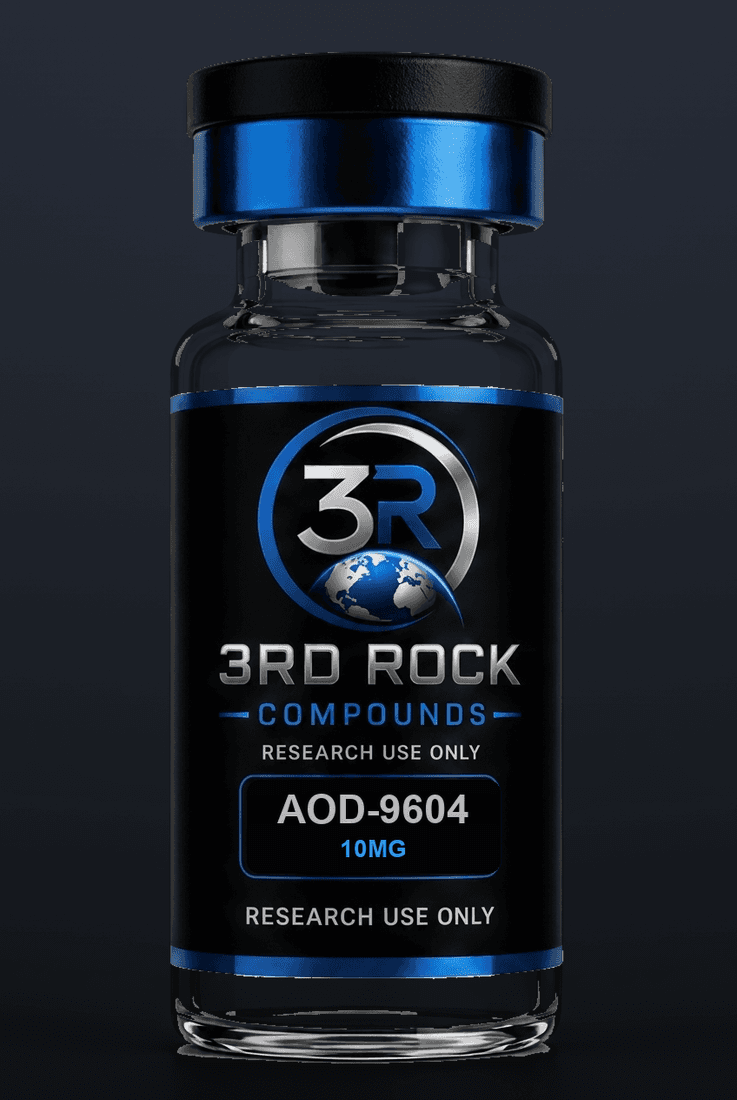
Front label
Metabolic | 99.71% purity
AOD-9604 10MG
- AOD9604
- Tyr-hGH Frag 176-191
$99
Lot
—
Purity (HPLC-UV/VIS)
99.71%
Reported
05/12/2026
Lab
Freedom Diagnostics
Issued by Freedom Diagnostics. Testing was commissioned by our fulfilment partner on the material we ship; the certificate names that party, not 3rd Rock Compounds.
Quantity
AOD-9604 10MG
1 vial · $99
- Third-party HPLC tested
- Lot-matched certificate
- Same-day fulfilment before 2pm
- Shipping 2–4 business days
Identifiers
- CAS number
- 221231-10-3
- Molecular formula
- C78H123N23O23S2
- Molecular weight
- 1815.1 g/mol
- PubChem CID
- 16131447
- Sequence
- Tyr-Leu-Arg-Ile-Val-Gln-Cys-Arg-Ser-Val-Glu-Gly-Ser-Cys-Gly-Phe (Disulfide bridge: Cys7-Cys14)
Mechanism of Action
The mechanism of action of AOD9604 centers on the regulation of lipid metabolism through a signaling cascade that is distinct from the growth-promoting pathways activated by full-length hGH. The key pathways are:
1. Beta-3 Adrenergic Receptor (β3-AR) Activation
In murine adipose tissue, the lipolytic effects of AOD9604 are critically dependent on functional beta-3 adrenergic receptors (β3-AR). Studies using β3-AR knockout mice demonstrated a complete abolition of AOD9604-induced lipolysis, confirming the receptor as an essential mediator [1]. In obese (ob/ob) mice, chronic research application with AOD9604 at 500 µg/kg/day i.p. for 14 days resulted in significant upregulation of β3-AR mRNA expression in white adipose tissue, effectively restoring lipolytic sensitivity that is typically blunted in the obese phenotype [1][10].
2. cAMP / Hormone-Sensitive Lipase (HSL) Pathway
Activation of β3-AR by AOD9604 stimulates adenylate cyclase, increasing intracellular cyclic adenosine monophosphate (cAMP) levels. Elevated cAMP activates protein kinase A (PKA), which phosphorylates hormone-sensitive lipase (HSL), the rate-limiting enzyme in triglyceride hydrolysis. This cascade promotes the breakdown of stored triglycerides into free fatty acids and glycerol (lipolysis) [2][11].
3. Inhibition of Acetyl-CoA Carboxylase (ACC) / Anti-Lipogenesis
Concurrently, AOD9604 inhibits acetyl-CoA carboxylase (ACC), the enzyme that catalyzes the first committed step in de novo fatty acid synthesis (lipogenesis). By suppressing ACC activity, AOD9604 reduces the conversion of acetyl-CoA to malonyl-CoA, thereby inhibiting new fat formation [2][12]. This dual action—stimulating fat breakdown while inhibiting fat synthesis—accounts for the net reduction in adipose tissue mass observed in preclinical models.
4. Why AOD9604 Does NOT Activate IGF-1 or the hGH Receptor
A critical distinction of AOD9604 from full-length hGH is its inability to activate the growth hormone receptor (GHR). Full-length hGH binds two GHR molecules (receptor dimerization), triggering the JAK2/STAT5 signaling cascade that stimulates hepatic production of Insulin-like Growth Factor 1 (IGF-1) [13]. Because AOD9604 represents only the C-terminal tail of hGH (residues 177–191), it lacks the structural domains (helices A and B) required for high-affinity GHR binding and dimerization [8][14]. Consequently, AOD9604 does not:
- Elevate serum IGF-1 levels [3][15]
- Stimulate cell proliferation (no mitogenic activity) [8]
- Induce insulin resistance or hyperglycemia [2][16]
This selectivity for metabolic effects without growth-promoting reported observations in study populations was a key design objective in the development of AOD9604 [3].
Preclinical Research Findings
AOD9604 was originally developed as a potential anti-obesity experimental. In preclinical studies, the peptide demonstrated significant effects on body composition:
- ob/ob Mouse Model: Chronic research application with AOD9604 at 500 µg/kg/day i.p. for 14 days produced an average body weight reduction of ~8.1 g (~5.5%) compared to saline-treated controls, without any change in food intake, blood glucose, or serum IGF-1 [1][2].
- Zucker Rat Model: In obese Zucker (fa/fa) rats, oral administration of AOD9604 at 200–600 µg/kg/day for 18 days resulted in a dose-dependent reduction in body fat mass with no effects on lean body mass, demonstrating selectivity for adipose tissue [11][12].
- Fat Oxidation: Metabolic chamber studies showed a 50–60% increase in fat oxidation rate in AOD9604-treated animals versus controls, as measured by respiratory quotient (RQ) shifts [2].
Despite these promising preclinical results, a large randomized Phase 2b clinical trial (n=536, 24 weeks, oral dosing 1–25 mg/day) failed to demonstrate statistically significant weight loss compared to placebo in humans, leading to the termination of the obesity development program by Metabolic Pharmaceuticals in 2007 [16][17].
Regenerative research compound (Cartilage & Musculoskeletal Repair)
AOD9604 has attracted significant interest in the field of musculoskeletal regeneration, particularly for cartilage repair in osteoarthritis (OA):
- Rabbit OA Model (Kwon & Park, 2015): In a collagenase-induced OA model, intra-articular injection of AOD9604 alone significantly improved gross morphological scores (scale 0–4) from a mean of 3.4 (severe damage) to 1.6 (mild damage) at 8 weeks. When combined with hyaluronic acid (HA), scores improved further to 0.8 (near-normal). Histopathological analysis (Mankin scoring system) confirmed enhanced proteoglycan staining and restored cartilage surface regularity in research application groups [5].
- Chondrocyte Proliferation: In vitro studies suggest AOD9604 may enhance chondrocyte proliferation and extracellular matrix (ECM) synthesis, although the precise molecular pathway remains under investigation [6].
- Synergistic Combinations: AOD9604 is frequently studied in combination with BPC-157 and HA for potential synergistic tissue-repair effects [6][18].
Influenza Research (LAT8881)
Under the designation LAT8881, AOD9604 has been evaluated by Lateral Pharma Pty Ltd for host-protective properties against severe influenza A infection. Preclinical data suggests potential immunomodulatory effects [7].
Safety Profile
Findings summarised above derive from in-vitro and animal studies. No safety profile for human use is established or implied, and none is offered here.
Handle as a laboratory reagent: avoid inhalation and contact, reconstitute under aseptic conditions, and observe the storage conditions below.
For research use only. Not for human consumption.
Shipping and Storage
- Supplied as lyophilised powder in a sealed vial.
- Store at 2–8°C (36–46°F). Protect from light.
- Same-day fulfilment on orders before 2pm; shipping 2–4 business days.
- For research use only. Not for human consumption.
References
- [1]Heffernan, M., et al. (2001). The effects of human GH and its lipolytic fragment (AOD9604) on lipid metabolism following chronic research application in obese mice and beta(3)-AR knock-out mice. Endocrinology, 142(12), 5182-5189.
- [2]Ng, F. M., et al. (2000). Metabolic studies of a synthetic lipolytic domain (AOD9604) of human growth hormone. Hormone Research, 53(6), 274-278. PubMed →
- [3]Ng, F. M. & Bornstein, J. (1978). Hyperglycemic action of synthetic C-terminal fragments of human growth hormone. Am J Physiol, 235(1), E55-E59.
- [4]Ng, F. M., et al. (2000). Molecular and cellular actions of a structural domain of human growth hormone (AOD9401) on lipid metabolism in Zucker fatty rats. J Mol Endocrinol, 25(3), 287-298.
- [5]Kwon, D. R. & Park, G. Y. (2015). Effect of Intra-articular Injection of AOD9604 with or without Hyaluronic Acid in Rabbit Osteoarthritis Model. Ann Clin Lab Sci, 45(4), 426-432.
- [6]Kwon, D. R., et al. (2020). Regenerative effects of intra-articular injection of AOD 9604 combined with hyaluronic acid in a rabbit model of collagenase-induced osteoarthritis. compound Des Devel Ther, 14, 2193-2201.
- [7]Lateral Pharma Pty Ltd. (2020). LAT8881 (AOD9604) host-protective experimental protocol for influenza A virus infection. Clinical development update.
- [8]Wu, Z., et al. (1993). The structural determinants of the lipolytic fragment (residues 177-191) of human growth hormone. Int J Pept Protein Res, 41(5), 432-438. PubMed →
- [9]Ng, F. M., et al. (1990). Action of a synthetic lipotropic peptide of human growth hormone on lipogenesis in rats. J Mol Endocrinol, 5(3), 265-271.
- [10]Heffernan, M., et al. (2000). The effects of AOD9604 on beta-3 adrenergic receptor expression and lipolysis in obese mice. Obesity Research, 8(S1), abstract.
- [11]Groenewegen, W. A., et al. (2004). Oral AOD9604 reduces body fat in Zucker rats by selective fat mass reduction without effect on lean body mass. Appetite, 42(3), abstract.
- [12]Ng, F. M. & Roupas, P. (1999). Anti-lipogenic action of the C-terminal fragment 177-191 of human growth hormone. Res Commun Mol Pathol Pharmacol, 106(1-2), 35-48.
- [13]Tomer, Y. & Bhargava, A. S. (1999). Growth hormone receptor and signal transduction. In: Molecular Biology of Growth Hormone Receptors. Springer.
- [14]Wu, Z., et al. (1994). Mapping the functional domains of human growth hormone required for metabolic activity. J Biol Chem, 269(22), 15523-15530.
- [15]Stier, H., et al. (2013). tolerability and Tolerability of the Hexadecapeptide AOD9604 in Humans. J Endocrinol Metab, 3(1-2), 7-15.
- [16]Metabolic Pharmaceuticals Limited. (2007). Metabolic’s obesity compound – Phase 2B clinical trial results. ASX Announcement, 27 June 2007.
- [17]Thompson, G., et al. (2004). Phase 2b clinical trial results for AOD9604. Presented at the International Congress on Obesity.
- [18]Kwon, D. R., et al. (2019). Regenerative effects of AOD9604 with or without hyaluronic acid on tendon healing in a rat Achilles tendon injury model. compound Des Devel Ther, 13, 4173-4186.
- [19]Stier, H. & Kenley, D. (2012). Preclinical and clinical tolerability review of AOD9604. Regul Toxicol Pharmacol, 64(2), S34-S35.
- [20]U.S. Food and Drug Administration. (2023). Bulk Drug Substances Used in Compounding Under Section 503B. FDA.gov.
- [21]World Anti-Doping Agency. (2024). The Prohibited List: International Standard. Section S2. wada-ama.org →
Entries without a link have no DOI or PubMed identifier in the source record. The reference is reproduced as given; every link that does appear has been checked and resolves to the work it names.
9 references carry an identifier in our record that resolves to a different paper. We have withheld those links rather than send you to the wrong work, and we do not substitute one we cannot verify.