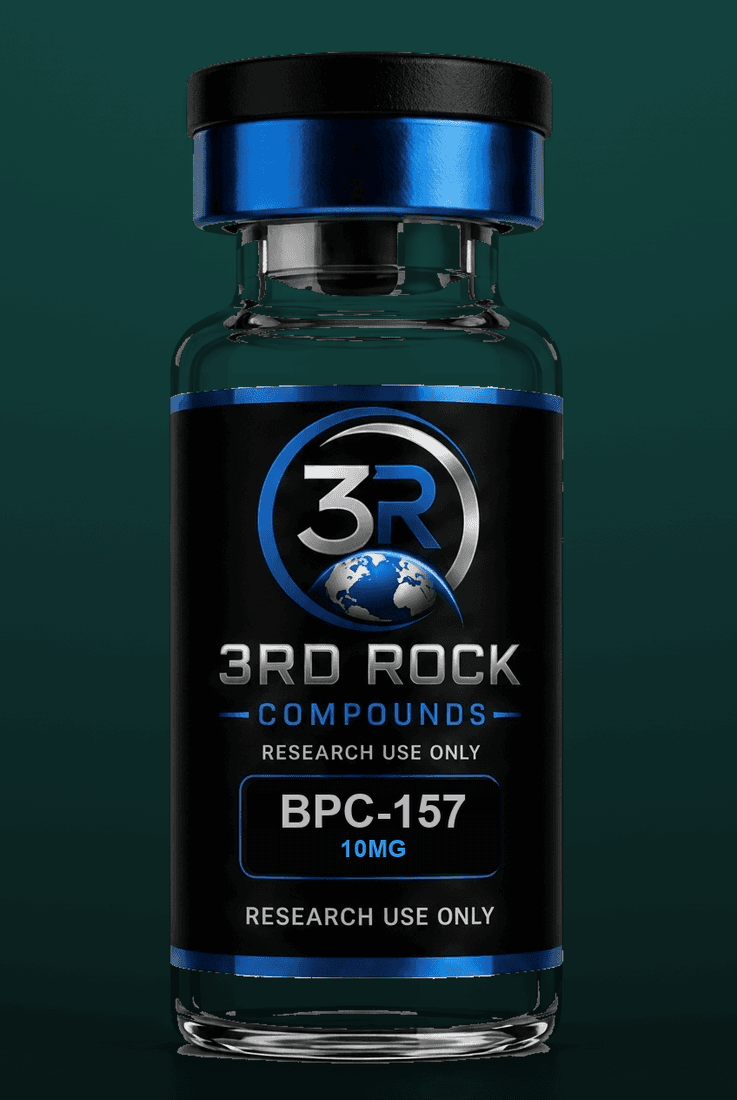
Front label
Repair & Recovery | 99.54% purity
BPC-157 10MG
- Bepecin
- PL 14736
- PL-10
- PLD-116
- PCO-02
BPC-157 (Body Protection Compound-157) is a synthetic pentadecapeptide composed of 15 amino acids, derived from a partial sequence of a larger protein naturally found in human gastric juice.
Strength
$60
Lot
—
Purity (HPLC-UV/VIS)
99.54%
Reported
06/17/2026
Lab
Kovera Labs
Issued by Kovera Labs. Testing was commissioned by our fulfilment partner on the material we ship; the certificate names that party, not 3rd Rock Compounds.
Quantity
BPC-157 10MG
1 vial · $60
- Third-party HPLC tested
- Lot-matched certificate
- Same-day fulfilment before 2pm
- Shipping 2–4 business days
Identifiers
- CAS number
- 137525-51-0
- Molecular formula
- C₆₂H₉₈N₁₆O₂₂
- Molecular weight
- 1419.556 g/mol
- Sequence
- GEPPPGKPADDAGLV
Mechanism of Action
VEGFR2 Activation (Primary Target)
BPC-157 binds to and activates vascular endothelial growth factor receptor 2 (VEGFR2) on endothelial cells. Unlike standard ligands, BPC-157 promotes VEGFR2 internalization — a critical step in activating downstream repair pathways.[7][10]
Src Family Kinase Activation
A 2025 study proposes that BPC-157 adopts a polyproline II helix structure that engages the SH3 domains of Src family kinases (c-Src, Yes, Fyn), relieving autoinhibition and acting as an intracellular "switch" for signal transduction.[11]
VEGFR2-Akt-eNOS Cascade
Upon VEGFR2 binding, BPC-157 triggers phosphorylation of Akt (Protein Kinase B), which activates endothelial nitric oxide synthase (eNOS), producing nitric oxide (NO) — essential for angiogenesis and vascular repair.[7]
Src-Caveolin-1-eNOS Pathway
BPC-157 promotes phosphorylation of Src and Caveolin-1 (Cav-1). Under normal conditions, Cav-1 inhibits eNOS — BPC-157 disrupts this inhibitory complex, enhancing NO production.[10]
FAK-Paxillin Pathway
In tendon fibroblasts, BPC-157 activates focal adhesion kinase (FAK) and paxillin, essential for cell migration, adhesion, and cytoskeletal organization during tissue repair.[12]
JAK-2 / Growth Hormone Receptor Upregulation
BPC-157 activates JAK-2, linked to upregulation of growth hormone receptors (GHR) on tendon fibroblasts, enhancing tissue sensitivity to growth hormone.[12][13]
Egr-1/NAB2 Feedback Loop
ERK1/2 activation upregulates Egr-1 and simultaneously its corepressor NAB2, establishing a feedback loop that prevents uncontrolled angiogenic signaling.[14]
Nitric Oxide System Modulation (Bidirectional)
BPC-157 exhibits a unique modulatory interaction with the NO system — it counteracts both L-NAME (NOS inhibitor → hypertension) and L-arginine (NOS substrate → hypotension), acting as a homeostatic buffer rather than a strict agonist or antagonist.[15]
Dopamine/Serotonin System Regulation
BPC-157 antagonizes the effects of dopamine receptor blockers (haloperidol) and agonists (amphetamine), as well as serotonin syndrome precursors — suggesting a regulatory influence on these neurotransmitter systems rather than direct receptor binding.[16]
Egr-1/NAB2 Angiogenic Restraint Loop
The Egr-1/NAB2 motif investigated in BPC-157 work distinguishes it from unrestrained pro-angiogenic ligands such as exogenous VEGF-A. By co-inducing the corepressor NAB2, BPC-157-stimulated angiogenesis remains negatively regulated by an intrinsic feedback element, which preclinical authors have proposed as one explanation for the compound's broad therapeutic-index profile in animal models.[14][29]
Brain-Gut Axis Crosstalk
Sikiric and colleagues have positioned BPC-157 as an integrator of the brain-gut axis, with effects observed in both peripheral mucosal injury and central nervous system models reflecting parallel cytoprotective signaling. This cross-axis activity is hypothesized to involve coordinated VEGFR2/eNOS and dopamine/serotonin tone normalization, supporting a single underlying organoprotective mechanism rather than tissue-specific receptor families.[2][3]
Preclinical Research Findings
BPC-157 demonstrates pleiotropic effects across multiple experimental paradigms, with unusually broad tissue coverage for a single peptide:
- Gastrointestinal Healing — Anti-ulcer peptidergic agent effective against IBD, ulcerative colitis, NSAID-induced lesions, and complex fistulas. Phase II human data available (n=53, ulcerative colitis).[6]
- Musculoskeletal Regeneration — Accelerated healing of transected/detached tendons (Achilles, quadriceps), ligaments (MCL), and skeletal muscle injuries. Improved biomechanical function and reversed corticosteroid impairment.[17][18]
- Neuroprotection and CNS Repair — Protective in models of TBI, spinal cord compression, and bilateral carotid occlusion. Reduced edema, neuronal necrosis, demyelination. Functional recovery maintained to 1 year (spinal cord).[19][20]
- Vascular Occlusion Models — Rapidly activates collateral vessels to bypass occlusions (Budd-Chiari syndrome, Pringle maneuver). Prevents thrombotic/ischemic damage and preserves organ function.[21]
- Corneal Healing — Maintains corneal transparency and accelerates ulcer/perforation healing without inducing neovascularization (uniquely anti-angiogenic in cornea).[22]
- Hepatoprotection — Protective against alcohol/NSAID-induced liver injury, fibrosis, and cirrhosis. Normalized liver enzymes and bilirubin in bile duct ligation models.[23]
- Pain Management — Human pilot data: intra-articular injection (2 mg) for knee pain (91.6% significant improvement, n=16) and intravesical injection (10 mg) for interstitial cystitis (83.3% complete resolution, n=12).[24][25]
- Dopaminergic/Serotonergic Modulation — Efficacy in models of schizophrenia and depression; counteracted catalepsy, amphetamine-induced hyperactivity, and ketamine-induced "negative-like" symptoms.[16]
- Bidirectional NO-System Modulation Studies — Investigated for its capacity to counteract both NOS inhibition (L-NAME) and NOS-substrate excess (L-arginine), positioning it in research as a homeostatic NO buffer rather than a unidirectional agonist or antagonist.[15]
- Polyproline-Helix / SH3 Engagement Profiling — Examined for the conformational basis of its broad signaling profile, with structural work suggesting Src-family-kinase SH3 engagement underlies the diverse downstream phosphorylation cascades reported across organ systems.[11]
Comparative Research Context
BPC-157 is most commonly cross-referenced in the cytoprotection literature with TB-500 (actin-mediated repair), GHK-Cu (matrix remodeling), and Thymosin alpha-1 (immunoregulation). These cross-comparisons inform research designs investigating whether BPC-157's pleiotropic profile reflects a single integrative kinase-engagement mechanism or convergent activity across independent reparative pathways.[29][30]
Safety Profile
Findings summarised above derive from in-vitro and animal studies. No safety profile for human use is established or implied, and none is offered here.
Handle as a laboratory reagent: avoid inhalation and contact, reconstitute under aseptic conditions, and observe the storage conditions below.
For research use only. Not for human consumption.
Shipping and Storage
- Supplied as lyophilised powder in a sealed vial.
- Store at 2–8°C (36–46°F). Protect from light.
- Same-day fulfilment on orders before 2pm; shipping 2–4 business days.
- For research use only. Not for human consumption.
References
- [1]Sikiric P, et al. A new gastric juice peptide, BPC. An overview of the stomach-stress-organoprotection hypothesis and beneficial effects of BPC. Journal of Physiology-Paris. 1993;87(5):313-327. DOI →
- [2]Sikiric P, et al. Brain-gut Axis and Pentadecapeptide BPC 157: Theoretical and Practical Implications. Current Neuropharmacology. 2016;14(8):857-865. DOI →
- [3]Sikiric P, et al. Stable Gastric Pentadecapeptide BPC 157, Robert's Stomach Cytoprotection/Adaptive Cytoprotection/Organoprotection, and Selye's Stress Coping Response. Current Pharmaceutical Design. 2020;26(25):3024-3044.
- [4]U.S. Food and Drug Administration. Certain Bulk Drug Substances for Use in Compounding that May Present Significant Safety Risks. FDA.gov. Updated 2023. fda.gov →
- [5]World Anti-Doping Agency. The 2025 Prohibited List. WADA. January 1, 2025. wada-ama.org →
- [6]Ruenzi M, et al. BPC-157 in patients with ulcerative colitis: A Phase II multicenter, randomized, double-blind, placebo-controlled study. Gastroenterology. 2005;128(Suppl 2):A-585.
- [7]Hsieh MJ, et al. Therapeutic potential of pro-angiogenic BPC157 is associated with VEGFR2 activation and up-regulation. Journal of Molecular Medicine. 2017;95(3):323-333. DOI →
- [8]Sikiric P, et al. Stable Gastric Pentadecapeptide BPC 157 as a Therapy and Safety Key: A Special Beneficial Pleiotropic Effect. Current Pharmaceutical Design. 2025.
- [9]Xu C, et al. Preclinical safety evaluation of body protection compound-157, a potential drug for treating various wounds. Regulatory Toxicology and Pharmacology. 2020;114:104665. DOI →
- [10]Hsieh MJ, et al. BPC157 enhances the growth hormone receptor expression in tendon fibroblasts. Molecules. 2020;25(21):5159.
- [11]Schlosser N. BPC-157: A Polyproline II Helix Engages SH3 Domains of Src Family Kinases. 2025.
- [12]Chang CH, et al. The promoting effect of pentadecapeptide BPC 157 on tendon healing involves tendon outgrowth, cell survival, and cell migration. Journal of Applied Physiology. 2011;110(3):774-780. DOI →
- [13]Chang CH, et al. Pentadecapeptide BPC 157 Enhances the Growth Hormone Receptor Expression in Tendon Fibroblasts. Molecules. 2014;19(12):19066-19077. DOI →
- [14]Vukojevic J, et al. Rat inferior caval vein (ICV) ligature and BPC 157. Molecular Neurobiology. 2020;57:4029-4044.
- [15]Sikiric P, et al. The pharmacological properties of the novel peptide BPC 157. Inflammopharmacology. 1999;7(1):1-14.
- [16]Zemba Cilic A, et al. Stable gastric pentadecapeptide BPC 157 and dopamine system. Current Neuropharmacology. 2021;19(11):1696-1714.
- [17]Staresinic M, et al. Gastric pentadecapeptide BPC 157 accelerates healing of transected rat Achilles tendon and in vitro stimulates tendocytes growth. Journal of Orthopaedic Research. 2003;21(6):976-983. DOI →
- [18]Matek D, et al. BPC 157 counteracts muscle-to-bone detachment: Oral application evidence. Biomedicine & Pharmacotherapy. 2025.
- [19]Tudor M, et al. The gastroprotective and neuroprotective pentadecapeptide BPC 157 in the treatment of traumatic brain injury in rats. Regulatory Peptides. 2010;160(1-3):26-32. DOI →
- [20]Perovic D, et al. Stable gastric pentadecapeptide BPC 157 can improve the healing course of spinal cord injury. Journal of Orthopaedic Surgery and Research. 2019;14:440.
- [21]Sikiric P, et al. Vascular occlusion and stable gastric pentadecapeptide BPC 157. Current Pharmaceutical Design. 2022;28(25):2082-2093.
- [22]Masnec S, et al. Stable gastric pentadecapeptide BPC 157 heals corneal injuries. Current Pharmaceutical Design. 2015;21(33):4868-4875.
- [23]Sever M, et al. Stable gastric pentadecapeptide BPC 157 counteracts liver fibrosis. Journal of Physiology and Pharmacology. 2019;70(3):391-400.
- [24]Lee E, Padgett B. BPC-157 and knee pain: A retrospective chart review. Alternative Therapies in Health and Medicine. 2021.
- [25]Lee E, Walker C, Ayadi B. BPC-157 intravesical therapy for interstitial cystitis: A pilot study. Alternative Therapies in Health and Medicine. 2024.
- [26]He Y, et al. Pharmacokinetics and excretion study of BPC157 in rats and dogs. Journal of Chromatography B. 2022;1201:123300.
- [27]Veljaca M, et al. BPC-157: Safety and pharmacokinetics after rectal administration in healthy male volunteers. Gut. 2003;52(Suppl VI):A246.
- [28]Lee E, Burgess K. Intravenous BPC-157 in healthy adults: A pilot tolerability study. Alternative Therapies in Health and Medicine. 2025.
- [29]Seiwerth S, et al. BPC 157 and Standard Angiogenic Growth Factors: GI Tract Healing. Current Pharmaceutical Design. 2018;24(18):1972-1989.
- [30]Seiwerth S, et al. Stable Gastric Pentadecapeptide BPC 157 and Wound Healing. Frontiers in Pharmacology. 2021;12:627533. DOI →
Entries without a link have no DOI or PubMed identifier in the source record. The reference is reproduced as given; every link that does appear has been checked and resolves to the work it names.
1 reference carries an identifier in our record that resolves to a different paper. We have withheld those links rather than send you to the wrong work, and we do not substitute one we cannot verify.