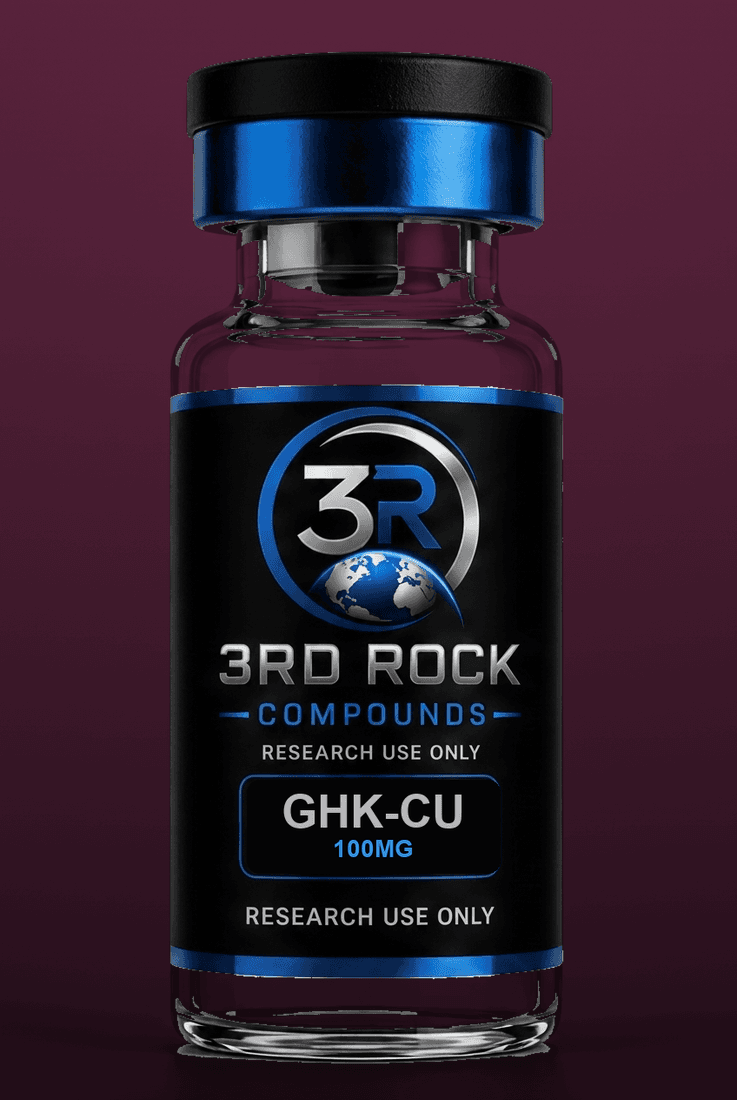
Front label
Cosmetic & Other | 99.75% purity
GHK-CU 100MG
GHK-Cu ( Copper Tripeptide-1 ) is a naturally occurring tripeptide-copper complex (Gly-His-Lys chelated to Cu²⁺) first isolated from human plasma in 1973 by Dr.
$85
Lot
20260102GK
Purity (HPLC-UV/VIS)
99.75%
Reported
—
Lab
Freedom Diagnostics
Issued by Freedom Diagnostics. Testing was commissioned by our fulfilment partner on the material we ship; the certificate names that party, not 3rd Rock Compounds.
Quantity
GHK-CU 100MG
1 vial · $85
- Third-party HPLC tested
- Lot-matched certificate
- Same-day fulfilment before 2pm
- Shipping 2–4 business days
Identifiers
- CAS number
- 89030-95-5
- Molecular formula
- C₁₄H₂₂CuN₆O₄
- Molecular weight
- ~401.9 Da
- PubChem CID
- 378611
- Sequence
- GHK
Mechanism of Action
Copper Transport & "Redox Silencing"
GHK-Cu acts as a carrier peptide with high affinity for copper(II) ions (pKa = 16.44). The complex "silences" copper's redox activity, preventing Fenton reaction damage while delivering copper safely into cells — essential for enzymes like lysyl oxidase (collagen crosslinking) and superoxide dismutase (antioxidant defense).[3]
Key Signaling Pathways
| Pathway | Mechanism | Effect |
|---|---|---|
| NF-κB/p38 MAPK | Inhibits phosphorylation of NF-κB p65 and p38 MAPK | Blocks nuclear translocation → suppresses TNF-α, IL-6 (Park et al., 2016)[4] |
| Nrf2/Keap1 | Promotes Nrf2 dissociation from Keap1 → nuclear translocation | HO-1 transcription → antioxidant defense (Zhang et al., 2022)[5] |
| SIRT1/STAT3 | Upregulates SIRT1 → deacetylates STAT3 → suppresses RORγt | Reduces Th17 inflammation; ↑ ZO-1/Occludin tight junctions (Mao et al., 2025)[6] |
| TGF-β | Context-dependent modulation | Restores in COPD lungs (Campbell et al., 2012); suppresses in scarring/fibrosis[7] |
Ferritin Iron Blockade
GHK-Cu binds to ferritin channels → prevents Fe(II) release → reduces iron-catalyzed lipid peroxidation by 87% (Miller et al., 1990).[8]
Gene Modulation
GHK-Cu induces >50% change in expression of 31.2% of human genes. It resets gene expression to a "younger/healthier" state — suppressing inflammatory and metastatic genes while activating repair and remodeling genes. Analysis via the Broad Institute Connectivity Map confirmed GHK modulates >4,000 genes.[2][9]
ECM Synthesis
Stimulates Collagen I/III, elastin, GAGs, and decorin; modulates MMPs and TIMPs for balanced tissue remodeling.[10]
Anti-Cancer Activity
Reactivates apoptosis (caspases 3/7) in neuroblastoma, leukemia, and breast cancer cell lines. Reverses 70% of 54 metastasis genes in colon cancer via Connectivity Map analysis.[9]
Dose-Response: Biphasic
Collagen synthesis stimulation begins at 10⁻¹² M, peaks at 10⁻⁹ M (1 nanomolar), and disappears at higher concentrations. Systemic wound healing in animals at ~1.1 mg/kg — far below the toxic threshold (LD50 estimated ~23,000 mg in 70 kg human).[10][3]
GHK vs. GHK-Cu
| Form | Key Difference |
|---|---|
| GHK (peptide alone) | Some efficacy (quenches lipid peroxidation by-products); copper complex required for most wound healing/gene effects |
| GHK-Cu | Full regenerative profile; "redox silences" copper for safe delivery; strong chelators abolish effects |
| HGK:Cu (analog) | SOD-mimetic activity 223-fold higher than native GHK-Cu |
Preclinical Research Findings
GHK-Cu research spans dermatology, wound healing, pulmonology, oncology, and neuroscience across 10+ indication categories:
- Wound Healing & Tissue Regeneration — Accelerates contraction, re-epithelialization, collagen accumulation; reduces TNF-α and MMPs. 64.5% wound size reduction vs 28.2% control (Canapp et al., 2003).[11]
- Dermatology & Anti-Aging — Tightens skin, improves elasticity/density/thickness; reduces wrinkles 55%; outperforms Vitamin C and retinoic acid for collagen production (70% vs 50% vs 40%).[12]
- Hair Growth Stimulation — Enlarges follicle size, prolongs anagen phase; comparable to 5% minoxidil. MDCT approach: SALT score 40%→7.5%.[13]
- COPD/Emphysema — Reverses emphysematous gene expression; restores TGF-β pathway in lung fibroblasts.[7]
- Anti-Cancer & Metastasis Suppression — Connectivity Map identifies GHK as reverser of metastatic colon cancer gene signature; reactivates apoptosis in neuroblastoma/leukemia/breast cancer.[9]
- DNA Repair & Radiation Recovery — Restores replicative vitality to irradiated fibroblasts; ↑ bFGF, VEGF.[14]
- Antioxidant & Anti-Inflammatory — Neutralizes acrolein/4-HNE; blocks ferritin iron release (87% ↓ lipid peroxidation); suppresses NF-κB.[8]
- Neuroprotection — Promotes nerve outgrowth; ↑ NGF, NT-3, NT-4; reduces anxiety/pain/aggression at 0.5 µg/kg.[15]
- Bone Regeneration — Promotes reparative osteogenesis in fracture models at 0.5 µg/kg.[16]
- Gastrointestinal Healing — 60% reduction in IBD severity (n=16); ulcerative colitis relief via SIRT1/STAT3 pathway.[6]
- Connectivity Map Gene-Signature Profiling — A research workflow used in oncology and aging laboratories applies the Broad Institute's Connectivity Map (CMAP) to interrogate which transcriptional states GHK can reverse. Published analyses report that the tripeptide modulates expression of ~4,000 human genes by >50%, including reversal of ~70% of a 54-gene metastatic colon-cancer signature, and partial reversal of COPD-emphysema and Alzheimer's hippocampal signatures. This positions GHK-Cu as a model substrate for studying small-peptide control of large gene-network programs.[9]
- Redox-Silenced Copper Delivery Studies — Bioinorganic chemistry investigations use GHK-Cu as a model carrier for delivering Cu(II) to cells without triggering Fenton-driven hydroxyl-radical generation. The N3O coordination sphere "silences" copper's redox cycling, allowing controlled handoff to enzymes like SOD3 and lysyl oxidase. This research informs the broader peptide-metal-complex field, including investigations of analog HGK:Cu (223-fold higher SOD-mimetic activity) and copper-binding PIP-tides.[3]
- Ferritin Iron-Blockade and Lipid Peroxidation Research — Cell-free and cell-culture investigations use GHK-Cu to probe whether copper-tripeptide complexes can prevent iron release from ferritin and downstream membrane lipid peroxidation. Reports show 87% suppression of microsomal lipid peroxidation, providing a research tool for studying iron-driven oxidative stress in models of aging, ischemia-reperfusion, and neurodegeneration.[8]
Comparative Research Context
Within the matrix-remodeling and tissue-repair research domain, GHK-Cu is most directly compared with BPC-157 (gastric pentadecapeptide that drives angiogenesis via Egr-1/NAB2 and VEGFR2), TB-500 (thymosin beta-4 fragment that sequesters G-actin and accelerates cell migration), and thymosin alpha-1 (TLR-modulating immunopeptide). Where BPC-157 and TB-500 act primarily through actin/cytoskeletal and growth-factor pathways, GHK-Cu's mechanism is dominated by transcriptional reprogramming via copper-dependent gene regulation, making it a complementary research tool when investigators wish to dissect transcription-driven from structural-protein-driven repair phenotypes.
Safety Profile
Findings summarised above derive from in-vitro and animal studies. No safety profile for human use is established or implied, and none is offered here.
Handle as a laboratory reagent: avoid inhalation and contact, reconstitute under aseptic conditions, and observe the storage conditions below.
For research use only. Not for human consumption.
Shipping and Storage
- Supplied as lyophilised powder in a sealed vial.
- Store at 2–8°C (36–46°F). Protect from light.
- Same-day fulfilment on orders before 2pm; shipping 2–4 business days.
- For research use only. Not for human consumption.
References
- [1]Pickart L, Vasquez-Soltero JM, Margolina A. GHK-Cu may Prevent Oxidative Stress in Skin by Regulating Copper and Modifying Expression of Numerous Antioxidant Genes. Cosmetics. 2015;2(3):236-247. DOI →
- [2]Pickart L. The human tri-peptide GHK and tissue remodeling. Journal of Biomaterials Science, Polymer Edition. 2008;19(8):969-988. DOI →
- [3]Pickart L, Margolina A. Regenerative and Protective Actions of the GHK-Cu Peptide in the Light of the New Gene Data. International Journal of Molecular Sciences. 2018;19(7):1987. DOI →
- [4]Park JR, Lee H, Kim SI, Yang SR. The tri-peptide GHK-Cu complex ameliorates lipopolysaccharide-induced acute lung injury in mice. Oncotarget. 2016;7(36):58405-58417. DOI →
- [5]Zhang Q, Yan L, Lu J, Zhou X. Glycyl-L-histidyl-L-lysine-Cu2+ attenuates cigarette smoke-induced pulmonary emphysema and inflammation by reducing oxidative stress pathway. Frontiers in Molecular Biosciences. 2022;9:925700. DOI →
- [6]Mao S, Huang J, Li J, et al. Exploring the beneficial effects of GHK-Cu on an experimental model of colitis and the underlying mechanisms. Frontiers in Pharmacology. 2025;16:1551843. DOI →
- [7]Campbell JD, McDonough JE, Zeskind JE, et al. A gene expression signature of emphysema-related lung destruction and its reversal by the tripeptide GHK. Genome Medicine. 2012;4(8):67. DOI →
- [8]Miller DM, DeSilva D, Pickart L, Aust SD. Effects of glycyl-histidyl-lysyl chelated Cu(II) on ferritin dependent lipid peroxidation. Advances in Experimental Medicine and Biology. 1990;264:79-84.
- [9]Pickart L, Vasquez-Soltero JM, Margolina A. GHK and DNA: Resetting the human genome to health. BioMed Research International. 2014;2014:151479. DOI →
- [10]Maquart FX, Pickart L, Laurent M, et al. Stimulation of collagen synthesis in fibroblast cultures by the tripeptide-copper complex glycyl-L-histidyl-L-lysine-Cu2+. FEBS Letters. 1988;238(2):343-346. DOI →
- [11]Canapp SO Jr, Farese JP, Schultz GS, et al. The effect of topical tripeptide-copper complex on healing of ischemic open wounds. Veterinary Surgery. 2003;32(6):515-523. DOI →
- [12]Abdulghani AA, Sherr A, Shirin S, et al. Effects of topical creams containing vitamin C, a copper-binding peptide cream and melatonin compared with tretinoin on the ultrastructure of normal skin. Disease Management and Clinical Outcomes. 1998;1(4):136-141.
- [13]Kuceki G, Coppinger AJ, Ragi SD, et al. Enhanced hair regrowth with five monthly sessions of minoxidil-dutasteride-copper peptides tattooing for androgenetic alopecia. JAAD International. 2025;20:38-40. DOI →
- [14]Pollard JD, Quan S, Kang T, Koch RJ. Effects of copper tripeptide on the growth and expression of growth factors by normal and irradiated fibroblasts. Archives of Facial Plastic Surgery. 2005;7(1):27-31. DOI →
- [15]Dou Y, Lee A, Zhu L, et al. The potential of GHK as an anti-aging peptide. Aging Pathobiology and Therapeutics. 2020;2(1):58-61. DOI →
- [16]Cherdakov VYu, et al. Peptide combination (GHK, Dalargin, Thymogen) promotes reparative osteogenesis in rats with bone fractures. Bulletin of Experimental Biology and Medicine. 2010.
- [17]Gul NY, Topal A, Cangul IT, Yanik K. The effects of topical tripeptide copper complex and helium-neon laser on wound healing in rabbits. Veterinary Dermatology. 2008;19(1):7-14. DOI →
- [18]Badenhorst T, Svirskis D, Merrilees M, et al. Effects of GHK-Cu on MMP and TIMP Expression, Collagen and Elastin Production, and Facial Wrinkle Parameters. Journal of Aging Science. 2016;4(3):166. DOI →
- [19]Pickart L, Vasquez-Soltero JM, Margolina A. GHK Peptide as a Natural Modulator of Multiple Cellular Pathways in Skin Regeneration. BioMed Research International. 2015;2015:648108. DOI →
- [20]Hong Y, Downey T, Eu KW, et al. A 'metastasis-prone' signature for early-stage mismatch-repair proficient sporadic colorectal cancer patients and its implications for possible therapeutics. Clinical & Experimental Metastasis. 2010;27(2):83-90. DOI →
- [21]Pickart L, Freedman JH, Loker WJ, et al. Growth-modulating plasma tripeptide may function by facilitating copper uptake into cells. Nature. 1980;288(5792):715-717. DOI →
- [22]Simeon A, Emonard H, Hornebeck W, Maquart FX. The tripeptide-copper complex glycyl-L-histidyl-L-lysine-Cu2+ stimulates matrix metalloproteinase-2 expression by fibroblast cultures. Life Sciences. 2000;67(18):2257-2265. DOI →
- [23]Kang YA, Choi HR, Na JI, et al. Copper-GHK increases integrin expression and p63 positivity by keratinocytes. Archives of Dermatological Research. 2009;301(4):301-306. DOI →
- [24]Pickart L, Vasquez-Soltero JM, et al. The Effect of the Human Peptide GHK on Gene Expression Relevant to Nervous System Function and Cognitive Decline. Brain Sciences. 2017;7(2):20. DOI →
Entries without a link have no DOI or PubMed identifier in the source record. The reference is reproduced as given; every link that does appear has been checked and resolves to the work it names.
1 reference carries an identifier in our record that resolves to a different paper. We have withheld those links rather than send you to the wrong work, and we do not substitute one we cannot verify.