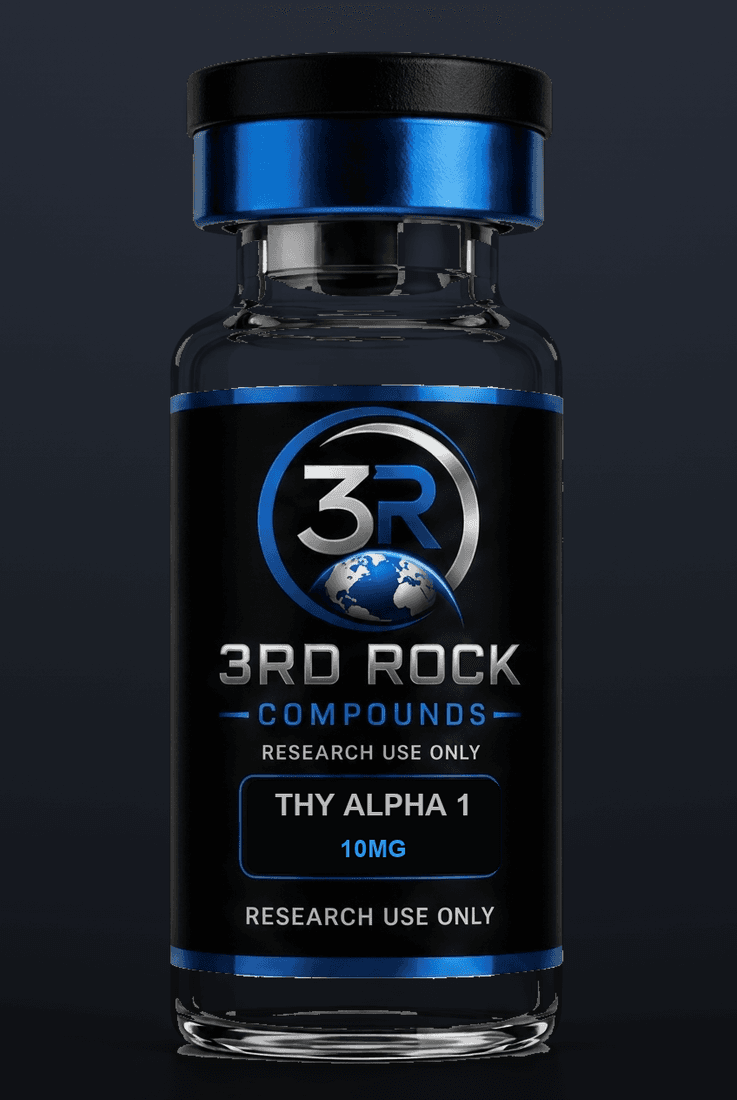
Front label
Research Compounds | >99.80% purity
THY ALPHA 1 10MG
- Thymalfasin
- Zadaxin
- Tα1
- Talpha1
- Alpha1-thymosin
Thymosin Alpha 1 (Tα1), also known as thymalfasin (trade name Zadaxin ), is a highly conserved, 28-amino acid immunomodulatory polypeptide originally isolated from calf thymus tissue in 1977 by Dr.
$99
Lot
T26C709
Purity (HPLC-UV/VIS)
>99.80%
Reported
2/24/2026
Lab
Vanguard Laboratory
Issued by Vanguard Laboratory, A2LA #6377.01.01. Testing was commissioned by our fulfilment partner on the material we ship; the certificate names that party, not 3rd Rock Compounds.
Quantity
THY ALPHA 1 10MG
1 vial · $99
- Third-party HPLC tested
- Lot-matched certificate
- Same-day fulfilment before 2pm
- Shipping 2–4 business days
Identifiers
- CAS number
- 62304-98-7 (also 69440-99-9, 69521-94-4)
- Molecular formula
- C₁₂₉H₂₁₅N₃₃O₅₅
- Molecular weight
- 3108.3 Da
- PubChem CID
- 16130571
- Sequence
- Ac-SDAAVDTSSEITTKDLKEKKEVVEEAEN-OH (28 aa)
Mechanism of Action
Tα1 is the N-terminal fragment (residues 1–28) of the larger precursor protein prothymosin alpha (ProTα), an acidic nuclear protein of 109–111 amino acids involved in chromatin remodeling and cell proliferation. ProTα is cleaved by the lysosomal enzyme legumain (δ-secretase) to release the bioactive Tα1 peptide. [3]
Structural Conformation: In aqueous solution, Tα1 is intrinsically unstructured (disordered). Upon interaction with negatively charged membranes (especially those exposing phosphatidylserine) or organic solvents, it adopts a structured conformation with an α-helix from residues 14–26 and two double β-turns in the N-terminal residues. [8]
2. Primary Receptor Targets
Tα1 functions as a pleiotropic modulator by interacting with pattern recognition receptors (PRRs) and specific membrane components:
- TLR9 and TLR2 Agonist: Signals through TLR9 in plasmacytoid dendritic cells (pDCs) and TLR2 in myeloid dendritic cells (mDCs). [4]
- Membrane Interaction: N-terminal inserts into hydrophobic regions of cell membranes, particularly those exposing phosphatidylserine (PS) (found on apoptotic cells), triggering signal transduction.
- Hyaluronic Acid (HA) Interaction: C-terminal “LKEKK” motif interacts electrostatically with HA, potentially interfering with CD44/RHAMM binding and suppressing tumor progression.
3. Downstream Signaling Cascades
A. MyD88 → TRAF6 → IKK → NF-κB (Immune Activation):
TLR9/TLR2 stimulation recruits the adaptor protein MyD88, activating TRAF6 → IKK complex → NF-κB transcription factor, promoting cytokine gene expression (IL-2, IFN-γ, IL-12). Often involves atypical PKC. [4] [10]
B. p38 MAPK / JNK (DC Maturation):
Tα1 induces phosphorylation of p38 MAPK and JNK (c-Jun N-terminal kinase). The p38 MAPK pathway is critical for dendritic cell maturation and production of Th1-priming cytokines. [11]
C. cAMP / PKC (Anti-Apoptosis in Thymocytes):
In thymocytes, Tα1 antagonizes steroid-induced apoptosis by stimulating cAMP production and activating PKC-dependent pathways.
D. IDO1 Pathway → Immune Tolerance:
Through TLR9 and Type I interferon receptor signaling, Tα1 induces IDO1 in dendritic cells, activating tryptophan catabolism (kynurenines), which promotes generation of regulatory T cells (Tregs) — inducing immune tolerance and dampening excessive inflammation/cytokine storms. [12]
🔑 Dual Role: Tα1 uniquely provides both immune activation (NF-κB, MAPK → cytokines, T-cell maturation) AND immune tolerance (IDO1 → Tregs), depending on the immunological context. This dual capacity is central to its clinical versatility.
The product supplied here is for research use only regardless of regulatory status of related formulations.
4. Cellular and Tissue-Level Effects
- Promotes functional maturation, increasing expression of HLA-DR, CD86, and CD40
- Stimulates IL-12 production → drives Th1 phenotype (antiviral/antitumor) [4]
- Can also promote tolerance via IDO1 pathway [12]
T-Cells:
- Promotes differentiation of stem cells into thymocytes
- Increases activated CD4+ and CD8+ T cell numbers
- Antagonizes glucocorticoid-induced apoptosis in immature thymocytes
- Activates complement receptor (CR)-mediated phagocytosis (via actin/vinculin recruitment), distinct from Fc receptor mechanisms [13]
- Dose-dependent response at 50–100 ng/mL
Tumor Cells:
- Upregulates MHC Class I expression, making tumors more visible to cytotoxic T cells
- Can directly inhibit cell proliferation in certain cancer lines
- Enhances NK cell activity and function [5]
5. Selectivity and Cross-Reactivity
Tα1 acts as a “regulator of regulators” — modulating the sensitivity of TLRs to other stimuli (e.g., viral antigens) rather than solely acting as a direct agonist. It is highly conserved across mammalian species (human, bovine, porcine, ovine). [5]
Distinct from Thymosin Beta-4 (TB-500): While Tα1 focuses on adaptive/innate immune modulation (TLR/T-cell maturation), TB-500 is primarily an actin-sequestering protein involved in cell motility, wound healing, and tissue repair.
6. Pharmacokinetics
| Parameter | Value |
|---|---|
| Route | Subcutaneous (standard) |
| Peak Serum Levels | 1–2 hours post-SC injection |
| Half-Life (T½) | ~2 hours |
| Urinary Excretion | 31–60% of administered dose |
| Dose-Response | Proportional Cmax/AUC for 0.8–6.4 mg single / 1.6–16 mg multiple |
| Accumulation | No evidence of accumulation with repeated dosing |
| Albumin Binding | C-terminal residues 11–20 bind HSA (carrier) |
Preclinical Research Findings
Tα1 is most established for chronic Hepatitis B (CHB) and Hepatitis C (CHC). Clinical data demonstrates induction of HBeAg seroconversion, ALT normalization, and viral suppression, with synergistic effects when combined with interferon-alpha or nucleoside analogs. [5]
🎯 Oncology (Solid Tumors)
Research demonstrates efficacy in malignant melanoma, hepatocellular carcinoma (HCC), and NSCLC. Tα1 is used as an adjuvant to chemotherapy (e.g., dacarbazine) or immunotherapy (e.g., ipilimumab), reducing tumor growth, increasing survival, and mitigating chemo-induced toxicity. [14] [15]
🏥 Sepsis
In severe sepsis, Tα1 reverses immunosuppression by upregulating HLA-DR expression on monocytes and preventing lymphocyte apoptosis. The ETASS trial (n=361) showed 26% vs 35% mortality (P=0.049). [16]
🦠 COVID-19 / SARS
During the COVID-19 pandemic, Tα1 was used in severe cases to restore lymphocytopenia and reverse T-cell exhaustion. A Wuhan retrospective study (n=76) showed observed effects on immune markers in research settings. [17]
💉 HIV/AIDS
Studied as adjunct to HAART, facilitating immune reconstitution by increasing CD4+ T-cell counts and sjTRECs (markers of thymic output). [18]
💉 Vaccine Adjuvant
Enhances immunogenicity of influenza, H1N1, and HBV vaccines, particularly in immunocompromised populations (elderly, hemodialysis study subjects). In hemodialysis study subjects, 89% vs 53% seroconversion with H1N1 vaccine (P<0.01). [19]
🫁 Cystic Fibrosis (CF)
Tα1 has shown potential to correct maturation/activity of mutated F508del-CFTR protein while simultaneously reducing lung inflammation, though reproducibility has been debated. [20]
🍄 Fungal & Bacterial Infections
Activates dendritic cells for Th1 resistance against invasive aspergillosis and enhances resistance to Pseudomonas in bone marrow transplant settings. [4]
🔬 Autoimmune Diseases
study subjects with psoriatic arthritis, rheumatoid arthritis, and SLE exhibit lower serum Tα1 levels. Administration may restore immune homeostasis and regulate inflammation. [21]
Safety Profile
Findings summarised above derive from in-vitro and animal studies. No safety profile for human use is established or implied, and none is offered here.
Handle as a laboratory reagent: avoid inhalation and contact, reconstitute under aseptic conditions, and observe the storage conditions below.
For research use only. Not for human consumption.
Shipping and Storage
- Supplied as lyophilised powder in a sealed vial.
- Store at 2–8°C (36–46°F). Protect from light.
- Same-day fulfilment on orders before 2pm; shipping 2–4 business days.
- For research use only. Not for human consumption.
References
- [1]Dominari A, Hathaway III D, Pandav K, et al. Thymosin alpha 1: A comprehensive review of the literature. World J Virol, 9(5), 67-78, 2020.
- [2]Goldstein AL, Low TL, McAdoo M, et al. Thymosin alpha1: Isolation and sequence analysis of an immunologically active thymic polypeptide. Proc Natl Acad Sci USA, 74(2), 725-729, 1977.
- [3]Li J, Liu CH, Wang FS. Thymosin alpha 1: biological activities, applications and genetic engineering production. Peptides, 31(11), 2151-2158, 2010.
- [4]Romani L, Bistoni F, Gaziano R, et al. Thymosin alpha 1 activates dendritic cells for antifungal Th1 resistance through toll-like receptor signaling. Blood, 103(11), 4232-4239, 2004. PubMed →
- [5]King R, Tuthill C. Immune Modulation with Thymosin Alpha 1 research application. Vitamins and Hormones, 102, 151-178, 2016. PubMed →
- [6]Pica F, Chimenti MS, Gaziano R, et al. Serum thymosin alpha 1 levels in study subjects with chronic inflammatory autoimmune diseases. Clin Exp Immunol, 186(1), 39-45, 2016.
- [7]FDA. Certain Bulk Drug Substances for Use in Compounding that May Present Significant Tolerability Concerns. U.S. Food and Drug Administration, 2025. fda.gov →
- [8]Elizondo-Riojas MA, Chamow SM, Tuthill CW, et al. NMR structure of human thymosin alpha-1. Biochem Biophys Res Commun, 416(3-4), 356-61, 2011.
- [9]Billich A. Thymosin alpha1. SciClone Pharmaceuticals. Curr Opin Investig Drugs, 3(5), 698-707, 2002. PubMed →
- [10]Garaci E. Thymosin alpha1: a historical overview. Ann N Y Acad Sci, 1112, 14-20, 2007. PubMed →
- [11]Tao N, Xu X, Ying Y, et al. Thymosin alpha1 and Its Role in Viral Infectious Diseases: The Mechanism and Clinical Application. Molecules, 28(8), 3539, 2023.
- [12]Romani L, Bistoni F, Perruccio K, et al. Thymosin alpha1 activates dendritic cell tryptophan catabolism and establishes a regulatory environment for balance of inflammation and tolerance. Blood, 108(7), 2265-74, 2006.
- [13]Serafino A, Pica F, Andreola F, et al. Thymosin alpha1 Activates Complement Receptor-Mediated Phagocytosis in Human Monocyte-Derived Macrophages. J Innate Immun, 6(1), 72-88, 2014.
- [14]Maio M, Mackiewicz A, Testori A, et al. Large randomized study of thymosin alpha 1, interferon alfa, or both in combination with dacarbazine in study subjects with metastatic melanoma. J Clin Oncol, 28(10), 1780-1787, 2010.
- [15]Costantini C, Bellet MM, Pariano M, et al. A Reappraisal of Thymosin Alpha1 in Cancer Therapy. Front Oncol, 9, 873, 2019.
- [16]Wu J, Zhou L, Liu J, et al. The efficacy of thymosin alpha 1 for severe sepsis (ETASS): a multicenter, single-blind, randomized and controlled trial. Critical Care, 17(1), R8, 2013. PubMed →
- [17]Liu Y, Pan Y, Hu Z, et al. Thymosin alpha-1 Reduces the Mortality of Severe Coronavirus Disease 2019 by Restoration of Lymphocytopenia and Reversion of Exhausted T Cells. Clin Infect Dis, 71(16), 2150-2157, 2020. PubMed →
- [18]Matteucci C, Grelli S, Balestrieri E, et al. Thymosin alpha 1 and HIV-1: recent advances and future perspectives. Future Microbiol, 12, 141-155, 2017.
- [19]Carraro G, Naso A, Montomoli E, et al. Thymosin-alpha 1 (Zadaxin) enhances the immunogenicity of an adjuvanted pandemic H1N1v influenza vaccine. Vaccine, 30(11), 2001-2004, 2012.
- [20]Romani L, Oikonomou V, Moretti S, et al. Thymosin alpha1 represents a potential potent single-molecule-based experimental protocol for cystic fibrosis. Nat Med, 23(5), 590-600, 2017.
- [21]Pica F, Chimenti MS, Gaziano R, et al. Serum thymosin alpha 1 levels in chronic inflammatory autoimmune diseases. Clin Exp Immunol, 186(1), 39-45, 2016.
- [22]Peng R, Xu C, Zheng H, et al. Modified Thymosin Alpha 1 Distributes and Inhibits the Growth of Lung Cancer in Vivo. ACS Omega, 5(18), 10374-10381, 2020.
- [23]Garaci E, Mastino A, Pica F, Favalli C. Combination research application using thymosin alpha 1 and interferon after cyclophosphamide is able to experimental endpoint Lewis lung carcinoma in mice. Cancer Immunol Immunother, 36(5), 355-359, 1993.
- [24]Simonova MA, Ivanov I, Shoshina NS, et al. Aging and Thymosin Alpha-1. Int J Mol Sci, 26(23), 11470, 2025.
Entries without a link have no DOI or PubMed identifier in the source record. The reference is reproduced as given; every link that does appear has been checked and resolves to the work it names.
17 references carry an identifier in our record that resolves to a different paper. We have withheld those links rather than send you to the wrong work, and we do not substitute one we cannot verify.