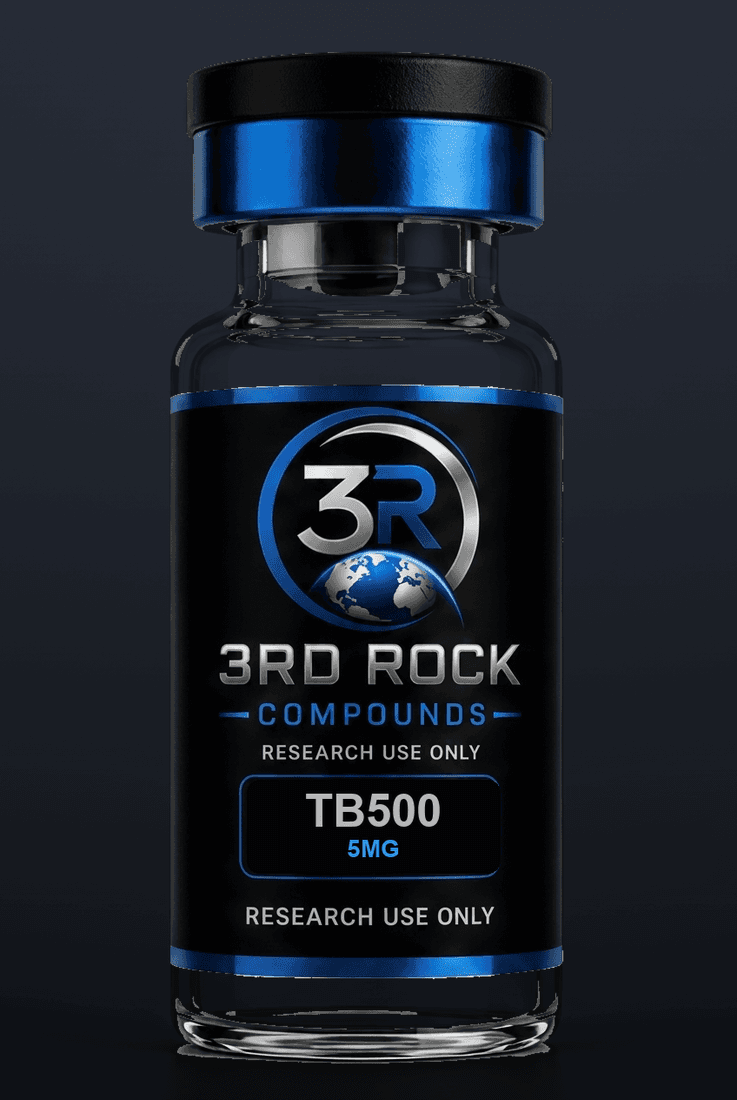
Front label
Repair & Recovery | Research use only
TB500 5MG
- Fequesetide
- Thymosin β4 fragment (17-23)
- N-acetylated LKKTETQ
TB-500 is a synthetic heptapeptide consisting of the N-terminal acetylated fragment (amino acids 17–23) of the naturally occurring protein Thymosin Beta-4 (Tβ4).
$48
Certificate of analysis available on request
We have not yet published a third-party certificate for this compound. Contact us for the current lot's documentation before ordering.
Quantity
TB500 5MG
1 vial · $48
- Third-party HPLC tested
- Lot-matched certificate
- Same-day fulfilment before 2pm
- Shipping 2–4 business days
Identifiers
- CAS number
- 885340-08-9
- Molecular formula
- C₃₈H₆₈N₁₀O₁₄
- Molecular weight
- 889.018 g/mol
- Sequence
- Ac-LKKTETQ
Mechanism of Action
Primary Target: G-Actin Sequestration
The fundamental molecular target of TB-500 is monomeric globular actin (G-actin). The LKKTETQ motif binds G-actin in a 1:1 stoichiometric complex, sequestering monomeric actin and preventing its uncontrolled polymerization into filamentous actin (F-actin).[6] By regulating actin polymerization, TB-500 modulates cytoskeletal organization — the prerequisite for cell motility and migration essential for tissue repair.[9]
ATP Synthase Interaction
Tβ4 (and potentially its active fragments) interacts with F1-F0 ATP synthase on the surface of endothelial cells, binding the beta-subunit with a dissociation constant (KD) of approximately 12 nM. This interaction increases cell surface ATP levels, which is necessary for purinergic receptor signaling involved in cell migration.[10]
ILK-PINCH-Akt Pathway (Cell Survival)
TB-500 forms a functional complex with Integrin-Linked Kinase (ILK) and PINCH (Particularly Interesting New Cys-His protein). This complex leads to phosphorylation and activation of Akt (Protein Kinase B), specifically Akt2 in endothelial cells, promoting cell survival and cardiomyocyte protection following ischemic injury.[11][12]
NF-κB Pathway (Anti-Inflammatory)
TB-500 modulates inflammation by interrupting the NF-κB signal transduction pathway. It blocks phosphorylation and nuclear translocation of the RelA/p65 subunit, suppressing transcription of pro-inflammatory cytokines IL-8, IL-1β, and TNF-α.[13][14]
Matrix Metalloproteinase (MMP) Upregulation
The peptide increases production of Matrix Metalloproteinases (MMP-2 and MMP-9), enzymes necessary for degrading the basement membrane to facilitate cell migration during angiogenesis and wound repair.[15]
Antioxidant Enzyme Upregulation
TB-500 upregulates manganese superoxide dismutase (Mn-SOD), copper/zinc SOD, and catalase, providing cytoprotection against oxidative stress.[16]
TB-500 vs. Full-Length Thymosin Beta-4
A critical distinction: the anti-fibrotic properties of Tβ4 are largely attributed to the N-terminal tetrapeptide Ac-SDKP (amino acids 1–4), which is not present in TB-500. Ac-SDKP inhibits hematopoietic stem cell proliferation and reduces fibrosis by interfering with TGF-β signaling. Therefore, TB-500 retains the actin-binding and migratory properties but may lack the specific anti-fibrotic signaling of the full-length protein.[7]
Additionally, recent research (Rahaman et al., 2024) suggests that TB-500's metabolite Ac-LKKTE may be the primary wound-healing driver rather than the parent peptide itself.[17]
Preclinical Research Findings
In laboratory research, TB-500 and its parent molecule Tβ4 are investigated in multiple experimental paradigms:
- Dermal Wound Healing — Accelerated repair of full-thickness dermal wounds in diabetic (db/db) and aged mouse models. Promoted keratinocyte migration, collagen deposition, and reduced scar tissue formation.[8][18]
- Corneal Repair and Dry Eye — Improved signs and symptoms of moderate-to-severe dry eye and neurotrophic keratopathy. Promoted corneal epithelial cell migration and reduced ocular inflammation. Demonstrated efficacy in healing corneal defects from chemical burns and ethanol exposure.[19][20]
- Cardiovascular Models — In myocardial ischemia models, reduced infarct size, preserved cardiac function, and promoted angiogenesis. Facilitated mobilization and differentiation of epicardial progenitor cells.[11][21]
- Musculoskeletal Recovery — Investigated for accelerating muscle, tendon, and ligament injury recovery. Promoted myoblast migration and tenocyte proliferation in tendon transection models.[22]
- Neuroprotection and CNS Repair — Neuroprotective in models of traumatic brain injury, stroke, and multiple sclerosis. Promoted oligodendrocyte differentiation and remyelination. Suppressed Toll-like receptor pro-inflammatory signaling.[23]
- Liver and Kidney Fibrosis — Attenuated liver fibrosis and acute liver injury (ethanol/CCl₄ models) by suppressing oxidative stress, blocking NF-κB, and inhibiting hepatic stellate cell activation.[24][25]
- Hair Growth — The actin-binding domain (TB-500 region) has been identified as an active site for promoting hair growth in preclinical models.[3]
- Metabolite-Driven Wound-Healing Profiling — Investigated for the activity of its enzymatic metabolites (Ac-LKKTE, Ac-LKK, Ac-LK), with 2024 work suggesting the metabolite series rather than the parent peptide may be the operative wound-healing driver in fibroblast assays.[17]
- Anti-inflammatory Cytokine Profiling — Examined for capacity to interrupt NF-kappaB-mediated transcription of IL-1beta, IL-8, and TNF-alpha in stress-loaded epithelial and immune cell lines, supporting research designs that bridge cytoskeletal and inflammatory signaling.[13][14]
Comparative Research Context
TB-500 is most directly compared in the cytoskeletal-peptide research literature with the full-length parent Thymosin beta-4 for the actin-binding versus anti-fibrotic activity split, with BPC-157 for parallel pleiotropic tissue-repair coverage, and with GHK-Cu for matrix-remodeling and angiogenic crosstalk. These cross-comparisons inform research designs investigating whether the LKKTETQ minimal motif suffices to recapitulate the parent's broader regenerative profile.[7]
Safety Profile
Findings summarised above derive from in-vitro and animal studies. No safety profile for human use is established or implied, and none is offered here.
Handle as a laboratory reagent: avoid inhalation and contact, reconstitute under aseptic conditions, and observe the storage conditions below.
For research use only. Not for human consumption.
Shipping and Storage
- Supplied as lyophilised powder in a sealed vial.
- Store at 2–8°C (36–46°F). Protect from light.
- Same-day fulfilment on orders before 2pm; shipping 2–4 business days.
- For research use only. Not for human consumption.
References
- [1]Esposito S, Deventer K, Goeman J, Van der Eycken J, Van Eenoo P. Synthesis and characterization of the N-terminal acetylated 17-23 fragment of thymosin beta 4 identified in TB-500. Drug Testing and Analysis. 2012;4(9):733-738. DOI →
- [2]Delcourt V, Garcia P, Chabot B, Bailly-Chouriberry L. TB500/TB1000 and SGF1000: A scientific approach for a better understanding of misbranded and adulterated drugs. Drug Testing and Analysis. 2022;14(12):1963-1969.
- [3]Goldstein AL, Hannappel E, Sosne G, Kleinman HK. Thymosin β4: a multi-functional regenerative peptide. Basic properties and clinical applications. Expert Opinion on Biological Therapy. 2012;12(1):37-51. DOI →
- [4]U.S. Food and Drug Administration. Certain Bulk Drug Substances for Use in Compounding that May Present Significant Safety Risks. FDA.gov. Updated July 8, 2025. fda.gov →
- [5]World Anti-Doping Agency. The 2025 Prohibited List. WADA. January 1, 2025. wada-ama.org →
- [6]Xing Y, Ye Y, Zuo H, Li Y. Progress on the Function and Application of Thymosin β4. Frontiers in Endocrinology. 2021;12:767785. DOI →
- [7]Bock-Marquette I, Maar K, Maar S, et al. Thymosin beta-4 denotes new directions towards developing prosperous anti-aging regenerative therapies. International Immunopharmacology. 2023;116:109741. DOI →
- [8]Philp D, Badamchian M, Scheremeta B, Nguyen M, Goldstein AL, Kleinman HK. Thymosin β4 and a synthetic peptide containing its actin-binding domain promote dermal wound repair in db/db diabetic mice and in aged mice. Wound Repair and Regeneration. 2003;11(1):19-24. DOI →
- [9]Belsky JB, Rivers EP, Filbin MR, Lee PJ, Morris DC. Thymosin beta 4 regulation of actin in sepsis. Expert Opinion on Biological Therapy. 2018;18(sup1):193-197. DOI →
- [10]Hinkel R, El-Aouni C, Olson T, et al. Thymosin beta4 is an essential paracrine factor of embryonic endothelial progenitor cell-mediated cardioprotection. Circulation. 2008;117(17):2232-2240. DOI →
- [11]Bock-Marquette I, Saxena A, White MD, Dimaio JM, Srivastava D. Thymosin beta4 activates integrin-linked kinase and promotes cardiac cell migration, survival and cardiac repair. Nature. 2004;432(7016):466-472. DOI →
- [12]Smart N, Risebro CA, Melville AA, et al. Thymosin β4 induces adult epicardial progenitor mobilization and neovascularization. Nature. 2007;445(7124):177-182. DOI →
- [13]Sosne G, Kleinman HK. Primary Mechanisms of Thymosin β4 Repair Activity in Dry Eye Disorders and Other Tissue Injuries. Investigative Ophthalmology & Visual Science. 2015;56(9):5110-5117. DOI →
- [14]Reyes-Gordillo K, Shah R, Popratiloff A, et al. Thymosin-β4 (Tβ4) Blunts PDGF-Dependent Phosphorylation and Binding of AKT to Actin in Hepatic Stellate Cells. American Journal of Pathology. 2011;178(5):2100-2108. DOI →
- [15]Malinda KM, Sidhu GS, Mani H, et al. Thymosin beta 4 accelerates wound healing. Journal of Investigative Dermatology. 1999;113(3):364-368. DOI →
- [16]Shah R, Reyes-Gordillo K, Cheng Y, et al. Thymosin β4 Prevents Oxidative Stress, Inflammation, and Fibrosis in Ethanol- and LPS-Induced Liver Injury in Mice. Oxidative Medicine and Cellular Longevity. 2018;2018:9630175. DOI →
- [17]Rahaman KA, Muresan AR, Min H, et al. Simultaneous quantification of TB-500 and its metabolites by UHPLC-Q-Exactive orbitrap MS/MS and their screening by wound healing activities in-vitro. Journal of Chromatography B. 2024;1235:124033. DOI →
- [18]Malinda KM, Sidhu GS, Mani H, et al. Thymosin beta 4 accelerates wound healing. Journal of Investigative Dermatology. 1999;113(3):364-368. DOI →
- [19]Sosne G, Ousler GW. Thymosin beta 4 ophthalmic solution for dry eye: a randomized, placebo-controlled, Phase II clinical trial. Clinical Ophthalmology. 2015;9:877-884. DOI →
- [20]Sosne G, Dunn SP, Kim C. Thymosin β4 Significantly Improves Signs and Symptoms of Severe Dry Eye in a Phase 2 Randomized Trial. Cornea. 2015;34(5):491-496. DOI →
- [21]Bao W, Ballard VL, Needle S, et al. Cardioprotection by systemic dosing of thymosin beta four following ischemic myocardial injury. Frontiers in Pharmacology. 2013;4:149. DOI →
- [22]Treadwell T, Kleinman HK, Crockford D, et al. The regenerative peptide thymosin β4 accelerates the rate of dermal healing in preclinical animal models and in patients. Annals of the New York Academy of Sciences. 2012;1270:37-44. DOI →
- [23]Nguyen J, Verma S, Vuong VT, et al. Engineered Tandem Thymosin Peptide Promotes Corneal Wound Healing. Investigative Ophthalmology & Visual Science. 2025;66(14):31. DOI →
- [24]Sosne G, Qiu P, Goldstein AL, Wheater M. Biological activities of thymosin beta 4 defined by active sites in short peptide sequences. The FASEB Journal. 2010;24(7):2144-2151. DOI →
- [25]Ho EN, Kwok WH, Lau MY, et al. Doping control analysis of TB-500 in equine urine and plasma by liquid chromatography-mass spectrometry. Journal of Chromatography A. 2012;1265:57-69. DOI →
- [26]Kwok WH, Leung GN, Wan TS, et al. Doping control analysis of seven peptide hormones in horse plasma and urine by liquid chromatography-mass spectrometry. Analytical and Bioanalytical Chemistry. 2013;405:2653-2667.
- [27]Smart N, Risebro CA, Melville AA, et al. Thymosin β4 induces adult epicardial progenitor mobilization and neovascularization. Nature. 2007;445(7124):177-182. DOI →
- [28]RegeneRx Biopharmaceuticals. Phase I Safety Trial for RGN-352: Injectable Thymosin Beta 4. 2009. fiercebiotech.com →
- [29]Treadwell T, Kleinman HK, Crockford D, et al. The regenerative peptide thymosin β4 accelerates dermal healing. Annals of the New York Academy of Sciences. 2012;1270:37-44. DOI →
Entries without a link have no DOI or PubMed identifier in the source record. The reference is reproduced as given; every link that does appear has been checked and resolves to the work it names.
1 reference carries an identifier in our record that resolves to a different paper. We have withheld those links rather than send you to the wrong work, and we do not substitute one we cannot verify.