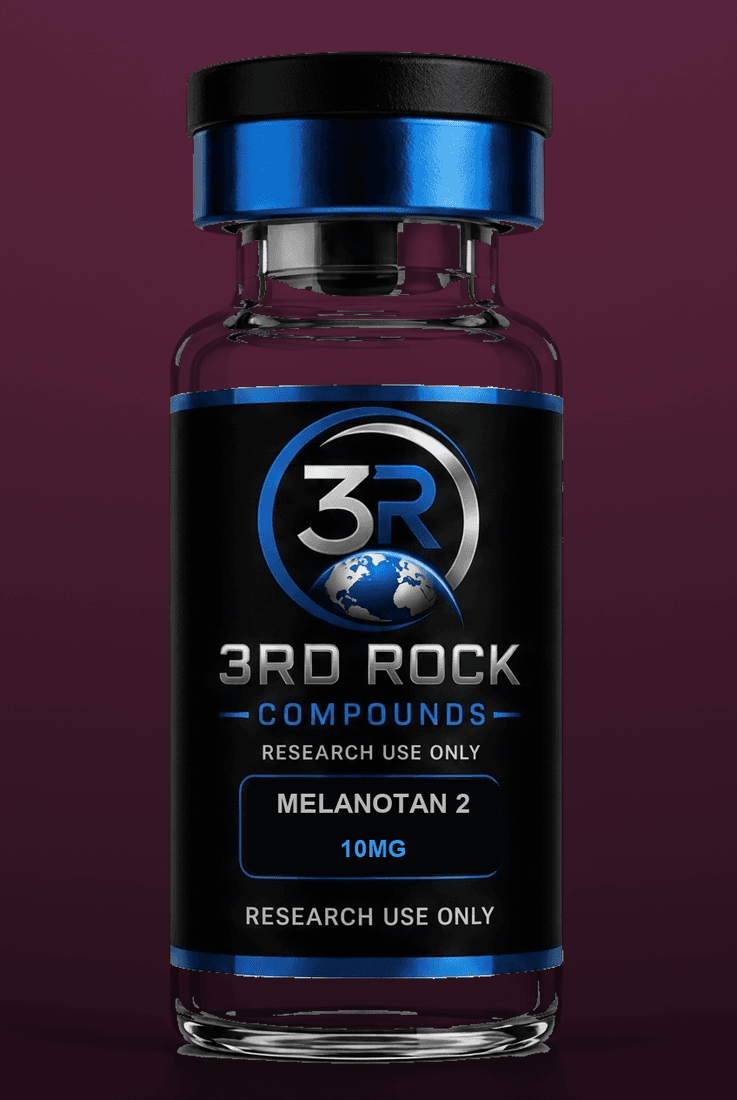
Front label
Cosmetic & Other | 99.49% purity
MELANOTAN 2 10MG
Melanotan II (MT-II) is a synthetic, cyclic heptapeptide analog of the endogenous hormone α-melanocyte-stimulating hormone (α-MSH), with the sequence Ac-Nle-c[Asp-His-D-Phe-Arg-Trp-Lys]-NH₂.
$55
Lot
—
Purity (HPLC-UV/VIS)
99.49%
Reported
—
Lab
Kovera Labs
Issued by Kovera Labs. Testing was commissioned by our fulfilment partner on the material we ship; the certificate names that party, not 3rd Rock Compounds.
Quantity
MELANOTAN 2 10MG
1 vial · $55
- Third-party HPLC tested
- Lot-matched certificate
- Same-day fulfilment before 2pm
- Shipping 2–4 business days
Identifiers
- CAS number
- 121062-08-6
- Molecular formula
- C₅₀H₆₉N₁₅O₉
- Molecular weight
- 1024.18 Da
- PubChem CID
- 92432
- Sequence
- Ac-Nle-c[Asp-His-D-Phe-Arg-Trp-Lys]-NH₂
Mechanism of Action
Melanocortin Receptor Binding
MT-II is a non-selective agonist at four of five melanocortin receptors (MCRs), all members of the GPCR superfamily:
| Receptor | Primary Location | Function When Activated | Affinity |
|---|---|---|---|
| MC1R | Melanocytes (skin) | Eumelanin synthesis → tanning/photoprotection | High |
| MC3R | Hypothalamus, NAcc | Energy homeostasis, feeding behavior | Ki ~1.3 nM |
| MC4R | Hypothalamus (PVN), spinal cord | Erectile function, appetite suppression, thermogenesis | Ki ~1.1 nM |
| MC5R | Exocrine glands, lymphocytes | Sebum production, immune modulation | Moderate |
| MC2R | Adrenal cortex | ACTH receptor — NO MT-II binding | None |
Primary Signaling: cAMP-PKA Pathway
Upon MCR binding, MT-II activates Gs-coupled adenylate cyclase → increased intracellular cAMP → PKA activation:[2]
- Melanogenesis (MC1R): PKA → CREB phosphorylation → MITF transcription → tyrosinase upregulation → eumelanin production
- Erectile function (MC4R/CNS): Hypothalamic PVN activation → dopaminergic/oxytocinergic downstream → neuronal NO release → intracavernosal pressure increase[5]
- Appetite suppression (MC3R/MC4R): Hypothalamic MCR activation → reduced food intake + increased thermogenesis[6]
- Social behavior (MC4R): Selective nucleus accumbens activation → oxytocin-dependent social learning[7]
Off-Target: Mast Cell Activation
MT-II cross-reacts with MRGPRB2/MRGPRX2 receptors on mast cells, causing pseudo-allergic histamine release → H1 receptor activation → hypothermia (in mice). Subcutaneous dosing reduces histamine release by 63% vs. intraperitoneal.[8]
Receptor Conformational Bias
The cyclic D-Phe7 substitution stabilizes the beta-turn conformation of the core His-Phe-Arg-Trp pharmacophore, producing a ligand profile that resembles ago-allosteric modulation rather than pure orthosteric agonism. This conformational bias has been studied for its differential coupling efficiency across the MC1R/MC3R/MC4R/MC5R receptor subtypes, particularly with respect to sustained Gs/cAMP signaling versus transient receptor internalization.[2]
Central versus Peripheral Effect Compartmentalization
MT-II's blood-brain-barrier permeability separates it pharmacologically from the linear parent peptide afamelanotide, which engages predominantly peripheral MC1R for melanogenesis without robust CNS entry. As a result, MT-II preclinical models can interrogate combined peripheral (skin pigment, exocrine gland) and central (hypothalamic feeding/erectile, nucleus-accumbens social-behavior) MCR pharmacology in a single compound — a property leveraged extensively in melanocortin behavioral neuroscience.[7][11]
vs. Related Compounds
| Compound | Structure | BBB | Key Difference |
|---|---|---|---|
| MT-II | Cyclic heptapeptide | Yes | Non-selective MCR agonist; tanning + erectogenic + anorexigenic |
| Melanotan I (Afamelanotide) | Linear [Nle⁴,D-Phe⁷]-α-MSH | No | Tanning only (peripheral MC1R); no CNS effects; TGA/EMA approved for EPP |
| Bremelanotide (PT-141) | Deaminated MT-II metabolite | Yes | FDA-approved (Vyleesi) for HSDD; reduced tanning activity |
| α-MSH (native) | Linear tridecapeptide | Limited | Short half-life; rapidly degraded; weak potency |
Preclinical Research Findings
Melanotan II research spans dermatology, sexual medicine, neuroendocrinology, oncology, and behavioral neuroscience across 7+ indication categories:
- Skin Pigmentation & Photoprotection — MC1R stimulation → eumelanin synthesis → tanning without UV exposure; as few as 5 low doses induced visible tanning in Phase I trials.[1]
- Sexual Dysfunction — 80% of men with psychogenic ED achieved clinically apparent erections (0.025 mg/kg SC); tip rigidity >80% for 38 min vs 3 min placebo (p=0.0045); enhanced proceptive behaviors in female rats.[3][9]
- Metabolic Regulation & Obesity — Central MC3R/MC4R activation: intraabdominal fat -35% (low dose) to -55% (high dose); iBAT thermogenesis 3-fold increase; appetite suppression via NAcc.[6][10]
- Autism & Social Behavior — Sociability index increased from 3.1 to 26.3 (p<0.0001) in MIA autism model mice; oxytocin-dependent NAcc activation in social contexts; partner preference facilitation in prairie voles.[11][7]
- Neuroprotection & Nerve Regeneration — 20 µg/kg SC every 48h enhanced sensory function recovery in rat sciatic nerve crush model.[12]
- Addiction Research — Synergistic augmentation of naltrexone to reduce binge-like ethanol intake in mice.[13]
- Oncology — Topical MT-II suppressed melanoma tumor growth via MC1R → PTEN upregulation + COX-2/PGE2 inhibition; systemic use carries melanoma risk.[14]
- Receptor-Subtype Selectivity Profiling — Investigated as a non-selective tool ligand to dissect the relative contributions of MC1R, MC3R, MC4R, and MC5R signaling in animal models, often paired with subtype-selective antagonists (SHU 9119, JKC 363) to isolate individual receptor pharmacology.[2][5]
- Mast-Cell-Crosstalk Studies — Examined for off-target activation of MRGPRB2/MRGPRX2 receptors and the ensuing pseudo-allergic histamine release, supporting research into peptide-induced mast-cell activation as a confound or independent endpoint in dermatology models.[8]
Comparative Research Context
Within the melanocortin-system research literature, MT-II is most directly compared with KPV (PepT1 entry, anti-inflammatory) for the receptor-binding versus intracellular-target distinction, with afamelanotide for the central-permeable cyclic versus peripheral-only linear structural class, and with the deaminated metabolite Bremelanotide (PT-141) for differential receptor-affinity profiles. These cross-comparisons inform research designs investigating the boundary between MCR engagement and downstream behavioral/dermatological output.[3]
Safety Profile
Findings summarised above derive from in-vitro and animal studies. No safety profile for human use is established or implied, and none is offered here.
Handle as a laboratory reagent: avoid inhalation and contact, reconstitute under aseptic conditions, and observe the storage conditions below.
For research use only. Not for human consumption.
Shipping and Storage
- Supplied as lyophilised powder in a sealed vial.
- Store at 2–8°C (36–46°F). Protect from light.
- Same-day fulfilment on orders before 2pm; shipping 2–4 business days.
- For research use only. Not for human consumption.
References
- [1]Dorr RT, Lines R, Levine N, et al. Evaluation of melanotan-II, a superpotent cyclic melanotropic peptide in a pilot phase-I clinical study. Life Sciences. 1996;58(20):1777-1784. DOI →
- [2]Hadley ME, Dorr RT. Melanocortin peptide therapeutics: Historical milestones, clinical studies and commercialization. Peptides. 2006;27(4):921-930.
- [3]Wessells H, Fuciarelli K, Hansen J, et al. Synthetic melanotropic peptide initiates erections in men with psychogenic erectile dysfunction: Double-blind, placebo controlled crossover study. The Journal of Urology. 1998;160(2):389-393.
- [4]FDA Warning Letters regarding unauthorized marketing of Melanotan products.
- [5]Vemulapalli R, Kurowski S, Salisbury B, et al. Activation of central melanocortin receptors by MT-II increases cavernosal pressure in rabbits by the neuronal release of NO. British Journal of Pharmacology. 2001;134(8):1705-1710. DOI →
- [6]Côté I, et al. Activation of the central melanocortin system chronically reduces body mass without the necessity of long-term caloric restriction. Canadian Journal of Physiology and Pharmacology. 2017.
- [7]Ford CL, McDonough AA, Horie K, Young LJ. Melanocortin agonism in a social context selectively activates nucleus accumbens in an oxytocin-dependent manner. Neuropharmacology. 2024;247:109848. DOI →
- [8]Jain S, Panyutin A, Liu N, et al. Melanotan II causes hypothermia in mice by activation of mast cells and stimulation of histamine 1 receptors. American Journal of Physiology-Endocrinology and Metabolism. 2018;315(3):E357-E366. DOI →
- [9]Wessells H, Levine N, Hadley ME, Dorr RT, Hruby VJ. Effect of an alpha-melanocyte stimulating hormone analog on penile erection and sexual desire in men with organic erectile dysfunction. Urology. 2000;56(4):641-646. DOI →
- [10]Eliason NL, Martin L, Low MJ, Sharpe AL. Melanocortin receptor agonist melanotan-II microinjected in the nucleus accumbens decreases appetitive and consumptive responding for food. Neuropeptides. 2022;96:102289. DOI →
- [11]Minakova E, Lang J, Medel-Matus JS, et al. Melanotan-II reverses autistic features in a maternal immune activation mouse model of autism. PLoS ONE. 2019;14(1):e0210389. DOI →
- [12]Ter Laak MP, et al. Melanotan II promotes peripheral nerve regeneration in a rat sciatic nerve crush model. 2003.
- [13]Evans-Brown M, Dawson RT, Chandler MD, McVeigh J. Use of melanotan I and II in the general population. BMJ. 2009;338:b566. DOI →
- [14]Wu JC, Tsai HE, Hsiao YH, et al. Topical MTII Therapy Suppresses Melanoma Through PTEN Upregulation and Cyclooxygenase II Inhibition. International Journal of Molecular Sciences. 2020;21(2):681. DOI →
- [15]Dreyer BA, Amer T, Fraser M. Melanotan-induced priapism: a hard-earned tan. BMJ Case Reports. 2019;12(2):e227644. DOI →
- [16]Nelson ME, Bryant SM, Aks SE. Melanotan II injection resulting in systemic toxicity and rhabdomyolysis. Clinical Toxicology. 2012;50(10):1169-1173. DOI →
- [17]Peters B, Hadimeri H, Wahlberg R, Afghahi H. Melanotan II: a possible cause of renal infarction. CEN Case Reports. 2020;9(2):159-161. DOI →
- [18]Sivyer GW. Dermatological changes with melanotan II use in a FAMMM patient. Dermatology Practical & Conceptual. 2012.
- [19]Ryakhovsky VV, Khachiyan GA, Kosovova NF, et al. The first preparative solution phase synthesis of melanotan II. Beilstein Journal of Organic Chemistry. 2008;4:39. DOI →
- [20]Hjuler KF, Lorentzen HF. Melanoma associated with the use of melanotan-II. Dermatology. 2014;228(1):34-36. PubMed →
- [21]Giuliano F, Clement P, Droupy S, et al. Melanotan-II: Investigation of the inducer and facilitator effects on penile erection in anaesthetized rat. Neuroscience. 2006;138(1):293-301. DOI →
- [22]Li G, Zhang Y, Wilsey JT, Scarpace PJ. Unabated anorexic and enhanced thermogenic responses to melanotan II in diet-induced obese rats. Journal of Endocrinology. 2004;182(1):123-132. DOI →
- [23]King SH, et al. Melanocortin Receptors, Melanotropic Peptides and Penile Erection. Current Topics in Medicinal Chemistry. 2007;7(11):1111-1119.
- [24]Wessells H, Levine N, Hadley ME, Dorr RT, Hruby VJ. Melanocortin receptor agonists, penile erection, and sexual motivation: human studies with Melanotan II. International Journal of Impotence Research. 2000;12(Suppl 4):S74-S79. DOI →
Entries without a link have no DOI or PubMed identifier in the source record. The reference is reproduced as given; every link that does appear has been checked and resolves to the work it names.
1 reference carries an identifier in our record that resolves to a different paper. We have withheld those links rather than send you to the wrong work, and we do not substitute one we cannot verify.