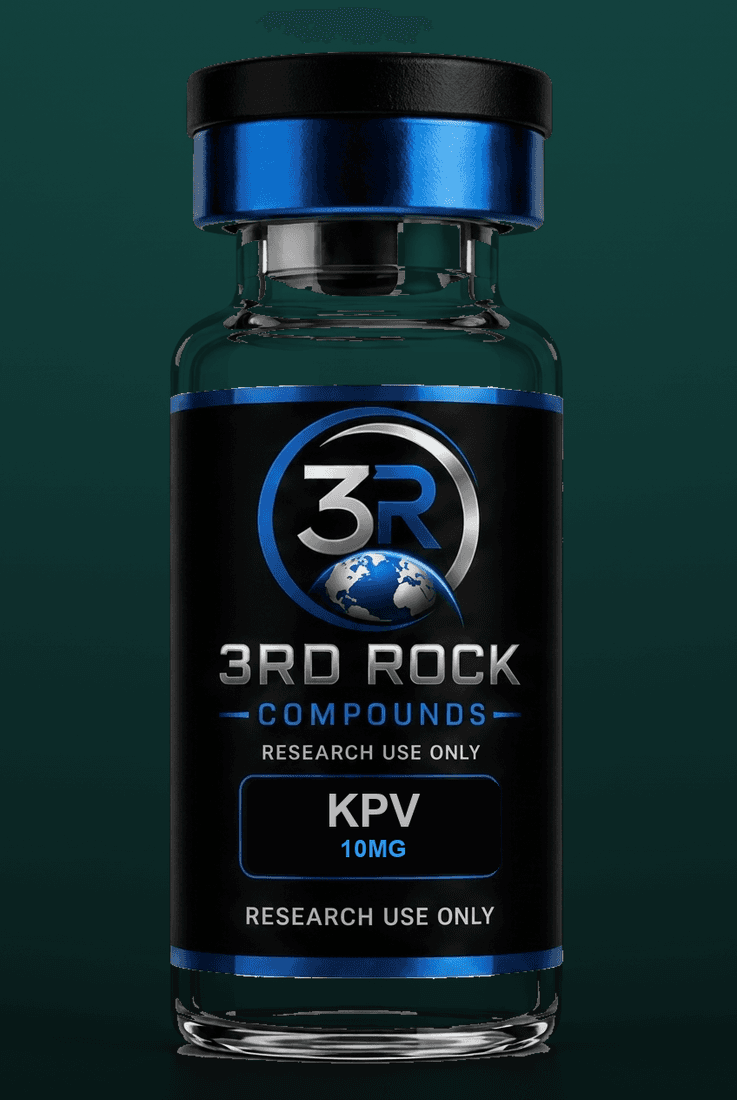
Front label
Repair & Recovery | 99.74% purity
KPV 10MG
- α-MSH(11-13)
- KPV peptide
KPV is a naturally occurring tripeptide composed of Lysine-Proline-Valine, derived from the C-terminal fragment (amino acids 11–13) of α-melanocyte-stimulating hormone (α-MSH).
$55
Lot
—
Purity (HPLC-UV/VIS)
99.74%
Reported
—
Lab
Kovera Labs
Issued by Kovera Labs. Testing was commissioned by our fulfilment partner on the material we ship; the certificate names that party, not 3rd Rock Compounds.
Quantity
KPV 10MG
1 vial · $55
- Third-party HPLC tested
- Lot-matched certificate
- Same-day fulfilment before 2pm
- Shipping 2–4 business days
Identifiers
- CAS number
- 107715-88-8
- Molecular formula
- C₁₆H₃₀N₄O₄
- Molecular weight
- 342.44 g/mol (378.47 for Ac-KPV-NH₂)
- Sequence
- KPV
Mechanism of Action
PepT1-Mediated Cellular Entry (Primary Mechanism)
Unlike its parent α-MSH — which acts through G-protein coupled melanocortin receptors (MC1R–MC5R) — KPV enters cells via the proton-coupled oligopeptide transporter PepT1 (SLC15A1). In human intestinal epithelial cells (Caco2-BBE), PepT1 transports KPV with a Km of ~160 µM; in Jurkat T-cells, Km ≈ 700 µM.[3][4]
Importin-α3 Binding (Intracellular Target)
Once internalized, KPV binds Importin-α3 (Imp-α3) at armadillo domains 7–8, physically blocking the nuclear import of NF-κB p65RelA — preventing it from entering the nucleus to transcribe pro-inflammatory genes.[10][11]
NF-κB Pathway Inhibition (Dual Mechanism)
KPV inhibits NF-κB through two complementary actions: (1) stabilizing IκBα by preventing its phosphorylation and degradation, and (2) blocking p65RelA nuclear translocation via Importin-α3 binding. This dual mechanism provides robust suppression of inflammatory gene transcription at concentrations as low as 10 nM.[10][12]
MAPK Pathway Inhibition
KPV inhibits phosphorylation and activation of three major MAP kinases: ERK1/2, JNK, and p38 — reducing pro-inflammatory cytokine production induced by TNFα and other stimuli.[13]
mTORC1 Activation
KPV activates mTORC1 (mechanistic target of rapamycin complex 1), evidenced by increased phosphorylation of p70 S6K at T389 — suggesting a role in translational control and cell growth recovery during inflammation.[14]
Calcium Signaling (Keratinocytes)
In human keratinocytes, KPV elevates intracellular Ca²⁺ concentrations via an adenosine agonist-dependent pathway — distinct from the cAMP pathway used by α-MSH in other tissues.[14]
α-MSH vs. KPV: Key Distinctions
| Feature | α-MSH (Parent) | KPV (Fragment) |
|---|---|---|
| Structure | 13 amino acids (tridecapeptide) | 3 amino acids (C-terminal tripeptide) |
| Primary Entry | Binds MC1R–MC5R (cell surface) | Transported by PepT1 (intracellular) |
| Second Messenger | Increases cAMP | Does NOT increase cAMP; ↑ Ca²⁺ in keratinocytes |
| Pigmentation | Induces melanogenesis | No pigmentation effect |
| Inflammation | Inhibits IκBα degradation | Inhibits IκBα + blocks p65 nuclear import via Importin-α3 |
PepT1-Inflammation Crosstalk
An additional research interest is the upregulation of PepT1 expression in inflamed colonic epithelium relative to healthy mucosa, which has been hypothesized to provide an inflammation-targeted enrichment mechanism for KPV uptake. This positions PepT1 not only as a transporter but as a contextual amplifier of the peptide's local concentration at sites of active inflammation.[3][23]
Importin-alpha3 / Nuclear-Import Specificity
The Importin-alpha3 binding site investigated for KPV is distinct from the Importin-alpha1/alpha5 carriers used by other transcription factors, suggesting that the peptide can attenuate p65/RelA nuclear translocation without indiscriminately blocking nuclear import of other regulatory proteins. This selectivity hypothesis underlies its experimentally observed favorable therapeutic-index profile.[10][11]
Preclinical Research Findings
KPV demonstrates potent anti-inflammatory activity across diverse tissue models, with unusually favorable therapeutic index given its nanomolar potency:
- Inflammatory Bowel Disease / Colitis — Oral KPV in drinking water reduces DSS/TNBS-induced colitis (MPO reduced ~50%, weight loss attenuated). HA-nanoparticle delivery achieves 12,000-fold potency increase over free peptide. PepT1-dependent mechanism confirmed in KO mice.[3][6][15]
- Dermatological Inflammation — Topical KPV reduces psoriasis symptoms (>8 hours relief vs 3 hours hydrocortisone), atopic/contact dermatitis without skin atrophy or steroid side effects. Patent case studies document human efficacy.[9][16]
- Corneal and Cutaneous Wound Healing — Accelerated re-epithelialization in rabbit corneal wounds (topical, 4x daily) and oral mucositis (KPV@PPP_E hydrogel) with tissue morphology restoration.[17][18]
- Antimicrobial Activity — Active against S. aureus and C. albicans at picomolar to micromolar range. Dimeric form [CKPV]₂ shows enhanced candidacidal activity.[19][20]
- Arthritis and Joint Inflammation — Reduced joint swelling, cartilage destruction, and PMN leukocyte infiltration in crystal-induced peritonitis models.[21]
- Pulmonary Inflammation — Inhibits MMP-9 activity, reduces eotaxin and IL-8 secretion in bronchial epithelial cells exposed to TNFα or RSV.[22]
- Colitis-Associated Cancer — KPV prevented AOM/DSS-induced carcinogenesis in WT mice but not PepT1-KO mice, confirming PepT1-dependent anti-tumorigenic mechanism.[23]
- Vascular Calcification — Self-assembled KPV/rapamycin nanodrugs inhibit vascular calcification via anti-inflammatory + autophagy pathways.[24]
- Transdermal Delivery Methodology — Investigated via iontophoretic delivery across microporated human skin to quantify percutaneous flux parameters relevant to topical anti-inflammatory peptide formulation research.[26]
- PepT1-Mediated Inflammation Profiling — Examined for the inverse relationship between mucosal PepT1 expression and inflammatory state, supporting a research model in which KPV uptake is enriched at sites of active disease activity.[23]
Comparative Research Context
Within the alpha-MSH-derived peptide research literature, KPV is most directly compared with Melanotan II for the receptor versus PepT1 entry distinction, with BPC-157 for parallel mucosal cytoprotection in colitis models, and with LL-37 for companion antimicrobial-and-anti-inflammatory profiles.[2]
Safety Profile
Findings summarised above derive from in-vitro and animal studies. No safety profile for human use is established or implied, and none is offered here.
Handle as a laboratory reagent: avoid inhalation and contact, reconstitute under aseptic conditions, and observe the storage conditions below.
For research use only. Not for human consumption.
Shipping and Storage
- Supplied as lyophilised powder in a sealed vial.
- Store at 2–8°C (36–46°F). Protect from light.
- Same-day fulfilment on orders before 2pm; shipping 2–4 business days.
- For research use only. Not for human consumption.
References
- [1]Sikiric P, et al. A new gastric juice peptide, BPC. An overview of the stomach-stress-organoprotection hypothesis. Journal of Physiology-Paris. 1993;87(5):313-327. DOI →
- [2]Brzoska T, Luger TA, Maaser C, Abels C, Böhm M. Alpha-melanocyte-stimulating hormone and related tripeptides: biochemistry, antiinflammatory and protective effects in vitro and in vivo, and future perspectives. Endocrine Reviews. 2008;29(5):581-602. DOI →
- [3]Dalmasso G, Charrier-Hisamuddin L, Nguyen HTT, Yan Y, Sitaraman S, Merlin D. PepT1-Mediated Tripeptide KPV Uptake Reduces Intestinal Inflammation. Gastroenterology. 2008;134(1):166-178. DOI →
- [4]Laroui H, Dalmasso G, Nguyen HT, Yan Y, Sitaraman SV, Merlin D. Drug-loaded nanoparticles targeted to the colon with polysaccharide hydrogel reduce colitis in a mouse model. Gastroenterology. 2010;138:843-853. DOI →
- [5]U.S. Food and Drug Administration. Certain Bulk Drug Substances for Use in Compounding that May Present Significant Safety Risks. FDA.gov. Updated 2023. fda.gov →
- [6]Xiao B, Xu Z, Viennois E, Zhang Y, Zhang Z, Zhang M, Han MK, Kang Y, Merlin D. Orally Targeted Delivery of Tripeptide KPV via Hyaluronic Acid-Functionalized Nanoparticles Efficiently Alleviates Ulcerative Colitis. Molecular Therapy. 2017;25(7):1628-1640. DOI →
- [7]Hiltz ME, Lipton JM. Antiinflammatory activity of a COOH-terminal fragment of the neuropeptide alpha-MSH. FASEB Journal. 1989;3:2282-2284. DOI →
- [8]Luger TA, Brzoska T. α-MSH related peptides: a new class of anti-inflammatory and immunomodulating drugs. Annals of the Rheumatic Diseases. 2007;66(Suppl 3):iii52-iii55. DOI →
- [9]Lipton JM, Catania AP. Use of KPV tripeptide for dermatological disorders. U.S. Patent No. 6,894,028 B2. 2005. patents.google.com →
- [10]Getting SJ, Schiöth HB, Perretti M. Dissection of the anti-inflammatory effect of the core and C-terminal (KPV) alpha-melanocyte-stimulating hormone peptides. Journal of Pharmacology and Experimental Therapeutics. 2003;306(2):631-637. DOI →
- [11]Kelly JM, Moir AJG, Carlson KE, Haycock JW. Immobilized alpha-melanocyte stimulating hormone 10-13 (GKPV) inhibits tumor necrosis factor-alpha stimulated NF-kappaB activity. Peptides. 2006;27(3):431-437.
- [12]Land SC. Inhibition of cellular and systemic inflammation cues in human bronchial epithelial cells by melanocortin-related peptides. International Journal of Physiology, Pathophysiology and Pharmacology. 2012;4(2):59-73. PubMed →
- [13]Elliott RJ, Szabo M, Wagner MJ, Kemp EH, MacNeil S, Haycock JW. alpha-Melanocyte-stimulating hormone, MSH 11-13 KPV and adrenocorticotropic hormone signalling in human keratinocyte cells. Journal of Investigative Dermatology. 2004;122(4):1010-1019.
- [14]Songok AC, Panta P, Doerrler WT, Macnaughtan MA, Taylor CM. Structural modification of the tripeptide KPV by reductive glycoalkylation of the lysine residue. PLOS One. 2018;13(6):e0199686. DOI →
- [15]Kannengiesser K, Maaser C, Heidemann J, et al. Melanocortin-derived tripeptide KPV has anti-inflammatory potential in murine models of inflammatory bowel disease. Inflammatory Bowel Diseases. 2008;14(3):324-331. DOI →
- [16]Böhm M, Luger T. Are melanocortin peptides future therapeutics for cutaneous wound healing? Experimental Dermatology. 2019;28:219-224.
- [17]Bonfiglio V, et al. Effects of the COOH-terminal tripeptide alpha-MSH(11-13) on corneal epithelial wound healing: role of nitric oxide. Experimental Eye Research. 2006;83(6):1366-1372. DOI →
- [18]Shao W, Chen R, Lin G, Ran K, Zhang Y, Yang J, Xu H. In situ mucoadhesive hydrogel capturing tripeptide KPV: the anti-inflammatory, antibacterial and repairing effect on chemotherapy-induced oral mucositis. Biomaterials Science. 2022;10:227-242. DOI →
- [19]Cutuli M, Cristiani S, Lipton JM, Catania A. Antimicrobial effects of alpha-MSH peptides. Journal of Leukocyte Biology. 2000;67(2):233-239. DOI →
- [20]Catania A, et al. Three-dimensional structure of the α-MSH-derived candidacidal peptide [Ac-CKPV]2. The Journal of Peptide Research. 2005;66(1):19-26. DOI →
- [21]Charnley M, Moir AJG, Douglas CWI, Haycock JW. Anti-microbial action of melanocortin peptides and identification of a novel X-Pro-d/l-Val sequence in Gram-positive and Gram-negative bacteria. Peptides. 2008;29(6):1004-1009.
- [22]Land SC, et al. KPV inhibits MMP-9 activity and reduces eotaxin and IL-8 secretion in bronchial epithelial cells. International Journal of Physiology, Pathophysiology and Pharmacology. 2012;4(2):59-73. PubMed →
- [23]Viennois E, et al. Critical Role of PepT1 in Promoting Colitis-Associated Cancer and Therapeutic Benefits of the Anti-inflammatory PepT1-Mediated Tripeptide KPV in a Murine Model. Cellular and Molecular Gastroenterology and Hepatology. 2016;2(3):340-357. DOI →
- [24]Wu Y, et al. KPV and RAPA Self-Assembled into Carrier-Free Nanodrugs for Vascular Calcification Therapy. Advanced Healthcare Materials. 2024.
- [25]Catania A, et al. Inhibitory effects of the peptide (CKPV)2 on endotoxin-induced host reactions. The Journal of Surgical Research. 2006;131.
- [26]Pawar K, Kolli CS, Rangari NS, Babu RJ. Transdermal Iontophoretic Delivery of Lysine-Proline-Valine (KPV) Peptide Across Microporated Human Skin. Journal of Pharmaceutical Sciences. 2017;106(7):1814-1820.
Entries without a link have no DOI or PubMed identifier in the source record. The reference is reproduced as given; every link that does appear has been checked and resolves to the work it names.
5 references carry an identifier in our record that resolves to a different paper. We have withheld those links rather than send you to the wrong work, and we do not substitute one we cannot verify.