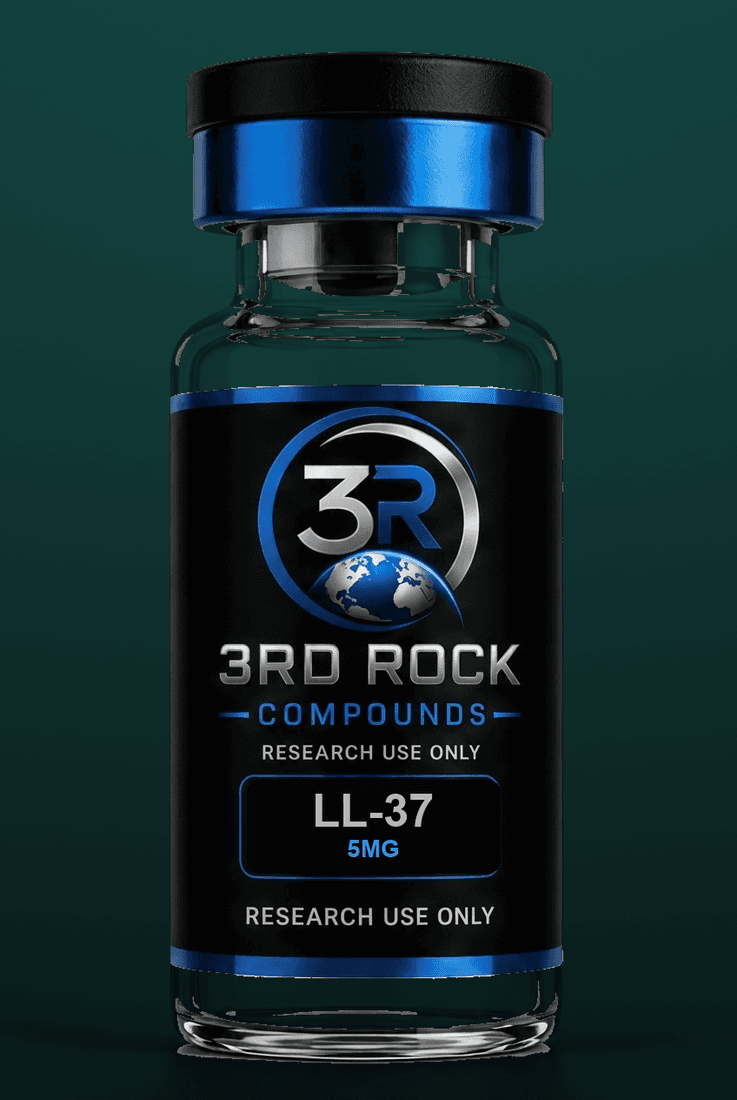
Front label
Repair & Recovery | >99.80% purity
LL-37 5MG
LL-37 is the only member of the cathelicidin family identified in humans — a 37-residue cationic, amphipathic α-helical antimicrobial peptide (AMP) with the sequence LLGDFFRKSKEKIGKEFKRIVQRIKDFLRNLVPRTES.
$80
Lot
L26C602
Purity (HPLC-UV/VIS)
>99.80%
Reported
2/19/2026
Lab
Vanguard Laboratory
Issued by Vanguard Laboratory, A2LA #6377.01.01. Testing was commissioned by our fulfilment partner on the material we ship; the certificate names that party, not 3rd Rock Compounds.
Quantity
LL-37 5MG
1 vial · $80
- Third-party HPLC tested
- Lot-matched certificate
- Same-day fulfilment before 2pm
- Shipping 2–4 business days
Identifiers
- CAS number
- Not established
- Molecular formula
- C₂₀₅H₃₄₀N₆₀O₅₃
- Molecular weight
- 4493.33 Da
- PubChem CID
- 16198951
- Sequence
- LLGDFFRKSKEKIGKEFKRIVQRIKDFLRNLVPRTES
Mechanism of Action
Primary Antimicrobial: "Carpet-Like" Membrane Disruption
LL-37 disrupts bacterial membranes via electrostatic attraction to anionic bacterial surfaces → hydrophobic insertion → toroidal pore formation or micellization ("carpet-like" mechanism). It acts preferentially on Gram-negative bacteria but is effective against both Gram-positive and drug-resistant strains. Eukaryotic membranes are protected by high cholesterol content.[3][7]
Receptor Targets
| Receptor | Type | Functional Effect |
|---|---|---|
| FPR2/FPRL1 | GPCR | Chemotaxis of neutrophils, monocytes, T cells (Yang et al., 2000)[8] |
| P2X7 | Purinergic | IL-1β processing; neutrophil survival (Elssner et al., 2004)[8] |
| EGFR | Receptor Tyrosine Kinase | Transactivation → keratinocyte migration → wound healing (Tokumaru et al., 2005)[9] |
| IGF-1R | Receptor Tyrosine Kinase | Partial agonist → proliferation (Girnita et al., 2012)[10] |
| CXCR2 | Chemokine | Functional ligand on neutrophils (Zhang et al., 2009)[8] |
| MrgX2 | GPCR | Mast cell degranulation (Subramanian et al., 2011)[8] |
| TLR9 | Toll-like Receptor | DNA-LL-37 complexes trigger endosomal TLR9 (Lande et al., 2007)[10] |
Downstream Signaling Cascades
- ERK1/2 and p38 MAPK: Crucial for keratinocyte migration and wound healing; modulates cytokine production in monocytes.[9]
- PI3K/Akt → CREB: Cell survival signaling via P2X7–SFK–Akt pathway in keratinocytes.[9]
- mTOR: Activation suppresses autophagy in pancreatic cancer → ROS accumulation → DNA damage.[11]
- NF-κB: Inhibits p50/p65 translocation in inflammation (anti-inflammatory); may activate in some cancers (context-dependent).[8]
Anti-Biofilm Activity
Inhibits quorum-sensing (Las/Rhl systems) and promotes twitching motility; effective at sub-MIC concentrations (0.5 µg/mL) — far below bactericidal thresholds.[7]
LPS Neutralization
Binds and neutralizes lipopolysaccharide (LPS) through high-affinity hydrophobic interaction with the lipid-A acyl chains, preventing endotoxin-induced TLR4/MD-2 dimerization, macrophage activation, and downstream cytokine storm in research models of Gram-negative sepsis.[12]
Biphasic Dose-Response
LL-37 exhibits a distinct bell-shaped dose response: ≤1 µM = anti-apoptotic, pro-healing; >10 µM = cytotoxic. In clinical trials, 0.5 mg/mL was 6-fold more effective than placebo, while the highest dose (3.2 mg/mL) showed no improvement.[5]
vs. Related Compounds
| Compound | Key Difference |
|---|---|
| hCAP18 | Inactive 18 kDa precursor; LL-37 is the active C-terminal domain released by proteolysis |
| KR-12 | Truncated fragment (residues 18–29); retains antimicrobial activity with less cytotoxicity |
| D-LL-37 | Protease-resistant enantiomer; retains antimicrobial and anti-biofilm activity |
| CRAMP (mouse) | Murine ortholog; functional homology but non-identical sequence |
Preclinical Research Findings
LL-37 research spans antimicrobial resistance, wound healing, oncology, and immunology across 8+ indication categories:
- Chronic Wound Healing — Promotes granulation tissue, re-epithelialization, and angiogenesis in venous leg ulcers (VLUs) and diabetic foot ulcers (DFUs).[5][13]
- Antimicrobial Resistance — Broad-spectrum activity against MDR bacteria; anti-biofilm; synergy with conventional antibiotics (azithromycin, colistin, ciprofloxacin, vancomycin).[7]
- Oncology (Dual Role) — Anti-tumorigenic: colon, gastric, and pancreatic cancer (apoptosis, autophagy suppression, immune reprogramming). Pro-tumorigenic: breast, lung, ovarian, and melanoma (context-dependent).[11][10]
- Antiviral Research — RSV, Influenza A, HSV-1, HIV-1 — disrupts viral envelopes and blocks entry.[3]
- Antifungal Research — Active against Candida albicans and Cryptococcus neoformans via membrane permeabilization.[3]
- Sepsis/Endotoxemia — LPS neutralization prevents endotoxin-induced macrophage activation and cytokine storms.[12]
- Bone Regeneration — Stimulates proliferation and osteogenic differentiation of BMSCs; recruits MSCs to injury sites.[14]
- Drug Delivery Systems — Lipid nanoparticles, chitosan nanoparticles, hydrogels for improved stability and reduced cytotoxicity.[15]
- Bell-Shaped Dose-Response Profiling — Investigated for the biphasic concentration-response in which sub-micromolar exposures yield anti-apoptotic and pro-healing endpoints while supra-micromolar exposures shift toward cytotoxicity, informing concentration-window design in chronic-wound research.[5]
- Quorum-Sensing and Anti-Biofilm Studies — Examined for capacity to disrupt Pseudomonas aeruginosa Las/Rhl quorum-sensing networks at sub-MIC concentrations (~0.5 microg/mL), supporting research models that decouple biofilm-disruption activity from frank bactericidal kill curves.[7]
- Receptor Pleiotropy Mapping — Used as a tool ligand to investigate signaling at FPR2/FPRL1, P2X7, EGFR, IGF-1R, CXCR2, MrgX2, and TLR9, informing research into how a single host-defense peptide engages multiple parallel innate-immune and tissue-repair pathways.[8][9]
- Vitamin-D Axis Crosstalk — Studied as a downstream effector of vitamin-D-receptor activation in keratinocytes and macrophages, supporting research into how circulating 1,25-dihydroxyvitamin-D status modulates innate antimicrobial capacity.[6]
Comparative Research Context
Within the antimicrobial-peptide research literature, LL-37 is most directly compared with KPV for parallel anti-inflammatory and innate-immune profiles, with Thymosin alpha-1 for companion immunoregulatory mechanisms, and with BPC-157 for shared wound-healing and angiogenic crosstalk. These cross-comparisons inform research designs investigating whether host-defense peptides converge on a single integrative signaling node or operate through independent receptor-coupled pathways.[3]
Safety Profile
Findings summarised above derive from in-vitro and animal studies. No safety profile for human use is established or implied, and none is offered here.
Handle as a laboratory reagent: avoid inhalation and contact, reconstitute under aseptic conditions, and observe the storage conditions below.
For research use only. Not for human consumption.
Shipping and Storage
- Supplied as lyophilised powder in a sealed vial.
- Store at 2–8°C (36–46°F). Protect from light.
- Same-day fulfilment on orders before 2pm; shipping 2–4 business days.
- For research use only. Not for human consumption.
References
- [1]Johansson J, Gudmundsson GH, Rottenberg ME, et al. Conformation-dependent antibacterial activity of the naturally occurring human peptide LL-37. Journal of Biological Chemistry. 1998;273(6):3718-3724.
- [2]Gudmundsson GH, Agerberth B, Odeberg J, et al. The human gene FALL39 and processing of the cathelin precursor to the antibacterial peptide LL-37 in granulocytes. European Journal of Biochemistry. 1996;238(2):325-332. PubMed →
- [3]Ridyard KE, Overhage J. The Potential of Human Peptide LL-37 as an Antimicrobial and Anti-Biofilm Agent. Antibiotics. 2021;10(6):650. DOI →
- [4]Duplantier AJ, van Hoek ML. The Human Cathelicidin Antimicrobial Peptide LL-37 as a Potential Treatment for Polymicrobial Infected Wounds. Frontiers in Immunology. 2013;4:143. DOI →
- [5]Grönberg A, Mahlapuu M, Ståhle M, et al. Treatment with LL-37 is Safe and Effective in Enhancing Healing of Hard-to-Heal Venous Leg Ulcers: A Randomized, Placebo-Controlled Clinical Trial. Wound Repair and Regeneration. 2014;22(5):613-621. DOI →
- [6]Yang B, Good D, Mosaiab T, et al. Significance of LL-37 on Immunomodulation and Disease Outcome. BioMed Research International. 2020;2020:8349712. DOI →
- [7]Heilborn JD, Nilsson MF, Kratz G, et al. The cathelicidin anti-microbial peptide LL-37 is involved in re-epithelialization of human skin wounds and is lacking in chronic ulcer epithelium. Journal of Investigative Dermatology. 2003;120(3):379-389. DOI →
- [8]Scott MG, Davidson DJ, Gold MR, et al. The human antimicrobial peptide LL-37 is a multifunctional modulator of innate immune responses. The Journal of Immunology. 2002;169(7):3883-3891. DOI →
- [9]Svensson D, Nilsson BO. Human antimicrobial/host defense peptide LL-37 may prevent the spread of a local infection through multiple mechanisms: an update. Inflammation Research. 2025;74(1):36. DOI →
- [10]Piktel E, Niemirowicz K, Wnorowska U, et al. The Role of Cathelicidin LL-37 in Cancer Development. Archivum Immunologiae et Therapiae Experimentalis. 2016;64(1):33-46. DOI →
- [11]Zhang Z, Chen WQ, Zhang SQ, et al. The human cathelicidin peptide LL-37 inhibits pancreatic cancer growth by suppressing autophagy and reprogramming of the tumor immune microenvironment. Frontiers in Pharmacology. 2022;13:906625. DOI →
- [12]Lu F, Zhu Y, Zhang G, Liu Z. Renovation as innovation: Repurposing human antibacterial peptide LL-37 for cancer therapy. Frontiers in Pharmacology. 2022;13:944147. DOI →
- [13]Miranda E, Bramono K, Yunir E, et al. Efficacy of LL-37 cream in enhancing healing of diabetic foot ulcer: a randomized double-blind controlled trial. Archives of Dermatological Research. 2023;315(9):2623-2633. DOI →
- [14]Seil M, Nagant C, Dehaye JP, et al. Spotlight on Human LL-37, an Immunomodulatory Peptide with Promising Cell-Penetrating Properties. Pharmaceuticals. 2010;3(11):3435-3460. DOI →
- [15]Ergün FC, Kars MD, Kars G. Development and Characterization of LL37 Antimicrobial-Peptide-Loaded Chitosan Nanoparticles. Polymers. 2025;17(13):1884. DOI →
- [16]Mahlapuu M, Sidorowicz A, Mikosinski J, et al. Evaluation of LL-37 in healing of hard-to-heal venous leg ulcers: A multicentric prospective randomized placebo-controlled clinical trial. Wound Repair and Regeneration. 2021;29(6):938-950. DOI →
- [17]Ohuchi K, Ikawa T, Amagai R, et al. LL-37 Might Promote Local Invasion of Melanoma by Activating Melanoma Cells and Tumor-Associated Macrophages. Cancers. 2023;15(6):1678. DOI →
- [18]Miura S, Garcet S, Li X, et al. Cathelicidin Antimicrobial Peptide LL37 Induces Toll-Like Receptor 8 and Amplifies IL-36γ and IL-17C in Human Keratinocytes. Journal of Investigative Dermatology. 2023;143(5):832-841.e4. DOI →
- [19]Lin X, Wang R, Mai S. Advances in delivery systems for the therapeutic application of LL37. Journal of Drug Delivery Science and Technology. 2020;60(9):102016. DOI →
- [20]Wu WK, Wang G, Coffelt SB, et al. Emerging Roles of the Host Defense Peptide LL-37 in Human Cancer and its Potential Therapeutic Applications. International Journal of Cancer. 2010;127(8):1741-1747. DOI →
- [21]Alalwani SM, Sierigk J, Herr C, et al. The antimicrobial peptide LL-37 modulates the inflammatory and host defense response of human neutrophils. European Journal of Immunology. 2010;40(4):1118-1126. DOI →
- [22]Lozeau LD, Kole D, Dominko T, et al. Activity and toxicity of a recombinant LL37 antimicrobial peptide. Frontiers in Bioengineering and Biotechnology. 2016. DOI →
- [23]Wan W, Zhang L, Lin Y, et al. Mitochondria-derived peptide MOTS-c: effects and mechanisms related to stress, metabolism and aging. Journal of Translational Medicine. 2023;21(1):36. DOI →
- [24]M.D. Anderson Cancer Center. Induction of Antitumor Response in Melanoma Patients Using the Antimicrobial Peptide LL37. ClinicalTrials.gov Protocol NCT02225366. 2015. clinicaltrials.gov →
Entries without a link have no DOI or PubMed identifier in the source record. The reference is reproduced as given; every link that does appear has been checked and resolves to the work it names.
1 reference carries an identifier in our record that resolves to a different paper. We have withheld those links rather than send you to the wrong work, and we do not substitute one we cannot verify.