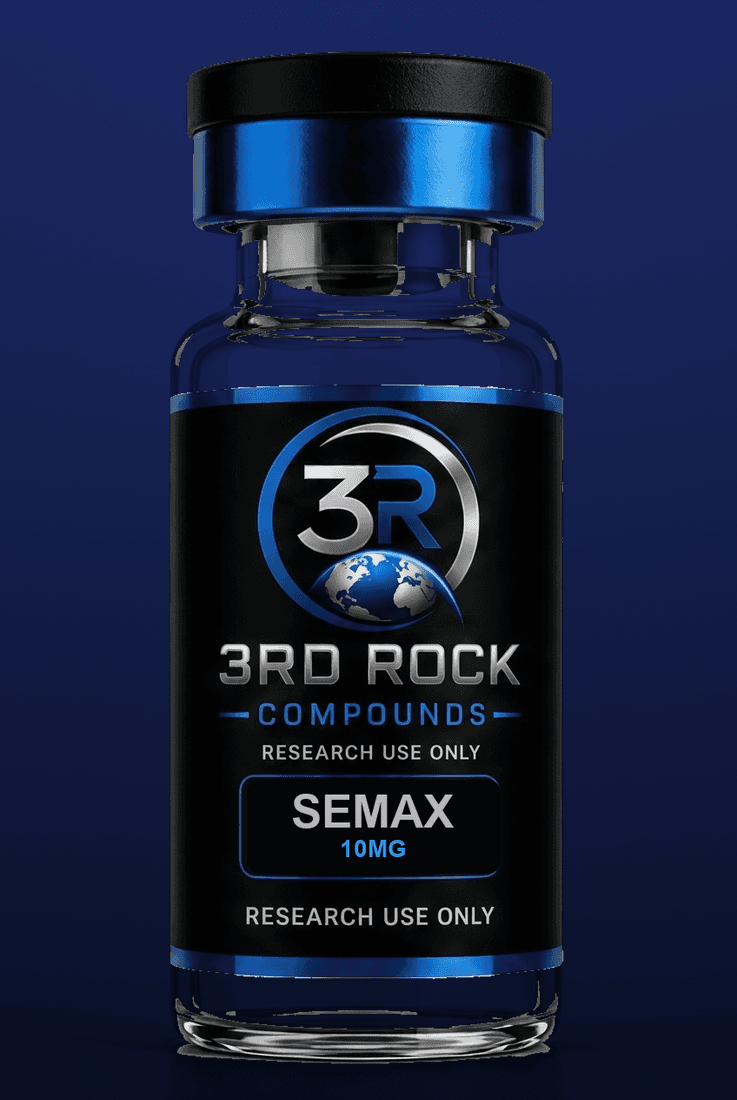
Front label
Cognitive | 99.05% purity
SEMAX 10MG
Semax (ACTH 4-7-PGP) is a synthetic heptapeptide (Met-Glu-His-Phe-Pro-Gly-Pro) derived from the N-terminal fragment of adrenocorticotropic hormone (ACTH).
$55
Lot
S26C703
Purity (HPLC-UV/VIS)
99.05%
Reported
3/2/2026
Lab
Vanguard Laboratory
Issued by Vanguard Laboratory, A2LA #6377.01.01. Testing was commissioned by our fulfilment partner on the material we ship; the certificate names that party, not 3rd Rock Compounds.
Quantity
SEMAX 10MG
1 vial · $55
- Third-party HPLC tested
- Lot-matched certificate
- Same-day fulfilment before 2pm
- Shipping 2–4 business days
Identifiers
- CAS number
- 80714-61-0
- Molecular formula
- C₃₇H₅₁N₉O₁₀S
- Molecular weight
- 813.93 Da
- Sequence
- MEHFPGP
Mechanism of Action
Receptor Targets and Binding
Specific binding sites for Semax have been identified in basal forebrain membranes. Binding is reversible, specific, and time-dependent, with a dissociation constant (Kd) of 2.4 ± 1.0 nM and maximal binding capacity (Bmax) of 33.5 ± 7.9 fmol/mg protein.[9] This binding strictly requires calcium ions (Ca²⁺) and is blocked by manganese ions (Mn²⁺), characteristic of G-protein-coupled receptor interactions.[10]
In receptor assays, Semax acts as a competitive antagonist of α-melanocyte-stimulating hormone (α-MSH) at the MC4 and MC5 melanocortin receptors. No antagonism was observed at MC3.[11] Additionally, Semax inhibits enzymes responsible for enkephalin degradation (IC50 = 10 μM).[12]
BDNF/TrkB Signaling Cascade
Semax stimulates tyrosine phosphorylation of TrkB receptors (the high-affinity receptor for BDNF), producing a 1.5–1.6-fold increase in TrkB phosphorylation in the hippocampus within 3 hours of administration.[9] In glial cell cultures, BDNF mRNA increased 8-fold and NGF mRNA 5-fold within 30 minutes.[13] In vivo, Semax increased hippocampal BDNF protein by 1.4-fold and exon III BDNF mRNA by 3-fold.[14]
Neurotransmitter Modulation
Semax activates the dopaminergic and serotonergic systems. It increases extracellular levels of 5-HIAA (a serotonin metabolite) in the striatum by approximately 25%.[1] While it does not alter basal dopamine levels alone, it significantly potentiates dopamine release induced by D-amphetamine.[1] Semax also regulates intracellular calcium homeostasis, preventing Ca²⁺ deregulation under glutamate excitotoxicity conditions.[10]
Gene Expression and Transcription
Genome-wide transcriptional analysis following ischemia-reperfusion demonstrated that Semax modulates 394 differentially expressed genes. It upregulates neurotransmission-related genes including Gpr6, Drd2, Hes5, and Gpr88, while downregulating pro-inflammatory genes such as Il1b, Il6, and Ccl6.[15][16]
Pharmacokinetic Paradox
Despite a relatively short plasma elimination half-life of approximately 1–2 hours, the experimental effects of a single intranasal dose persist for 20–24 hours.[5] Intranasal bioavailability is reported at 60–70%, with rapid CNS penetration across the blood-brain barrier.[17]
Active-Metabolite Pro-Drug Architecture
Once Semax enters circulation, peptidase activity progressively releases the C-terminal PGP tripeptide and intermediate fragments. Independent research has documented that the PGP fragment itself displays neuroprotective and anti-ulcer activity, providing a research framework in which the parent heptapeptide functions as both an active ligand and as a slow-release source of bioactive metabolites that prolong the apparent in-vivo signature beyond what plasma elimination kinetics would predict.[8]
Preclinical Research Findings
In laboratory research, Semax is utilized in multiple experimental paradigms:
- Ischemic Stroke and TIA Models — Registered in the Russian Federation for investigations related to acute ischemic stroke. Experimental readouts involve suppression of inflammatory genes and activation of neurotransmitter gene networks in the penumbra zone.[15][16]
- Cognitive Enhancement / Nootropic Paradigms — Studied for effects on memory consolidation and selective attention. In experimental protocols, a single intranasal dose produced measurable cognitive effects lasting 20–24 hours.[18]
- Optic Nerve Investigations — Experimental readouts involving optic nerve atrophy and glaucomatous neuropathy models demonstrate improved visual acuity, expanded visual field, and increased optic nerve electric sensitivity.[19]
- Neuroprotection and Oxidative Stress — In neuronal cultures, Semax demonstrated anti-apoptotic effects, protecting against glutamate neurotoxicity and oxidative stress. It contributes to mitochondrial stability and upregulates neurotrophin expression (BDNF, NGF).[9][14]
- Stress and Anxiety Models — In rodent models of chronic stress, Semax exhibited anxiolytic effects linked to modulation of dopaminergic and serotonergic systems and normalization of hippocampal BDNF levels. Corticosterone levels decreased 28–34%.[20]
- Alzheimer's Disease Models — In APP/PS1 transgenic mice, intranasal Semax reduced amyloid plaque count in cortex by 2.8-fold and hippocampus by 2.6-fold (p<0.0001), with restored cognitive function.[21]
- Spinal Cord Injury Models — Improved functional recovery scores via μ-opioid receptor (Oprm1) / USP18 / FTO pathway, inhibiting lysosomal membrane permeabilization and pyroptosis.[22]
- Gastric Ulcer Investigations — In a comparative study, ulcer healing was observed in 89.5% of subjects receiving Semax vs. 30.8% in the control group at day 14.[23]
- Immune System Modulation — Transcriptional analyses indicate Semax influences immunoglobulin and chemokine gene expression, with potential antiviral activity observed in experimental influenza models.[16]
Safety Profile
Findings summarised above derive from in-vitro and animal studies. No safety profile for human use is established or implied, and none is offered here.
Handle as a laboratory reagent: avoid inhalation and contact, reconstitute under aseptic conditions, and observe the storage conditions below.
For research use only. Not for human consumption.
Shipping and Storage
- Supplied as lyophilised powder in a sealed vial.
- Store at 2–8°C (36–46°F). Protect from light.
- Same-day fulfilment on orders before 2pm; shipping 2–4 business days.
- For research use only. Not for human consumption.
References
- [1]Eremin KO, Kudrin VS, Saransaari P, Oja SS, Grivennikov IA, Myasoedov NF, Rayevsky KS. Semax, an ACTH(4-10) Analogue with Nootropic Properties, Activates Dopaminergic and Serotoninergic Brain Systems in Rodents. Neurochemical Research. 2005;30(12):1493–1500. PubMed →
- [2]Potaman VN, Alfeeva LY, Kamensky AA, Levitzkaya NG, Nezavibatko VN. N-terminal degradation of ACTH(4-10) and its synthetic analog semax by the rat blood enzymes. Biochem Biophys Res Commun. 1991;176(2):741–746.
- [3]Ashmarin IP, Nezavibatko VN, Levitskaya NG, Koshelev VB, Kamensky AA. Design and investigation of an ACTH(4-10) analogue lacking D-amino acids and hydrophobic radicals. Neuroscience Research Communications. 1995;16(2):105–112.
- [4]Ashmarin IP, Nezavibatko VN, Myasoedov NF, et al. A nootropic adrenocorticotropin analog 4-10-semax (15 years experience in its design and study). Zhurnal Vysshei Nervnoi Deiatelnosti. 1997;47(2):420–430.
- [5]Gusev EI, Skvortsova VI, Chukanova EI. Semax in prevention of disease progress and development of exacerbations in patients with cerebrovascular insufficiency. Zhurnal Nevrologii i Psikhiatrii. 2005;105(2):35–40.
- [6]U.S. Food and Drug Administration. Bulk Drug Substances Used in Compounding Under Section 503B. FDA Compounding Database. 2023. fda.gov →
- [7]Gusev EI, Skvortsova VI, Myasoedov NF, et al. Effectiveness of Semax in acute period of hemispheric ischemic stroke. Zhurnal Nevrologii i Psikhiatrii. 1997;97(6):26–34.
- [8]Kolomin TA, Shadrina M, Slominsky P, Limborska SA, Myasoedov NF. A New Generation of Drugs: Synthetic Peptides Based on Natural Regulatory Peptides. Neuroscience and Medicine. 2013;4(4):223–252. DOI →
- [9]Dolotov OV, Karpenko EA, Seredenina TS, et al. Semax, an analogue of adrenocorticotropin (4-10), binds specifically and increases levels of BDNF protein in rat basal forebrain. J Neurochem. 2006;97(Suppl 1):82–86.
- [10]Dolotov OV, Karpenko EA, Inozemtseva LS, et al. Semax, an analog of ACTH(4-10) with cognitive effects, regulates BDNF and trkB expression in the rat hippocampus. Brain Research. 2006;1117(1):54–60.
- [11]Levitskaya NG, Glazova NY, Sebentsova EA, et al. Investigation of the Spectrum of Physiological Activities of the Heptapeptide Semax. Neurochemical Journal. 2008;2(1–2):95–101.
- [12]Shadrina MI, Dolotov OV, Grivennikov IA, et al. Rapid induction of neurotrophin mRNAs in rat glial cell cultures by Semax. Neuroscience Letters. 2001;308(2):115–118. PubMed →
- [13]Filippenkov IB, Stavchansky VV, Denisova AE, et al. Novel Insights into the Protective Properties of ACTH(4-7)PGP (Semax) Following Cerebral Ischaemia–Reperfusion in Rats. Genes. 2020;11(6):681.
- [14]Medvedeva EV, Dmitrieva VG, Povarova OV, et al. The peptide semax affects the expression of genes related to the immune and vascular systems in rat brain focal ischemia: genome-wide transcriptional analysis. BMC Genomics. 2014;15:228.
- [15]Stavchansky VV, Yuzhakov VV, Botsina AY, et al. The Effect of Semax and Its C-End Peptide PGP on the Morphology and Proliferative Activity of Rat Brain Cells During Experimental Ischemia. J Mol Neurosci. 2011;45(2):177–185.
- [16]Kaplan AY, Kochetova AG, Nezavibatko VN, Ryasina TV, Ashmarin IP. Synthetic ACTH analogue Semax displays nootropic-like activity in humans. Neuroscience Research Communications. 1996;19(2):115–123.
- [17]Polunin GS, Nurieva SM, Bayandin DL, Sheremet NL. Evaluation of therapeutic effect of new Russian peptide drug Semax in optic nerve disease. Vestnik Oftalmologii. 2000;116(1):15–18. PubMed →
- [18]Vorvul AO, Bobyntsev II, Medvedeva OA, et al. Effects of Semax in conditions of acute and chronic social stress. Zhurnal Vysshei Nervnoi Deiatelnosti. 2021;71(4):560–570.
- [19]Radchenko AI, Kuzubova EV, Apostol AA, et al. The Potential of the Peptide Drug Semax and Its Derivative for Correcting Pathological Impairments in the Animal Model of Alzheimer's Disease. Acta Naturae. 2025;17(4):110–120.
- [20]Liu Y, et al. Semax improves spinal cord injury via μ-opioid receptor targeting USP18-mediated FTO deubiquitination. Front Cell Neurosci. 2025.
- [21]Ivanikov IO. Novel approach to treatment of refractory peptic ulcers using intranasal Semax. Clinical Gastroenterology. 2002.
- [22]Stavchansky VV, Yuzhakov VV, Sevan'kaeva LE, et al. Melanocortin Derivatives Induced Vascularization and Neuroglial Proliferation in the Rat Brain under Conditions of Cerebral Ischemia. Curr Issues Mol Biol. 2024;46(3):2071–2092.
- [23]Volodina MA, Sebentsova EA, Glazova NY, et al. Semax Attenuates the Influence of Neonatal Maternal Deprivation on the Behavior of Adolescent White Rats. Bull Exp Biol Med. 2012;152(5):560–563.
Entries without a link have no DOI or PubMed identifier in the source record. The reference is reproduced as given; every link that does appear has been checked and resolves to the work it names.
16 references carry an identifier in our record that resolves to a different paper. We have withheld those links rather than send you to the wrong work, and we do not substitute one we cannot verify.