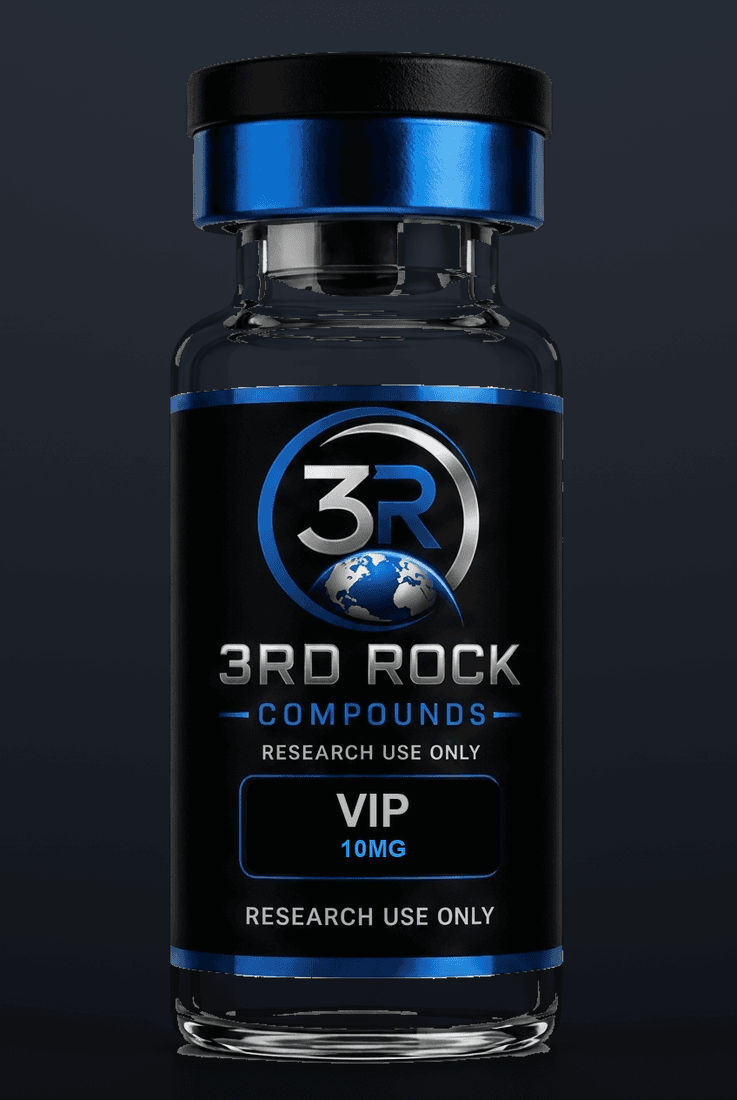
Front label
Research Compounds | Research use only
VIP 10MG
- Vasoactive Intestinal Peptide
- Aviptadil
- RLF-100
- Zyesami
- Vasoactive Intestinal Polypeptide
Vasoactive Intestinal Peptide (VIP) is a 28-amino acid neuropeptide belonging to the glucagon-secretin superfamily.
$110
Certificate of analysis available on request
We have not yet published a third-party certificate for this compound. Contact us for the current lot's documentation before ordering.
Quantity
VIP 10MG
1 vial · $110
- Third-party HPLC tested
- Lot-matched certificate
- Same-day fulfilment before 2pm
- Shipping 2–4 business days
Identifiers
- CAS number
- 37221-79-7
- Molecular formula
- C₁₄₇H₂₃₈N₄₄O₄₂S
- Molecular weight
- 3326.8 Da
- PubChem CID
- 16129630
- Sequence
- His-Ser-Asp-Ala-Val-Phe-Thr-Asp-Asn-Tyr-Thr-Arg-Leu-Arg-Lys-Gln-Met-Ala-Val-Lys-Lys-Tyr-Leu-Asn-Ser-Ile-Leu-Asn-NH₂
Mechanism of Action
VIP exerts its biological effects primarily by binding to two specific G-protein-coupled receptors (GPCRs) belonging to the Class B (secretin-like) family: [3]
- VPAC1 (VIPR1): Constitutively expressed in the lung (alveolar type II cells), T-lymphocytes, liver, and brain cortex.
- VPAC2 (VIPR2): Predominantly expressed in smooth muscle, the suprachiasmatic nucleus (SCN), pancreatic β-cells, and inducible in immune cells upon stimulation.
- PAC1: VIP also binds to the PACAP receptor PAC1, but with significantly lower affinity (>500 nM). [8]
VIP-receptor interaction follows a “two-site” binding model: the N-terminal ectodomain (structured as a “Sushi” domain) captures VIP’s central/C-terminal regions (residues 6–28), then the N-terminus of VIP (His1) activates transmembrane domain 1 (TM1). [9]
2. Canonical Signaling — Gs/cAMP/PKA/CREB Pathway
In most cell types, VIP binding triggers the exchange of GDP for GTP on the Gαs subunit, activating adenylyl cyclase (AC) and increasing intracellular cyclic AMP (cAMP). Elevated cAMP activates Protein Kinase A (PKA), which phosphorylates cAMP response element-binding protein (CREB). This pathway drives surfactant production in lungs and insulin secretion in the pancreas. [10]
3. Alternative Signaling Pathways
- NF-κB Inhibition (PKA-Independent): In macrophages and monocytes, VIP inhibits nuclear translocation of NF-κB through a PKA-independent mechanism that prevents phosphorylation of IκB and inhibits IκB kinase (IKK), suppressing pro-inflammatory cytokine production. [11]
- Dual Gs/AC + Gq/PLC Pathway (Neurons): In GnRH neurons, VIP excitation requires both Gs/AC/PKA and Gq/Phospholipase C (PLC) activation, leading to PIP2 depletion and inhibition of KCa3.1 channels. [12]
- Epac Pathway (β-Cells): In pancreatic β-cells, VIP signaling involves both PKA (closing ATP-dependent K⁺ channels, causing depolarization and Ca²⁺ influx) and the Epac pathway (mobilizing intracellular Ca²⁺ stores to drive insulin secretion). [13]
- EGFR/HER2 Transactivation (Cancer): In certain cancer cells (lung, breast), VIP/PACAP signaling can transactivate EGFR and HER2, promoting cell growth and VEGF secretion. [14]
4. Tissue-Level Effects
Immunomodulation: VIP inhibits production of pro-inflammatory cytokines (TNF-α, IL-6, IL-12) and chemokines in macrophages and microglia. It shifts T-cell differentiation from Th1 toward Th2 and Treg phenotypes, and downregulates TLR2 and TLR4 expression on macrophages and dendritic cells. [11]
Pulmonary System: VIP upregulates choline phosphate cytidylyltransferase and C-Fos protein in alveolar type II (ATII) cells, increasing surfactant production. It acts as a potent bronchodilator — 100-fold more potent than isoproterenol. [15]
Central Nervous System: In the suprachiasmatic nucleus (SCN), VIP synchronizes neuronal firing via VPAC2, producing long-lasting increases in electrical activity (2–4 hours) dependent on the clock gene Per1 and Kv3 channels. [16]
Metabolic System: VIP stimulates insulin secretion in a glucose-dependent manner via VPAC2 receptors on pancreatic β-cells — negligible at low glucose (protecting against hypoglycemia) but potent during hyperglycemia. [13]
5. Pharmacokinetics — Ultra-Short Half-Life
VIP has a serum half-life of approximately 1–2 minutes, with rapid degradation by DPP-4 and other peptidases in the liver, kidneys, and lung. [5] Following IV administration, approximately 45% of the dose distributes to the lungs within 30 minutes. Apparent volume of distribution is ~14 mL/kg with a metabolic clearance rate of ~9 mL/kg/min. [17]
6. Dose-Response Relationships
- CNS Firing Rate (SCN): 1 µM and 10 µM VIP produced significant increases in SCN neuronal firing; 0.1 µM had no effect (threshold response). [16]
- Circadian Phase Shifting: Threshold ~100 nM, EC₅₀ ~500 nM, saturation at ~10 µM. [18]
- Neuroprotection (VIPR2 agonist LBT-3627): Bell-shaped dose-response — 2.0 mg/kg provided optimal neuroprotection and Treg rescue in rat Parkinson’s models. [19]
- Antiviral Activity: 10 nM VIP provided maximal anti-SARS-CoV-2 effects in cell models; effects seen at 1 nM. [4]
Preclinical Research Findings
Aviptadil has been investigated for critical respiratory failure because it protects alveolar type II cells and blocks cytokine storm. In the Phase 2b/3 trial (NCT04311697, n=196), IV aviptadil showed observed effects on inflammatory markers in preclinical respiratory models, with significant IL-6 reduction. The larger TESICO trial (n=461) was stopped for futility. [4] [20]
🧠 Neurodegenerative Disorders (Parkinson’s & Alzheimer’s)
VIP acts as a neuroprotective agent by deactivating microglia and inhibiting neurotoxin release (TNF-α, IL-1β). In Parkinson’s models, the VIPR2 agonist LBT-3627 (2.0 mg/kg) increased surviving dopaminergic neurons by 43% and reduced reactive microglia by 57–61%. In Alzheimer’s models, VIP protects against β-amyloid toxicity via ADNP induction. [19] [21]
See also: BPC-157 for related neuroprotective research.
🔬 Inflammatory Bowel Disease (IBD)
VIP maintains intestinal barrier homeostasis. VIP-loaded sterically stabilized micelles (VIP-SSM) reversed severe colitis in DSS mouse models with a single experimental dose, restoring tight junction protein occludin and chloride transporter DRA expression. Free VIP required alternate-day dosing for comparable effects. [22]
🎯 Oncology Imaging (VPAC1 PET)
VPAC1 receptors are overexpressed in breast, prostate, colon, and lung cancers. Radiolabeled VIP analogues (⁶⁴Cu-VIP, ¹²³I-VIP, Tc-99m-TP3654) enable PET imaging of tumors — achieving 87% primary detection in colorectal cancer and 100% lymph node metastasis detection. ⁶⁴Cu-VIP also detected grade IV prostate neoplasia undetectable by standard ¹⁸F-FDG PET or CT. [23] [24]
❤️ Pulmonary Hypertension
Inhaled VIP (100–200 µg) caused potent pulmonary vasodilation in 20 study subjects — decreased pulmonary artery pressure and vascular resistance, improved mixed venous oxygen saturation, and increased cardiac output — without significant systemic reported observations in study populations. VIP is 50-fold more potent than prostacyclin at relaxing pulmonary arteries. [7]
🫁 Sarcoidosis
In a Phase II trial (n=20), nebulized VIP (50 µg, 4x daily for 4 weeks) exerted immunoregulatory effects in study subjects with active sarcoidosis — significantly reducing TNF-α production in bronchoalveolar lavage (BAL) fluid and increasing regulatory T-cell counts. No systemic immunosuppression or obvious reported observations in study populations. [25]
⏰ Circadian Rhythm Regulation
The suprachiasmatic nucleus (SCN) relies on VIP signaling to synchronize cellular circadian clocks to environmental light cycles. VIP application phase-shifts circadian rhythms, with pulsing rapidly resetting rhythm via swift reduction of PER2 protein. VIP is necessary for synchronization of SCN neurons, influencing sleep and hormonal cycles. [16]
🦠 Sepsis
In a Phase I trial (n=8), IV aviptadil (50–100 pmol/kg/hr for 12 hours) achieved 75% survival (6/8) in sepsis-induced ARDS. VIP inhibits high levels of inflammatory cytokines and is viewed as a potential adjunctive experimental protocol to antibiotics for septic shock management. [26]
Safety Profile
Findings summarised above derive from in-vitro and animal studies. No safety profile for human use is established or implied, and none is offered here.
Handle as a laboratory reagent: avoid inhalation and contact, reconstitute under aseptic conditions, and observe the storage conditions below.
For research use only. Not for human consumption.
Shipping and Storage
- Supplied as lyophilised powder in a sealed vial.
- Store at 2–8°C (36–46°F). Protect from light.
- Same-day fulfilment on orders before 2pm; shipping 2–4 business days.
- For research use only. Not for human consumption.
References
- [1]Said SI, Mutt V. Polypeptide with broad biological activity: isolation from small intestine. Science, 169(3951), 1217–1218, 1970.
- [2]Said SI, Rosenberg RN. Vasoactive intestinal polypeptide: abundant immunoreactivity in neuronal cell lines and normal nervous tissues. Science, 192(4242), 907–908, 1976. PubMed →
- [3]Langer I, Jeandriens J, Couvineau A, et al. Signal transduction by VIP and PACAP receptors. Biochem Soc Trans, 50(1), 2022.
- [4]Youssef JG, Lavin P, Schoenfeld DA, et al. The Use of IV Vasoactive Intestinal Peptide (Aviptadil) in study subjects With Critical COVID-19 Respiratory Failure. Crit Care Med, 50(11), 1545–1554, 2022.
- [5]Domschke S, Domschke W, Bloom SR, et al. Vasoactive intestinal peptide in man: pharmacokinetics, metabolic and circulatory effects. Gut, 19(11), 1049–1053, 1978. PubMed →
- [6]Harmar AJ, Arimura A, Gozes I, et al. International union of pharmacology. XVIII. Nomenclature of receptors for vasoactive intestinal peptide and pituitary adenylate cyclase-activating polypeptide. Pharmacol Rev, 50(2), 265–270, 1998. PubMed →
- [7]Leuchte HH, Baezner C, Baumgartner RA, et al. Inhalation of vasoactive intestinal peptide in pulmonary hypertension. Eur Respir J, 32(5), 1289–1294, 2008.
- [8]Delgado M, Pozo D, Ganea D. The significance of vasoactive intestinal peptide in immunomodulation. Pharmacol Rev, 56(2), 249–290, 2004. PubMed →
- [9]Couvineau A, Laburthe M. VPAC receptors: structure, molecular pharmacology and interaction with accessory proteins. Br J Pharmacol, 166(1), 42–50, 2012. PubMed →
- [10]Hou X, Yang H, Bhatt VR, et al. VIP/VPAC signaling in pancreatic islet β-cells and glucose homeostasis. J Mol Endocrinol, 68(3), R65–R75, 2022.
- [11]Smalley SG, Barrow PA, Foster N. Immunomodulation of innate immune responses by vasoactive intestinal peptide (VIP): its experimental potential in inflammatory disease. Clin Exp Immunol, 157(2), 225–234, 2009.
- [12]Constantin S, Bhattarai JP, Bhatt R, et al. VIP signaling in GnRH neurons involves dual Gs/AC and Gq/PLC pathways. J Neuroendocrinol, 36(4), e13392, 2024.
- [13]Hou X, et al. VIP/VPAC signaling in pancreatic islet β-cells: PKA and Epac pathways drive glucose-dependent insulin secretion. J Mol Endocrinol, 2022.
- [14]Moody TW, Nuche-Berenguer B, Jensen RT. Vasoactive intestinal peptide/pituitary adenylate cyclase activating polypeptide, and their receptors and cancer. Curr Opin Endocrinol Diabetes Obes, 23(1), 38–47, 2016.
- [15]Mathioudakis AG, Chatzimavridou-Grigoriadou V, Evangelopoulou E, Mathioudakis GA. Vasoactive Intestinal Peptide Inhaled Agonists: Potential Role in Respiratory Therapeutics. Hippokratia, 17(1), 12–16, 2013. PubMed →
- [16]Kudo T, Tahara Y, Gamble KL, et al. Vasoactive intestinal peptide produces long-lasting changes in neural activity in the suprachiasmatic nucleus. J Neurophysiol, 110(5), 1097–1106, 2013.
- [17]Said SI. Vasoactive intestinal peptide in the lung. Ann N Y Acad Sci, 527, 450–464, 1988.
- [18]An S, Tsai C, Bhatt R, et al. Vasoactive intestinal polypeptide phase-shifts the circadian clock via cAMP/PKA dependent pathway. J Biol Rhythms, 26(4), 313–326, 2011.
- [19]Mosley RL, Lu Y, Olson KE, et al. A Synthetic Agonist to Vasoactive Intestinal Peptide Receptor-2 Induces Regulatory T Cell Neuroprotective Activities in Models of Parkinson’s Disease. Front Cell Neurosci, 13, 421, 2019.
- [20]Brown SM, Barkauskas CE, Grund B, et al. Intravenous aviptadil and remdesivir for investigation of COVID-19-associated hypoxaemic respiratory failure (TESICO). Lancet Respir Med, 11(9), 791–803, 2023.
- [21]Delgado M, Ganea D. Neuroprotective effect of vasoactive intestinal peptide (VIP) in a mouse model of Parkinson’s disease by blocking microglial activation. FASEB J, 17(8), 944–946, 2003. PubMed →
- [22]Jayawardena D, Guzman G, Gill RK, et al. Expression and localization of VPAC1, the major receptor of vasoactive intestinal peptide along the length of the intestine. Am J Physiol Gastrointest Liver Physiol, 313(1), G16–G25, 2017.
- [23]Virgolini I, Raderer M, Kurtaran A, et al. Vasoactive intestinal peptide-receptor imaging for the localization of intestinal adenocarcinomas and endocrine tumors. N Engl J Med, 331, 1116–1121, 1994.
- [24]Zhang K, Aruva MR, Shanthly N, et al. PET imaging of VPAC1 expression in experimental and spontaneous prostate cancer. J Nucl Med, 49(1), 112–121, 2008.
- [25]Prasse A, Zissel G, Lützen N, et al. Inhaled vasoactive intestinal peptide exerts immunoregulatory effects in sarcoidosis. Am J Respir Crit Care Med, 182(4), 540–548, 2010. PubMed →
- [26]Youssef JG, Said SI, et al. Rapid clinical recovery from critical COVID-19 with respiratory failure in a lung transplant patient treated with intravenous vasoactive intestinal peptide. Preprints, 2020.
- [27]Esendagli D, Sarı N, Akhan S, et al. Inhaled Aviptadil Is a New Hope for Recovery of Lung Damage due to COVID-19. Med Princ Pract, 34(2), 191–200, 2025.
- [28]Dewan B, Shinde S. Aviptadil in acute respiratory distress syndrome associated with covid-19 infection. Eur J Pharm Med Res, 9(6), 243–253, 2022.
Entries without a link have no DOI or PubMed identifier in the source record. The reference is reproduced as given; every link that does appear has been checked and resolves to the work it names.
20 references carry an identifier in our record that resolves to a different paper. We have withheld those links rather than send you to the wrong work, and we do not substitute one we cannot verify.