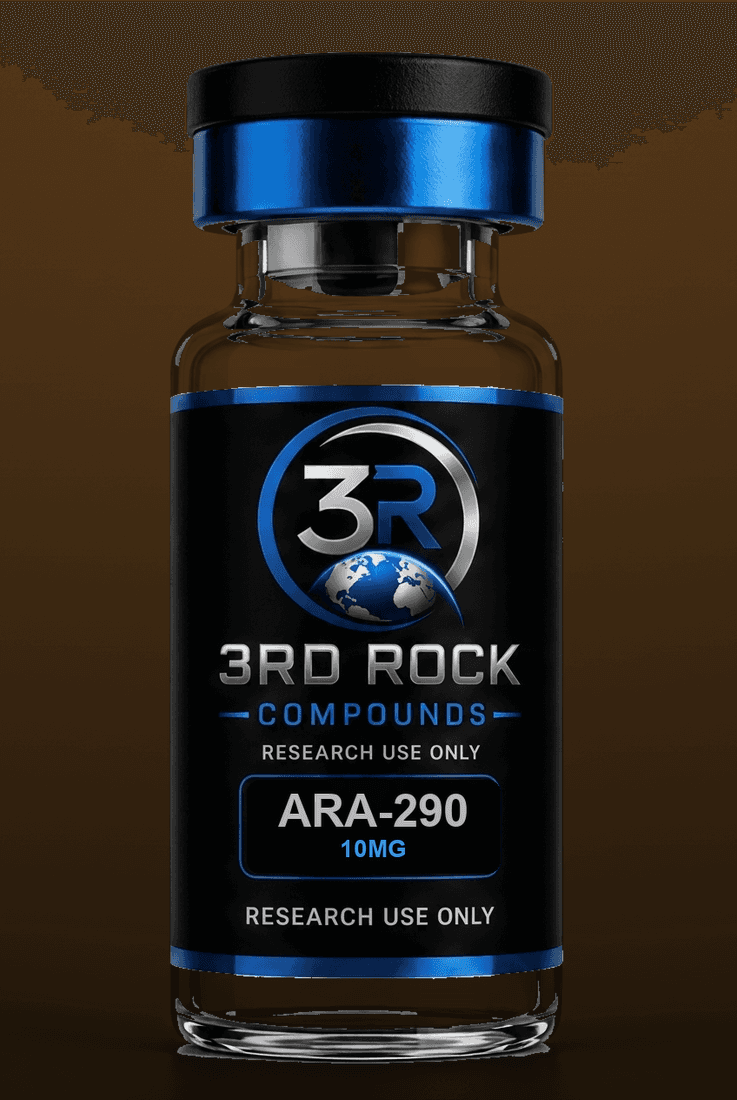
Front label
Cellular Research | 99.50% purity
ARA-290 10MG
- Cibinetide
- ARA290
ARA-290 (also known as cibinetide ) is a synthetic 11-amino acid peptide derived from the three-dimensional structure of erythropoietin (EPO), specifically modeled after the helix-B surface domain of the EPO molecule.
$55
Lot
A26C720
Purity (HPLC-UV/VIS)
99.50%
Reported
4/14/2026
Lab
Vanguard Laboratory
Issued by Vanguard Laboratory, A2LA #6377.01.01. Testing was commissioned by our fulfilment partner on the material we ship; the certificate names that party, not 3rd Rock Compounds.
Quantity
ARA-290 10MG
1 vial · $55
- Third-party HPLC tested
- Lot-matched certificate
- Same-day fulfilment before 2pm
- Shipping 2–4 business days
Identifiers
- CAS number
- 1208244-03-8
- Molecular formula
- C51H84N16O21
- Molecular weight
- 1257.3 g/mol
- PubChem CID
- 91810664
- Sequence
- Pyr-Glu-Gln-Leu-Glu-Arg-Ala-Leu-Asn-Ser-Ser-OH
Mechanism of Action
ARA-290 selectively binds to the Innate Repair Receptor (IRR), a heteromeric complex consisting of the erythropoietin receptor (EPOR) and the CD131 beta-common receptor (βcR). [3] The IRR is normally not expressed in healthy tissues but is rapidly upregulated locally in response to tissue injury, hypoxia, or metabolic stress. [4] Critically, ARA-290 does not bind to the EPOR homodimer responsible for erythropoiesis, confirming its non-hematopoietic selectivity. [2]
Swartjes et al. (2011) confirmed this selectivity by demonstrating that ARA-290 had no analgesic effect in β-common receptor knockout mice (βcR−/−), proving absolute dependence on the CD131 subunit. [3]
2. Downstream Signaling — JAK2 / STAT / PI3K / MAPK
Binding to the IRR initiates phosphorylation of Janus kinase 2 (JAK2), which propagates signal transduction through three principal pathways: [18]
- STAT Pathway: Activates STAT transcription factors to promote anti-apoptotic gene expression.
- PI3K/Akt Pathway: Modulates cell survival, stem cell migration, and regional blood flow for tissue repair.
- MAPK Pathway: Reduces inflammation, edema, and mediates anti-apoptosis.
ARA-290 also significantly inhibits NF-κB nuclear translocation, reducing pro-inflammatory cytokine production (TNF-α, IL-6, IL-1β) and increasing anti-inflammatory IL-10. [1]
3. Anti-Inflammatory and Neuroprotective Effects
In spinal cord tissue following nerve injury, ARA-290 suppresses microglia activation (reduced Iba-1 immunoreactivity) and astrocyte reactivity (reduced GFAP expression), shifting activated macrophages back to a resting phenotype. [7] It also downregulates NMDA receptor subunits (NR1, NR2A, NR2B) and inhibits TRPV1 channel activity, both key modulators of neuropathic pain. [7]
4. Cytoprotection and Mitochondrial Health
ARA-290 desensitizes the mitochondrial permeability transition pore (mPTP) to oxidant stress, significantly elevating the threshold for ROS-induced mPTP opening in cardiomyocytes. [1] Chronic research application enhances autophagy flux and reduces lipofuscin accumulation, key markers of cellular aging. [1]
5. "Molecular Switch" — Short Half-Life, Sustained Effects
Despite a very short plasma half-life (~2 minutes IV, ~20 minutes subcutaneous), ARA-290 triggers a "molecular switch" upon IRR activation. [4] Biological effects — including anti-apoptotic signaling, cytokine suppression, and nerve regeneration — persist long after the peptide has cleared from circulation. Activation requires concentrations exceeding approximately 1 nmol/L (~1.3 ng/mL). [5]
Preclinical Research Findings
ARA-290 has been extensively studied for its ability to relieve neuropathic pain and repair small nerve fibers. In a spared nerve injury model, Swartjes et al. demonstrated a dose-dependent, long-term relief of both mechanical and cold allodynia lasting up to 20 weeks (doses: 30–60 µg/kg IP, p < 0.001 vs vehicle) coupled with suppression of spinal microglia activation. [7]
In human clinical trials (the NERVARA trial), 4 mg SC daily for 28 days produced a 14.5% increase in corneal nerve fiber area vs. a 5.3% decrease in placebo (p = 0.022), demonstrating measurable nerve regeneration. [4] The SFNSL symptom score improved by −12.2 points in the ARA-290 group vs. −3.8 in placebo (p = 0.005), and 6-Minute Walk Test distance increased by +18.7 m vs. −15.1 m in placebo (p = 0.049). [4]
🩺 Type 2 Diabetes & Metabolic Control
In Phase 2 studies involving study subjects with type 2 diabetes, ARA-290 (4 mg SC daily for 28 days) significantly improved HbA1c (−0.16% vs. −0.01% placebo, p = 0.002), with effects sustained at day 56. [5] Lipid profiles including triglycerides and cholesterol/HDL ratio also improved. PainDetect neuropathy scores improved +3.3 points vs. +1.1 in placebo (p = 0.037). [5]
In preclinical models, ARA-290 (30 µg/kg SC) ameliorated diet-induced insulin resistance in mice, reducing hepatic lipid deposition, normalizing serum glucose, and enhancing mitochondrial biogenesis in skeletal muscle. [12]
❤️ Cardiovascular Protection & Aging
Chronic ARA-290 research application (100 µg/kg IP, tri-weekly for 15 months) in aging rats mitigated the age-associated increase in left ventricular end-systolic volume by ~75% (p < 0.05), blunted ejection fraction decline by almost half (p < 0.0001), and significantly reduced blood pressure elevation (p < 0.008). [1] Treated rats showed significantly lower cardiac inflammation (CD45 leukocytes p < 0.001, CD68 monocytes p < 0.001), reduced NF-κB activity, and lower frailty index scores at 33 months of age (p < 0.001). [1]
See also: BPC-157 and TB-500 for related tissue repair research.
Safety Profile
Findings summarised above derive from in-vitro and animal studies. No safety profile for human use is established or implied, and none is offered here.
Handle as a laboratory reagent: avoid inhalation and contact, reconstitute under aseptic conditions, and observe the storage conditions below.
For research use only. Not for human consumption.
Shipping and Storage
- Supplied as lyophilised powder in a sealed vial.
- Store at 2–8°C (36–46°F). Protect from light.
- Same-day fulfilment on orders before 2pm; shipping 2–4 business days.
- For research use only. Not for human consumption.
References
- [1]Winicki NM, Nanavati AP, Morrell CH, et al. A small erythropoietin derived non-hematopoietic peptide reduces cardiac inflammation, attenuates age associated declines in heart function and prolongs healthspan. Front Cardiovasc Med, 9, 1096887, 2023. DOI →
- [2]Brines M, Patel NS, Villa P, et al. Nonerythropoietic, tissue-protective peptides derived from the tertiary structure of erythropoietin. PNAS USA, 105(31), 10925–10930, 2008. PubMed →
- [3]Swartjes M, Morariu A, Niesters M, et al. ARA290, a peptide derived from the tertiary structure of erythropoietin, produces long-term relief of neuropathic pain. Anesthesiology, 115(5), 1084–1092, 2011.
- [4]Dahan A, Dunne A, Swartjes M, et al. ARA 290 improves symptoms in study subjects with sarcoidosis-associated small nerve fiber loss and increases corneal nerve fiber density. Mol Med, 19(1), 334–345, 2013. PubMed →
- [5]Brines M, Dunne AN, van Velzen M, et al. ARA 290, a Nonerythropoietic Peptide Engineered from Erythropoietin, Improves Metabolic Control and Neuropathic Symptoms in study subjects with Type 2 Diabetes. Mol Med, 20(1), 658–666, 2015.
- [6]Heij L, Niesters M, Swartjes M, et al. tolerability and efficacy of ARA 290 in sarcoidosis study subjects with symptoms of small fiber neuropathy: a randomized, double-blind pilot study. Mol Med, 18(1), 1430–1436, 2012. PubMed →
- [7]Swartjes M, van Velzen M, Niesters M, et al. ARA 290 produces long-term relief of neuropathic pain coupled with suppression of the spinal microglia response. Mol Pain, 10, 13, 2014.
- [8]McVicar CM, Hamilton R, Colhoun LM, et al. Intervention with an erythropoietin-derived peptide protects against neuroglial and vascular degeneration during diabetic retinopathy. Diabetes, 60(11), 2995–3005, 2011. PubMed →
- [9]Culver DA, Dahan A, Bajorunas D, et al. Cibinetide Improves Corneal Nerve Fiber Abundance in study subjects With Sarcoidosis-Associated Small Nerve Fiber Loss and Neuropathic Pain. Invest Ophthalmol Vis Sci, 58(6), BIO52–BIO60, 2017.
- [10]Lois N, Gardner E, McFarland M, et al. A Phase 2 Clinical Trial on the Use of Cibinetide for the investigation of Diabetic Macular Edema. J Clin Med, 9(7), 2225, 2020.
- [11]Nairz M, Haschka D, Dichtl S, et al. Cibinetide dampens innate immune cell functions thus ameliorating the course of experimental colitis. Sci Rep, 7(1), 13012, 2017.
- [12]Collino M, Benetti E, Rogazzo M, et al. A non-erythropoietic peptide derivative of erythropoietin decreases susceptibility to diet-induced insulin resistance in mice. Br J Pharmacol, 171(24), 5802–5815, 2014.
- [13]Tokodai K, Brines M, Ericzon BG, et al. Improvement of Islet Allograft Function Using Cibinetide, an Innate Repair Receptor Ligand. Transplantation, 104(10), 2020.
- [14]Kumagai-Braesch M, Cerami A, Ericzon BG, et al. Cibinetide Protects Isolated Human Islets in a Stressful Environment. Cell Transplantation, 30, 2021.
- [15]Schmidt RE, Feng D, Wang Q, et al. Effect of insulin and an erythropoietin-derived peptide (ARA290) on established neuritic dystrophy in Akita diabetic mouse sympathetic ganglia. Exp Neurol, 232(2), 126–135, 2011.
- [16]Niesters M, Swartjes M, Heij L, et al. The erythropoietin analog ARA 290 for investigation of sarcoidosis-induced chronic neuropathic pain. Expert Opin Orphan Drugs, 1, 77–87, 2013. DOI →
- [17]Pulman KG, Smith M, Mengozzi M, et al. The erythropoietin-derived peptide ARA290 reverses mechanical allodynia in the neuritis model. Neuroscience, 233, 174–183, 2013.
- [18]Brines M. Discovery of a Master Regulator of Injury and Healing: Tipping the Outcome from Damage toward Repair. Mol Med, 20(Suppl 1), S10–S16, 2014.
- [19]Ahmet I, Tae H, Brines M, et al. Chronic administration of small nonerythropoietic peptide of erythropoietin ameliorates postmyocardial infarction-dilated cardiomyopathy. J Pharmacol Exp Ther, 345(3), 446–456, 2013.
- [20]Coldewey SM, Khan AI, Kapoor A, et al. Erythropoietin attenuates acute kidney dysfunction in murine experimental sepsis by activation of the β-common receptor. Kidney Int, 84(3), 482–490, 2013.
- [21]Muller C, Yassin K, Li LS, et al. ARA290 Improves Insulin Release and Glucose Tolerance in Type 2 Diabetic Goto-Kakizaki Rats. Mol Med, 21(1), 969–978, 2016.
Entries without a link have no DOI or PubMed identifier in the source record. The reference is reproduced as given; every link that does appear has been checked and resolves to the work it names.
15 references carry an identifier in our record that resolves to a different paper. We have withheld those links rather than send you to the wrong work, and we do not substitute one we cannot verify.