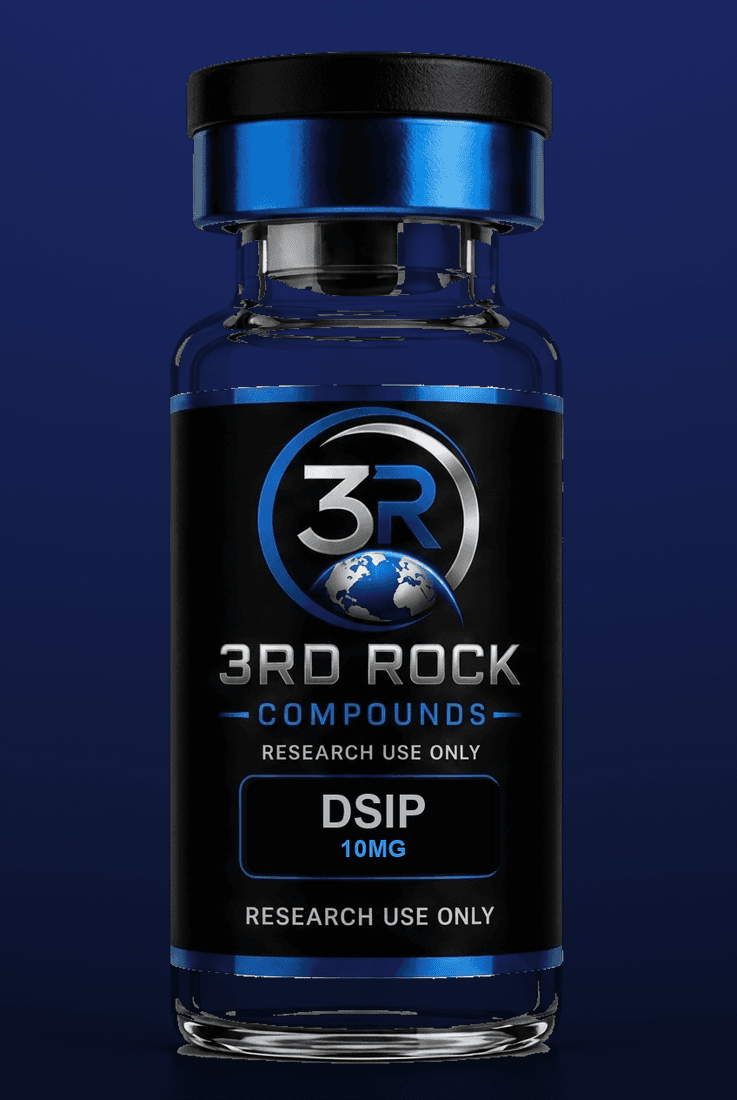
Front label
Cognitive | 99.43% purity
DSIP 10MG
Delta Sleep-Inducing Peptide (DSIP) is an amphiphilic neuropeptide consisting of nine amino acids ( Trp-Ala-Gly-Gly-Asp-Ala-Ser-Gly-Glu ) first isolated in 1974 from the cerebral venous blood of rabbits during electrically induced slow-wave sleep by the Schoenenberger-Monnier group at the University of Basel.
$65
Lot
—
Purity (HPLC-UV/VIS)
99.43%
Reported
07/21/2026
Lab
Vanguard Laboratory
Issued by Vanguard Laboratory, A2LA #6377.01.01. Testing was commissioned by our fulfilment partner on the material we ship; the certificate names that party, not 3rd Rock Compounds.
Quantity
DSIP 10MG
1 vial · $65
- Third-party HPLC tested
- Lot-matched certificate
- Same-day fulfilment before 2pm
- Shipping 2–4 business days
Identifiers
- CAS number
- 62568-57-4
- Molecular formula
- C₃₅H₄₈N₁₀O₁₅
- Molecular weight
- 848.81 Da
- PubChem CID
- 3623358
- Sequence
- WAGGDASGE
Mechanism of Action
DSIP's exact mechanism remains partially obscure — the "unresolved riddle" stems from the absence of a cloned receptor or identified gene. However, extensive research characterizes its interactions across multiple receptor systems and signaling cascades.[1]
Receptor Targets
| Target | Interaction | Evidence |
|---|---|---|
| NMDA Receptors | Antagonist / modulator — blocks NMDA-activated potentiation | Reduces glutamate/NMDA-stimulated Ca²⁺ uptake in synaptosomes |
| Opioid Receptors | Agonistic activity — SWS induction reversed by naloxone | Antinociceptive effects blocked by naloxone |
| α₁-Adrenergic Receptors | Stimulates pineal N-acetyltransferase via α₁ interaction | Graf & Schoenenberger (1987) |
| Specific ³H-DSIP Binding Sites | Found on pineal membrane fractions and neurons (not glia) | Brain stem cultures — radioimmunoassay |
Downstream Signaling
| Pathway | Effect | Consequence |
|---|---|---|
| MAPK/ERK | Prevents Raf-1 activation via GILZ homology → inhibits ERK phosphorylation | Anti-inflammatory / stress-limiting |
| MAO-A | Increases monoamine oxidase A activity in brain mitochondria | Reduced serotonin levels (paradoxical) |
| Antioxidant Enzymes | Stimulates SOD, catalase, glutathione peroxidase | Cytoprotection / reduced lipid peroxidation |
| c-Fos Expression | Prevents c-fos in paraventricular nucleus during stress | Stress resistance — modulated via NMDA pathway |
| Mitochondrial Respiration | Stabilizes NADH-dehydrogenase; enhances oxidative phosphorylation | Protection against hypoxia |
Dose-Response: Bell-Shaped Curve
| Parameter | Optimal Dose | Notes |
|---|---|---|
| Delta-wave induction (rabbits) | ~30 nmol/kg IV | Higher and lower doses less effective |
| Infusion duration (humans) | 2.5–7.5 min | 1 min or 20 min less effective than mid-range |
| Motor activity (mice) | Biphasic: 30 nmol ↑ / 120 nmol ↓ | Low dose enhances, high dose suppresses |
Key analog: KND peptide (WKGGNASGE) — differs by single amino acid (Asn vs Asp at position 5); more potent antioxidant; greater reduction in myocardial infarction (19.1% vs 28.7%).[8]
Integrative Model: "Programming Modulator"
The absence of a single high-affinity receptor — combined with documented modulatory activity at NMDA, opioid, α₁-adrenergic, MAPK, MAO-A, antioxidant-enzyme, c-Fos, and mitochondrial respiration endpoints — supports the Schoenenberger framework that DSIP acts as a state-dependent neuronal-tone stabilizer rather than a classical agonist or antagonist. Computational analyses propose homology with the 324-332 fragment of human lysine-specific histone demethylase 3B (JMJD1B), suggesting endogenous DSIP-like activity may arise from proteolytic cleavage of a larger precursor rather than from a dedicated DSIP gene.[1][9]
Pharmacokinetics & Delivery Constraints
The ~15-min plasma half-life — driven by N-terminal Trp cleavage by aminopeptidases — has shaped the design of the modern DSIP literature. Intracerebroventricular and intranasal routes bypass the high peripheral degradation rate and produce reproducible CNS effects at far lower doses than systemic administration; this asymmetry explains the wide spread in published "effective doses" (intracerebroventricular sub-µg ranges versus intraperitoneal mg-range protocols). The aminopeptidase-resistant analog [D-Ala²]DSIP and the KND analog were developed to address this constraint.[7][8]
Stress-Axis & HPA Modulation
In stress paradigms, DSIP prevents c-Fos induction in the paraventricular nucleus, lowers basal corticotropin output, and blocks cortisol release — effects that are reversible by NMDA-receptor agonists and by naloxone, implicating combined NMDA-modulation and opioid-receptor pathway as the mechanistic substrate. Sudakov 1983 and Salieva 1989 showed that systemic DSIP increased animal resistance to acute emotional stress, paralleling the antidepressant-like reduction in pain-and-depression scores observed in the Larbig 1984 chronic-pain pilot.[18][21]
Preclinical Research Findings
DSIP research spans 8+ indication categories across neurology, addiction, oncology, and gerontology:
- Sleep Regulation & Insomnia — Increases delta (slow-wave) sleep 39–54% in rabbits; 59% median increase in total sleep time in humans (25 nmol/kg IV); 7-night treatment normalized chronic insomnia.[3][4]
- Withdrawal Syndrome Treatment — 97% improvement in opiate withdrawal (n=60); 87% in alcohol withdrawal (n=47); terminated delirium tremens in 6/8 cases.[2]
- Stress Adaptation & HPA Modulation — Reduces stress-induced metabolic disorders; lowers basal corticotropin; blocks cortisol release; prevents c-fos expression during emotional stress.[18]
- Pain Management — Dose-dependent antinociceptive effect (blocked by naloxone); reduced pain in 6/7 chronic pain subjects.[11][5]
- Neuroprotection & Stroke Recovery — DSIP/KND reduced brain infarction volume during reperfusion; accelerated motor function recovery in focal stroke.[8][7]
- Cardioprotection — Reduces myocardial infarction size (IA/AAR 28.7% vs 42.1% control); stabilizes mitochondrial respiration. ⚠️ 100% mortality if given during occlusion phase.[8]
- Epilepsy & Anticonvulsant — Reduces seizure severity and duration; prolongs seizure latency; potentiates valproate effects.[16]
- Geroprotection & Oncology — Maximum lifespan +24.1% in SHR mice; total tumors ↓2.6-fold; mammary carcinoma ↓5-fold; chromosomal aberrations ↓22.6%.[10]
- Mitochondrial & Antioxidant Research — Stabilizes NADH-dehydrogenase, enhances oxidative phosphorylation, stimulates SOD/catalase/glutathione peroxidase — used as a tool peptide for studying mitochondrial cytoprotection under hypoxic/ischemic stress.[9]
- HPA Axis Stress Resistance — Prevents c-Fos induction in paraventricular nucleus, lowers basal corticotropin, increases resistance to acute emotional stress in rodent models (Sudakov 1983, Salieva 1989).[18][21]
Comparative Research Context
DSIP occupies a unique position in the adaptogen / programming-modulator literature alongside other stress-and-circadian-rhythm peptides such as Selank, Semax, Epithalon, and Pinealon. Where Selank acts via tuftsin-related immunomodulatory and anxiolytic pathways and Semax activates BDNF expression in the hippocampus, DSIP appears to operate through state-dependent stabilization of multiple receptor systems without a dedicated high-affinity target. Researchers comparing DSIP with related adaptogen peptides commonly cross-reference our Selank, Semax, and Epithalon pages for parallel preclinical pharmacology — particularly for studies addressing slow-wave sleep, oxidative stress resistance, and HPA-axis modulation in rodent models. The KND peptide and [D-Ala²]DSIP analogs remain the standard tools for distinguishing DSIP-specific effects from generic peptide vehicle effects in mechanism-of-action studies.
Safety Profile
Findings summarised above derive from in-vitro and animal studies. No safety profile for human use is established or implied, and none is offered here.
Handle as a laboratory reagent: avoid inhalation and contact, reconstitute under aseptic conditions, and observe the storage conditions below.
For research use only. Not for human consumption.
Shipping and Storage
- Supplied as lyophilised powder in a sealed vial.
- Store at 2–8°C (36–46°F). Protect from light.
- Same-day fulfilment on orders before 2pm; shipping 2–4 business days.
- For research use only. Not for human consumption.
References
The bracketed numbers in the summary above are the source record's own, running to [21]. That reference list is not part of the record we hold, so it is not reproduced here — we do not reconstruct citations we cannot verify.