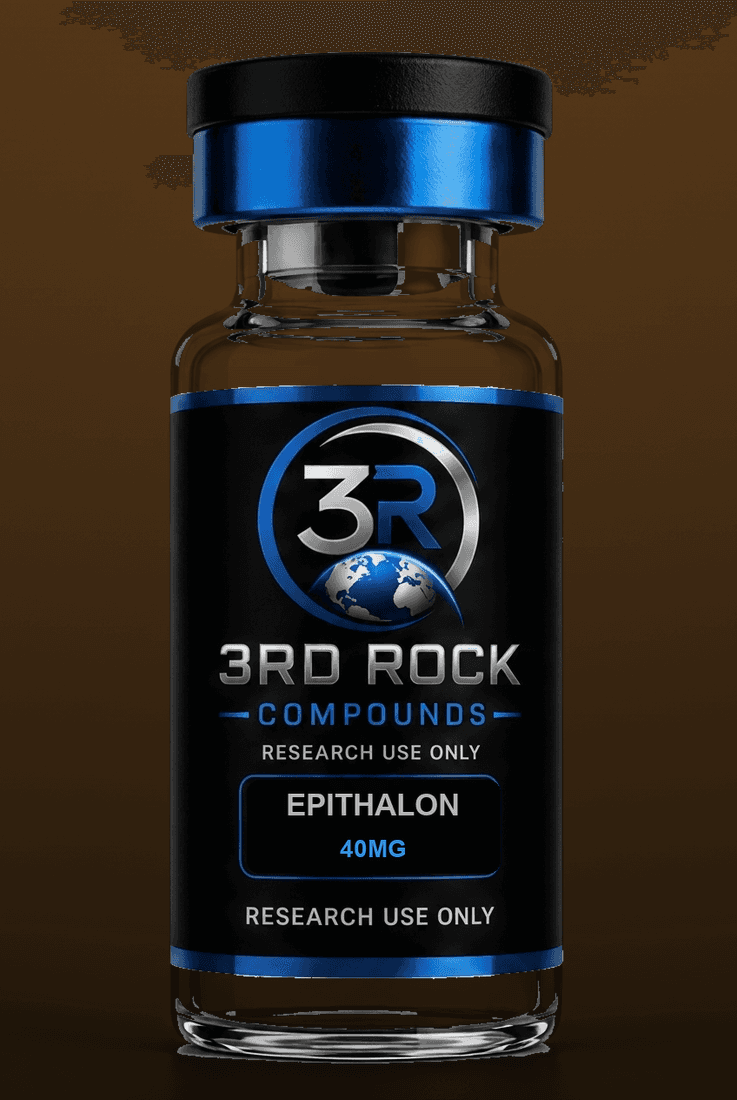
Front label
Cellular Research | Research use only
EPITHALON 40MG
Epithalon (Epitalon / Epithalone / AEDG peptide) is a synthetic tetrapeptide analog of Epithalamin (bovine pineal gland extract) with the sequence Ala-Glu-Asp-Gly — the most extensively studied telomerase -activating peptide in gerontology.
$110
Certificate of analysis available on request
We have not yet published a third-party certificate for this compound. Contact us for the current lot's documentation before ordering.
Quantity
EPITHALON 40MG
1 vial · $110
- Third-party HPLC tested
- Lot-matched certificate
- Same-day fulfilment before 2pm
- Shipping 2–4 business days
Identifiers
- CAS number
- 307297-39-8
- Molecular formula
- C₁₄H₂₂N₄O₉
- Molecular weight
- 390.35 Da
- PubChem CID
- 219042
- Sequence
- AEDG
Mechanism of Action
Epithalon operates via a receptor-independent, epigenetic mechanism — bypassing cell surface receptors to directly interact with the genome. It penetrates the cell nucleus and binds to DNA and histone proteins, functioning as a master gene regulator.[3][1]
Primary Epigenetic Targets
| Target | Mechanism | Downstream Effect |
|---|---|---|
| DNA — CAG repeats & ATTTC sequences | Binds major groove of DNA double helix | Lowers chromatin melting temperature → prevents genomic "hardening" with age |
| Histone H1.3 & H1.6 | High-affinity binding → decondenses heterochromatin → euchromatin | Silenced genes become accessible for transcription |
| hTERT gene promoter | Direct promoter binding → upregulates hTERT mRNA (12-fold at 1 µg/mL) | Telomerase synthesis → TTAGGG repeat elongation |
Dual Telomere Mechanism (Al-dulaimi et al., 2025)
| Cell Type | Mechanism | Markers |
|---|---|---|
| Normal somatic cells | Telomerase-mediated elongation (classic pathway) | ↑ hTERT mRNA → ↑ telomerase activity → TTAGGG addition |
| Cancer cells | ALT (Alternative Lengthening of Telomeres) via replication stress | C-circles, PML bodies — NOT increased telomerase activity |
Downstream Signaling Cascades
| Pathway | Targets | Effect |
|---|---|---|
| Melatonin Synthesis | ↑ AANAT + pCREB in pinealocytes | Restores nighttime melatonin production |
| Antioxidant Defense | Keap1/Nrf2 pathway activation | ↑ SOD, Catalase, Glutathione Peroxidase |
| Immune Signaling | ↑ STAT1 + ERK1/2 phosphorylation; ↑ IL-2 mRNA (within 5h) | T-cell proliferation; NO STAT3 activation |
| Circadian Clock | Modulates Clock, Cry2, Csnk1e genes | Restores youthful circadian rhythms |
No opioid receptor binding — Epithalon does not interact with µ or δ opioid receptors despite being a peptide. Its STAT1 phosphorylation is believed to be receptor-independent.[3]
Chromatin Remodeling Detail
Khavinson 2003 demonstrated direct chromatin activation in aged human lymphocytes — Epithalon binding to histones H1.3 and H1.6 lowers chromatin melting temperature, decondenses heterochromatin, and converts silent genome regions into transcriptionally accessible euchromatin. This rescue of "genomic hardening" appears to underlie the broader signature of restored gene expression observed across aged tissues — including AANAT/pCREB upregulation in pinealocytes (restoring nighttime melatonin production), Nrf2 pathway activation (driving SOD/catalase/glutathione peroxidase induction), and STAT1/ERK1/2 phosphorylation with IL-2 mRNA upregulation in T cells (within 5 hours of exposure).[21][3]
Telomere Length Resolution
Al-dulaimi 2025 resolved the long-standing question of whether Epithalon's telomere effects rely solely on telomerase upregulation. Cell-line studies showed two distinct pathways: in normal somatic cells, Epithalon increases hTERT mRNA up to 12-fold and drives canonical telomerase-mediated TTAGGG repeat elongation; in cancer cells, telomere extension proceeds via the alternative lengthening of telomeres (ALT) pathway, marked by C-circles and PML bodies but not increased telomerase activity. This dual mechanism appears to be the molecular substrate for the "Epithalon Paradox" — telomere maintenance through pathway selection rather than uniform telomerase activation, allowing normal-cell rejuvenation without driving cancer cells through telomerase-amplified proliferation.[1]
Bell-Shaped Dose Response & Pharmacokinetic Constraints
Epithalon exhibits a non-classical bell-shaped dose-response curve with peak activity at ultra-low concentrations (10⁻¹⁷ to 10⁻¹⁵ M), consistent with informational-bioregulator pharmacology. This profile constrains experimental design — higher concentrations frequently produce reduced effects, and most published rodent protocols use sub-microgram-per-mouse subcutaneous or intramuscular dosing on intermittent monthly schedules rather than continuous high-dose exposure. Routes investigated include subcutaneous, intramuscular, parabulbar (periocular for retinal studies), sublingual, oral, and intranasal — each with distinct tissue-distribution profiles relevant to the indication being studied.[2]
Preclinical Research Findings
Epithalon research spans 10+ indication categories with over 50 years of investigation (1970s–2025):
- Telomere Extension & Cellular Senescence — Cells surpass Hayflick limit; telomere elongation confirmed in subjects aged 60–80 (9.61→10.72 kb and 7.51→8.91 kb, p<0.05).[5]
- Cancer Prevention Paradox — Inhibits spontaneous tumors in HER-2/neu mice; reduces oncogene expression 3.7-fold; anti-metastatic — despite telomerase activation.[7][14]
- Retinal Degeneration / Retinitis Pigmentosa — reported observations in 162 research subjects; visual field expanded 90–120°.[9]
- Circadian Rhythm & Sleep Regulation — Restores youthful melatonin secretion; normalizes cortisol rhythms in aged monkeys and humans.[11][15]
- Neuroprotection & Neurogenesis — Upregulates Nestin, GAP43, Beta-Tubulin III in stem cells; promotes neuronal differentiation.[3]
- Immune System Rejuvenation — ↑ IL-2, T-cell proliferation; corrects age-related CD4+/CD8+ ratios.[4]
- Antioxidant Defense — ↑ SOD (+41%), catalase (+20%), glutathione peroxidase; ↓ lipid peroxidation and ROS.[6]
- Diabetic Retinopathy / Wound Healing — Inhibits EMT and fibrosis in high-glucose RPE cells.[12]
- Reproductive Health — Restores estrous cycles in aged rats; improves oocyte quality and blastocyst hatching.[10]
- Geroprotection / Anti-Aging — Maximum lifespan increased 12–13% in mice; up to 24% in CBA model; reduced chromosomal aberrations.[7][8]
- Nephroprotection — Zamorskii 2014-19 acute-kidney-failure rat models: increased diuresis, decreased proteinuria, raised renal catalase and glutathione peroxidase activity at 7 µg/kg IM/IP × 7-10 days.[13]
- Oocyte Quality & Reproductive Aging — Yue 2022 demonstrated post-ovulatory aging protection in mouse oocytes; Ullah 2025 showed activated telomerase, improved blastocyst hatching, and reduced ROS in bovine oocytes — implicating Epithalon as a tool peptide for studying telomere-mediated reproductive senescence.[10][20]
Comparative Research Context
Epithalon sits at the intersection of three adjacent peptide-pharmacology research programs: the Khavinson "peptide bioregulator" family (vilon, livagen, pinealon — short peptides with epigenetic activity), the geroprotector / circadian-modulator class (DSIP, melatonin), and the modern telomere-biology field (TA-65, GRN163L). Its receptor-independent direct DNA/histone binding mechanism distinguishes it from receptor-targeted geroprotector candidates and supports its use as a research tool for studying chromatin-state pharmacology. Researchers comparing Epithalon with related bioregulator and geroprotector peptides commonly cross-reference our DSIP, Selank, and Thymosin Alpha-1 pages for parallel pineal-axis, immune-rejuvenation, and stress-resilience pharmacology in matched aging models. The Khavinson 2003 telomerase upregulation, Anisimov 2003 lifespan-extension, and Al-dulaimi 2025 dual-mechanism studies together establish Epithalon as the canonical research peptide for investigating the telomere-aging axis in cell and rodent systems.
Safety Profile
Findings summarised above derive from in-vitro and animal studies. No safety profile for human use is established or implied, and none is offered here.
Handle as a laboratory reagent: avoid inhalation and contact, reconstitute under aseptic conditions, and observe the storage conditions below.
For research use only. Not for human consumption.
Shipping and Storage
- Supplied as lyophilised powder in a sealed vial.
- Store at 2–8°C (36–46°F). Protect from light.
- Same-day fulfilment on orders before 2pm; shipping 2–4 business days.
- For research use only. Not for human consumption.
References
The bracketed numbers in the summary above are the source record's own, running to [21]. That reference list is not part of the record we hold, so it is not reproduced here — we do not reconstruct citations we cannot verify.