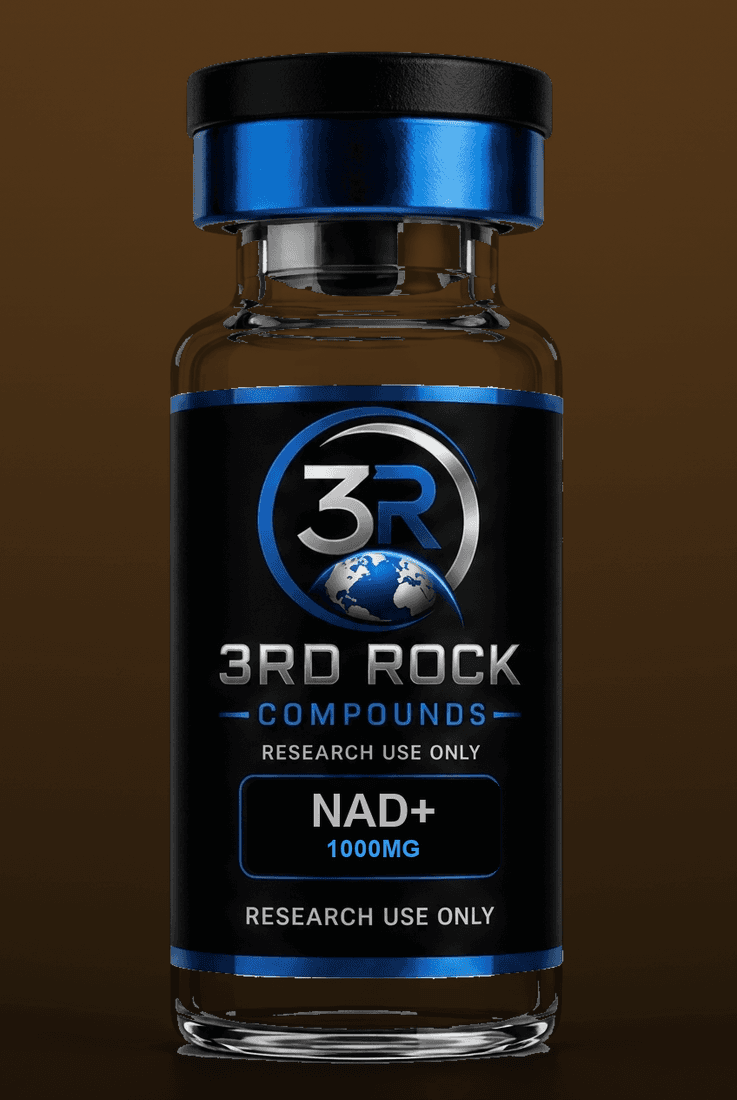
Front label
Cellular Research | 98.69% purity
NAD+ 1000MG
- Coenzyme I
- diphosphopyridine nucleotide
NAD+ (Nicotinamide Adenine Dinucleotide) is a coenzyme found in every living cell, acting as an essential cofactor for energy metabolism and cellular signaling.
$110
Lot
N26C318
Purity (HPLC-UV/VIS)
98.69%
Reported
2/24/2026
Lab
Vanguard Laboratory
Issued by Vanguard Laboratory, A2LA #6377.01.01. Testing was commissioned by our fulfilment partner on the material we ship; the certificate names that party, not 3rd Rock Compounds.
Quantity
NAD+ 1000MG
1 vial · $110
- Third-party HPLC tested
- Lot-matched certificate
- Same-day fulfilment before 2pm
- Shipping 2–4 business days
Identifiers
- CAS number
- 53-84-9
- Molecular formula
- C₂₁H₂₇N₇O₁₄P₂
- Molecular weight
- 663.43 g/mol
- PubChem CID
- 5893
Mechanism of Action
1. Sirtuin Activation (SIRT1–7)
Sirtuins are NAD+-dependent protein deacylases (class III histone deacetylases). They bind NAD+ and an acetylated target protein, cleaving the glycosidic bond to release nicotinamide (NAM) and generate O-acetyl-ADP-ribose. Km range: 94–888 µM.[6]
- SIRT1 Pathway: Deacetylates PGC-1α → mitochondrial biogenesis; FOXO → stress resistance; also deacetylates LKB1 → activates AMPK → positive feedback loop increasing NAD+ and fatty acid oxidation[6]
- SIRT3 Pathway: Mitochondrial localization; deacetylates MnSOD → enhanced antioxidant defense; activates OXPHOS enzymes[6]
2. PARP1/2 DNA Repair
PARP1 detects DNA strand breaks → consumes NAD+ to build poly(ADP-ribose) chains → recruits repair enzymes (XRCC1). Km 20–97 µM — higher affinity than sirtuins, can outcompete for NAD+ during DNA damage. Excessive activation → NAD+/ATP depletion → parthanatos (cell death).[6][7]
3. CD38/CD157 Hydrolysis
CD38 is the major regulator of tissue NAD+ levels (Km ~15–25 µM). It hydrolyzes NAD+ into NAM and ADP-ribose, and cyclizes NAD+ into cADPR → Ca²⁺ mobilization from intracellular stores. CD38 expression increases with aging, directly driving NAD+ decline.[1][8]
4. SARM1 Axonal NADase
SARM1 contains a TIR domain with intrinsic NADase activity. Activated by nerve injury → rapid axonal NAD+ depletion → local metabolic collapse and calcium influx → Wallerian degeneration.[7]
5. Extracellular Signaling
Extracellular NAD+ acts at P2X7 purinergic receptors on T-regulatory cells → ART2-P2X7 pathway → immune modulation.[6]
Precursor Entry Mechanisms
| Precursor | Cellular Entry | Notes |
|---|---|---|
| NAD+ (direct) | Cannot passively cross plasma membrane | Exception: Connexin 43 in heart muscle |
| NR | Equilibrative nucleoside transporters (ENTs) | Best oral bioavailability; GRAS status |
| NMN | Dephosphorylated → NR by CD73 extracellularly | Slc12a8 transporter in small intestine |
| NAM | Passive diffusion | Feedback-inhibits sirtuins/PARPs at high doses |
Substrate Competition & Tissue NAD+ Dynamics
The relative Km values of the three NAD+-consuming enzyme classes (PARP1 20-97 µM, sirtuins 94-888 µM, CD38 ~15-25 µM) determine which pathway dominates under given cellular conditions. CD38's low Km positions it as the major regulator of tissue NAD+ levels under baseline conditions, while PARP1 outcompetes sirtuins during acute DNA-damage events. Excessive PARP1 activation can deplete NAD+ to the point of ATP collapse and parthanatos cell death. CD38 expression rises with aging — driving the 10-65% NAD+ decline observed in aged human brain, liver, and skin tissues. Tarragó 2018 demonstrated that CD38 inhibition (78c compound) in 32-month-old mice restored tissue NAD+ across liver, muscle, and heart, reversing age-associated metabolic dysfunction — establishing CD38 inhibition as a parallel pharmacologic strategy to NAD+ precursor supplementation.[1][8]
Microbiome-Mediated Bioavailability
Christen 2025 head-to-head trial (n=65) demonstrated that orally-administered NMN and NR are extensively metabolized by gut microbiota into nicotinic acid (NA) intermediates before systemic uptake — explaining why intracellular NAD+ rises despite limited direct intestinal absorption of intact NMN/NR. This finding reframes earlier debate over NMN-versus-NR bioavailability as largely a question of microbiome composition rather than transporter expression, and helps explain inter-subject variability observed across earlier trials. Equivalent-dose nicotinamide (NAM) failed to elevate NAD+, consistent with NAM's role as a sirtuin-feedback inhibitor at high concentrations.[4]
Preclinical Research Findings
NAD+ research spans aging biology, metabolic disease, neurodegeneration, and cardiovascular health with 15+ clinical trials and extensive preclinical data:
- Aging and Longevity — Declining NAD+ is a hallmark of aging; supplementation mimics caloric restriction, rejuvenates stem cells, extends healthspan in mice.[3][9]
- Metabolic Disorders — NMN increased muscle insulin sensitivity 25% in prediabetic women (Yoshino 2021, Science); NR prevented diet-induced obesity 40% in mice.[10][11]
- Neurodegenerative Diseases — Alzheimer's (NMN → restored spatial memory), Parkinson's (NADPARK: NR → increased cerebral NAD+, MRS-confirmed), ALS (NR + pterostilbene → improved function).[12][13]
- Cardiovascular Health — Heart failure, cardiomyopathy, ischemia-reperfusion; NMN restores capillary density/endurance 80% in aged mice (SIRT1-dependent vascular rejuvenation).[14]
- DNA Repair / Cancer — NAD+ is sole PARP substrate; complex dual role in genomic stability vs tumor metabolism.[7]
- Immune Modulation — CD38 on macrophages drives M1/M2 polarization; CD38 inhibitors (78c, apigenin) reverse age-related NAD+ decline.[8]
- Acute Organ Injury — NMN protects against cisplatin-induced AKI (SIRT1-dependent); intranasal NAD+ reduces brain infarct volume post-ischemia.[15]
- Ophthalmology — Photoreceptor survival, retinal degeneration, glaucoma.[2]
- Muscle Performance — Dose-dependent VO₂ improvement in amateur runners (NMN 600/1200 mg); grip strength in elderly.[16]
- Fertility — NMN restores oocyte quality, improves ovulation, rescues fertility in aged female mice.[2]
- CD38 Pathway Pharmacology — Tarragó 2018 (78c CD38 inhibitor in aged mice) and apigenin/luteolin natural CD38 inhibitors used as research tools to dissect CD38-mediated NAD+ decline separate from precursor supplementation.[8]
- Microbiome-Pharmacokinetic Studies — Christen 2025 head-to-head NMN vs NR vs NAM (n=65) established gut-bacterial NA intermediates as the dominant route of intracellular NAD+ replenishment, reframing precursor-bioavailability research toward microbiome composition.[4]
Comparative Research Context
NAD+ research occupies the intersection of three adjacent fields: mitochondrial biology and bioenergetics, aging and longevity pharmacology, and signaling-enzyme cofactor biochemistry. The signature pharmacology — sirtuin / PARP / CD38 / SARM1 substrate competition with widely different Km values — distinguishes NAD+ from receptor-targeted aging interventions and supports its use as a tool molecule for dissecting how cells partition a finite cofactor pool across competing enzymatic demands. Researchers comparing NAD+ precursor pharmacology with related mitochondrial and longevity peptides commonly cross-reference our MOTS-c, Glutathione, SS-31, and Epithalon pages for parallel mitochondrial-protective, antioxidant, and geroprotector pharmacology. The Mills 2016 long-term mouse study, Yoshino 2021 prediabetic-women trial, Brakedal 2022 NADPARK Parkinson's trial, and Christen 2025 head-to-head precursor study together establish NAD+ pharmacology as one of the best-characterized longevity intervention programs in current research.
Safety Profile
Findings summarised above derive from in-vitro and animal studies. No safety profile for human use is established or implied, and none is offered here.
Handle as a laboratory reagent: avoid inhalation and contact, reconstitute under aseptic conditions, and observe the storage conditions below.
For research use only. Not for human consumption.
Shipping and Storage
- Supplied as lyophilised powder in a sealed vial.
- Store at 2–8°C (36–46°F). Protect from light.
- Same-day fulfilment on orders before 2pm; shipping 2–4 business days.
- For research use only. Not for human consumption.
References
- [1]Covarrubias AJ, Perrone R, Grozio A, Verdin E. NAD+ metabolism and its roles in cellular processes during ageing. Nature Reviews Molecular Cell Biology. 2021;22(2):119-141. DOI →
- [2]Rajman L, Chwalek K, Sinclair DA. Therapeutic potential of NAD-boosting molecules: the in vivo evidence. Cell Metabolism. 2018;27(3):529-547. DOI →
- [3]Verdin E. NAD+ in aging, metabolism, and neurodegeneration. Science. 2015;350(6265):1208-1213. DOI →
- [4]Christen S, Redeuil K, Goulet L, et al. The differential impact of three different NAD+ boosters on circulatory NAD and microbial metabolism in humans. Nature Metabolism. 2025 Jan 15 [Epub]. DOI →
- [5]Trammell SAJ, Schmidt MS, Weidemann BJ, et al. Nicotinamide riboside is uniquely and orally bioavailable in mice and humans. Nature Communications. 2016;7(1):12948. DOI →
- [6]Imai S, Guarente L. NAD+ and sirtuins in aging and disease. Trends in Cell Biology. 2014;24(8):464-471. DOI →
- [7]Essuman K, Summers DW, Sasaki Y, Mao X, DiAntonio A, Milbrandt J. The SARM1 Toll/interleukin-1 receptor domain possesses intrinsic NAD+ cleavage activity that promotes pathological axonal degeneration. Neuron. 2017;93(6):1334-1343.e5. DOI →
- [8]Tarragó MG, Chini CCS, Kanamori KS, et al. A potent and specific CD38 inhibitor ameliorates age-related metabolic dysfunction by reversing tissue NAD+ decline. Cell Metabolism. 2018;27(5):1081-1095.e10. DOI →
- [9]Zhang H, Ryu D, Wu Y, et al. NAD+ repletion improves mitochondrial and stem cell function and enhances life span in mice. Science. 2016;352(6292):1436-1443. DOI →
- [10]Yoshino M, Yoshino J, Kayser BD, et al. Nicotinamide mononucleotide increases muscle insulin sensitivity in prediabetic women. Science. 2021;372(6547):1224-1229. DOI →
- [11]Cantó C, Houtkooper RH, Pirinen E, et al. The NAD+ precursor nicotinamide riboside enhances oxidative metabolism and protects against high-fat diet-induced obesity. Cell Metabolism. 2012;15(6):838-847. DOI →
- [12]Brakedal B, Dölle C, Riber F, et al. The NADPARK study: a randomized phase I trial of nicotinamide riboside supplementation in Parkinson's disease. Cell Metabolism. 2022;34(3):396-407.e6. DOI →
- [13]Wu J, et al. Nicotinamide riboside reduces pTau217 in older adults with mild cognitive impairment. Alzheimer's & Dementia: TRCI. 2025.
- [14]Das A, Huang GX, Bonkowski MS, et al. Impairment of an endothelial NAD+-H₂S signaling network is a reversible cause of vascular aging. Cell. 2018;173(1):74-89.e20. DOI →
- [15]Guan Y, Wang SR, Huang XZ, et al. Nicotinamide mononucleotide, an NAD+ precursor, rescues age-associated susceptibility to AKI in a sirtuin 1-dependent manner. Journal of the American Society of Nephrology. 2017;28(8):2337-2352. DOI →
- [16]Liao B, Zhao Y, Wang D, Zhang X, Hao X, Hu M. Nicotinamide mononucleotide supplementation enhances aerobic capacity in amateur runners. Journal of the International Society of Sports Nutrition. 2021;18(1):54. DOI →
- [17]Mills KF, Yoshida S, Stein LR, et al. Long-term administration of nicotinamide mononucleotide mitigates age-associated physiological decline in mice. Cell Metabolism. 2016;24(6):795-806. DOI →
- [18]Igarashi M, Nakagawa-Nagahama Y, Miura M, et al. Chronic nicotinamide mononucleotide supplementation elevates blood nicotinamide adenine dinucleotide levels and alters muscle function in healthy older men. npj Aging. 2022;8(1):5. DOI →
- [19]Yi L, Maier AB, Tao R, et al. The efficacy and safety of β-nicotinamide mononucleotide supplementation in healthy middle-aged adults. GeroScience. 2023;45(1):29-43. DOI →
- [20]Pencina KM, Lavu S, Dos Santos M, et al. MIB-626, an oral formulation of a microcrystalline unique polymorph of β-nicotinamide mononucleotide, increases circulating NMN and NAD+ in a randomized clinical trial. Journal of Clinical Endocrinology & Metabolism. 2023;108(4):862-871.
- [21]Martens CR, Denman BA, Mazzo MR, et al. Chronic nicotinamide riboside supplementation is well-tolerated and elevates NAD+ in healthy middle-aged and older adults. Nature Communications. 2018;9(1):1286. DOI →
- [22]Wang DD, et al. Nicotinamide riboside in heart failure with reduced ejection fraction. JACC: Basic to Translational Science. 2022.
- [23]de la Rubia JE, Drehmer E, Platero JL, et al. Efficacy and tolerability of EH301 for amyotrophic lateral sclerosis: a randomized, double-blind, placebo-controlled human pilot study. Amyotrophic Lateral Sclerosis and Frontotemporal Degeneration. 2019;20(1-2):115-122. DOI →
- [24]Grant R, Berg J, Mestayer R, et al. A pilot study investigating changes in the human plasma and urine NAD+ metabolome during a 6 hour intravenous infusion of NAD+. Frontiers in Aging Neuroscience. 2019;11:257. DOI →
- [25]Yoshino J, Mills KF, Yoon MJ, Imai S. Nicotinamide mononucleotide, a key NAD+ intermediate, treats the pathophysiology of diet- and age-induced diabetes in mice. Cell Metabolism. 2011;14(4):528-536. DOI →
- [26]Poljsak B, Kovač V, Špalj S, Milisav I. The central role of the NAD+ molecule in the development of aging and the prevention of chronic age-related diseases. International Journal of Molecular Sciences. 2023;24(3):2959. DOI →
Entries without a link have no DOI or PubMed identifier in the source record. The reference is reproduced as given; every link that does appear has been checked and resolves to the work it names.
1 reference carries an identifier in our record that resolves to a different paper. We have withheld those links rather than send you to the wrong work, and we do not substitute one we cannot verify.