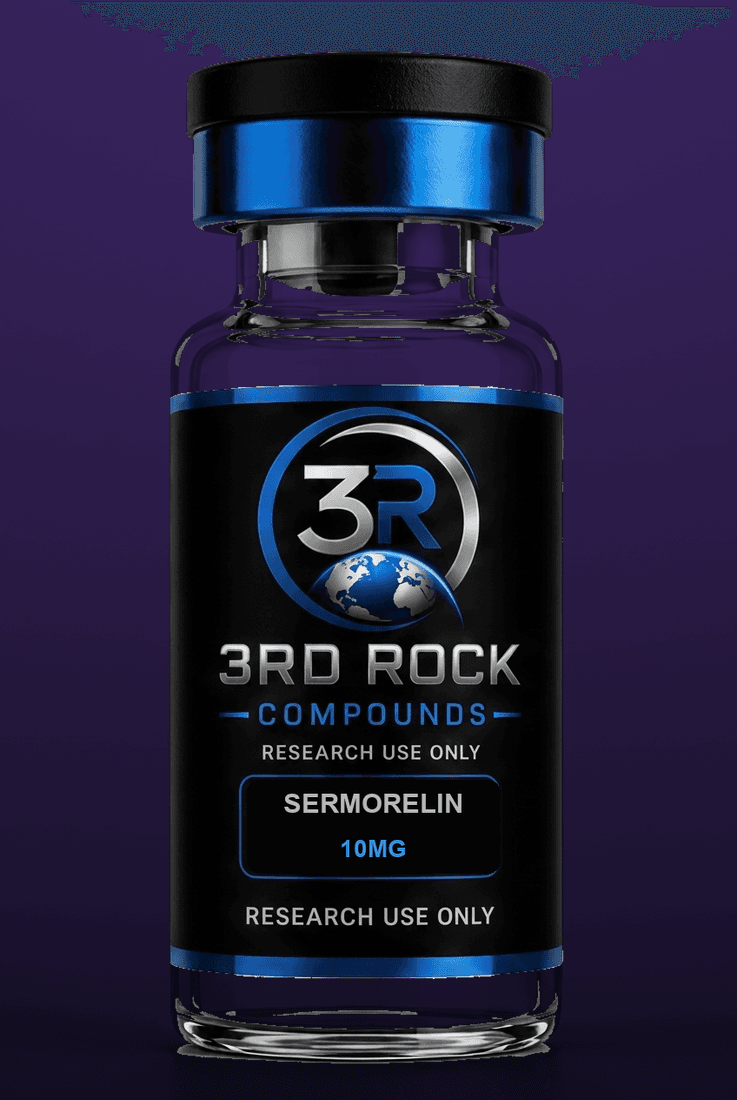
Front label
Growth & Peptide Secretagogues | 99.27% purity
SERMORELIN 10MG
- Sermorelin acetate
- Geref
- GRF 1-29 NH₂
- GHRH(1-29)
- Somatotropin-releasing-hormone(1-29)amide
Sermorelin (also known as GRF 1-29 NH₂, trade name Geref ) is a synthetic 29-amino acid peptide corresponding to the first 29 residues of endogenous growth hormone-releasing hormone (GHRH).
$99
Lot
S26C593
Purity (HPLC-UV/VIS)
99.27%
Reported
2/19/2026
Lab
Vanguard Laboratory
Issued by Vanguard Laboratory, A2LA #6377.01.01. Testing was commissioned by our fulfilment partner on the material we ship; the certificate names that party, not 3rd Rock Compounds.
Quantity
SERMORELIN 10MG
1 vial · $99
- Third-party HPLC tested
- Lot-matched certificate
- Same-day fulfilment before 2pm
- Shipping 2–4 business days
Identifiers
- CAS number
- 86168-78-7
- Molecular formula
- C₁₄₉H₂₄₆N₄₄O₄₂S
- Molecular weight
- 3,357.88 Da
- PubChem CID
- 16129620 / 16132413
- Sequence
- YADAIFTNSYRKVLGQLSARKLLQDIMSR-NH₂ (29 aa)
Mechanism of Action
Sermorelin binds specifically to the GHRH receptor (GHRHR) on somatotroph cells in the anterior pituitary gland. Despite being a 29-aa fragment, it is equipotent to full-length GHRH(1-40) in stimulating GH secretion. [1] [6]
2. Downstream Signaling Cascades
Upon binding to the GHRHR, Sermorelin activates multiple intracellular pathways:
- Gₛ/Adenylyl Cyclase → cAMP Pathway: Primary mechanism — receptor activation triggers Gₛα, stimulating adenylyl cyclase to produce cAMP as a second messenger [6]
- MAPK Pathway: GHRHR activation also stimulates the mitogen-activated protein kinase pathway [6]
- Ca²⁺ Signaling: Cascades raise intracellular calcium levels, facilitating vesicle fusion and exocytosis of growth hormone
🔑 Pulsatile GH Release: Unlike exogenous rhGH, Sermorelin stimulates the pituitary to release GH in natural bursts/pulses, mimicking neuroendocrine rhythms and avoiding tachyphylaxis. Its action is regulated by somatostatin negative feedback, making overdose difficult. [3]
The product supplied here is for research use only regardless of regulatory status of related formulations.
3. Dose-Response Characteristics
- Duration vs Peak: The duration of GH release is more dose-dependent than peak magnitude [6]
- Elderly Restoration: High-dose Sermorelin (1 mg BID) restores IGF-1 in elderly men to young adult levels [7]
- In Vitro Sensitivity: Minimal effective dose in rat pituitary cultures: 0.4 × 10⁻¹⁵ M [8]
4. Receptor Selectivity
In vitro: Does NOT stimulate LH, FSH, or Prolactin release (high somatotroph selectivity). [8]
In vivo (human): Minor acute rises in prolactin, FSH, and LH reported in children — effect not seen with GHRH(1-40) — suggesting slight differences between fragment and full-length. [9]
5. Cellular and Tissue-Level Effects
Anti-Tumor (Glioma):
- Blocks cell cycle progression in recurrent glioma cells
- Negatively regulates immune checkpoints, downregulates GHRHR/GGF
- Identified as most effective candidate from 4,865 drugs (P<0.0001) [10]
Immune Activation:
- Increases B cell number (~30%) and responsiveness to mitogens (+50%)
- Increases lymphocytes expressing IL-2 receptors (+70%)
- Enhances T cell responsiveness to phytohemagglutinin (+50%) [11]
6. Comparison to Related Compounds
| Compound | Structure | Key Difference |
|---|---|---|
| Sermorelin | 29 aa (native fragment) | Shortest functional GHRH; T½ ~11 min; equipotent to 1-40 |
| Tesamorelin | 44 aa + hexenoyl cap | DPP-4 resistant; T½ ~30 min; more potent |
| D-Ala²-GHRH(1-29) | 29 aa + D-Ala² | Lower clearance; longer T½ than native fragment |
| CJC-1295 + DAC | GHRH analog + DAC | Days-long T½ via albumin binding; continuous GH |
| Somatropin (rhGH) | Exogenous GH | Bypasses pituitary; constant levels; higher risk |
7. Pharmacokinetics
| Parameter | Value |
|---|---|
| Route | SC (experimental), IV (diagnostic) |
| Bioavailability | ~6% (SC); ~5.1% in rats |
| Half-Life (T½) | ~11–12 min (SC/IV); ~6.2 min in rats |
| Tmax | 5–20 min (SC) |
| Clearance | 2.4–2.8 L/min (adults) |
| GH Pulsatility | Preserved (natural pulses, somatostatin feedback intact) |
| Metabolism | DPP-4 proteolysis; no N-terminal modification |
Preclinical Research Findings
The Geref International Study Group multicenter trial (n=110) established Sermorelin for pediatric GH deficiency. Growth velocity increased from 4.1 cm/yr to 8.0 cm/yr at 6 months, with 74% good response rate. No excessive IGF-1 generation or glucose changes. [2]
🔬 Diagnostic Evaluation
A single IV dose (1 µg/kg) is used to assess pituitary GH reserve, distinguishing hypothalamic vs pituitary causes of GHD. Fewer false positives compared to other provocative tests. [2]
🧓 Anti-Aging / Age-Related GH Decline
In healthy elderly subjects (n=19), 16-week research application produced +107% nocturnal GH (men), +1.26 kg lean mass, improved insulin sensitivity, and enhanced well-being. High-dose (1 mg BID) restored IGF-1 to young adult levels in men aged 60–78. [7] [12]
🧠 Cognitive Function & Sleep
Sermorelin facilitates slow-wave sleep, which is correlated with nocturnal GH secretion. Modulates age-related decline in the somatotropic axis. [13]
🛡️ Immunosenescence
In aging adults, Sermorelin significantly enhanced immune function: B cell +30%, T cell responsiveness +50–70%, IL-2 receptor expression +70%, transient IgG/IgM/IgA increases. [11]
💪 Body Composition / Hypogonadal Men
A retrospective study (n=14) of hypogonadal men on testosterone + Sermorelin/GHRP-2/GHRP-6 showed significant IGF-1 increases at 90, 180, and 270 days. Lean body mass and visceral fat improvements. [14]
🎯 Oncology — Glioma
Bioinformatics screening of 4,865 drugs identified Sermorelin as the most effective candidate for recurrent glioma (P<0.0001). In vitro, it inhibited U87/LN229 cell growth dose-dependently by blocking cell cycle and negatively regulating immune checkpoints. [10]
GHRH-Receptor Pulsatility and Somatostatin-Feedback Profiling
Sermorelin is used as a research tool to investigate whether stimulating endogenous, pulsatile GH secretion through the GHRH receptor preserves the natural somatostatin negative-feedback loop and yields a different IGF-1 and metabolic-substrate signature compared to continuous exogenous recombinant human GH. Comparative ultradian profiling studies in young versus elderly cohorts have catalogued amplitude, frequency, and trough patterns useful for modelling natural-pulsatility versus tonic-elevation GH biology. [7]
Comparative Research Context
Within the GHRH-axis research family, sermorelin is most directly compared with tesamorelin (full-length GHRH(1-44) with N-terminal acylation for DPP-4 resistance), CJC-1295 (long-acting GHRH analog), and the lipolytic hGH-fragment AOD-9604. These cross-comparisons inform research designs investigating whether truncated GHRH(1-29), full-length GHRH(1-44), or albumin-binding long-acting GHRH analogs produce distinct downstream IGF-1 and substrate-handling phenotypes.
Safety Profile
Findings summarised above derive from in-vitro and animal studies. No safety profile for human use is established or implied, and none is offered here.
Handle as a laboratory reagent: avoid inhalation and contact, reconstitute under aseptic conditions, and observe the storage conditions below.
For research use only. Not for human consumption.
Shipping and Storage
- Supplied as lyophilised powder in a sealed vial.
- Store at 2–8°C (36–46°F). Protect from light.
- Same-day fulfilment on orders before 2pm; shipping 2–4 business days.
- For research use only. Not for human consumption.
References
- [1]Chang Y, Huang R, Zhai Y, et al. A potentially effective compound for study subjects with recurrent glioma: sermorelin. Ann Transl Med, 9(5), 406, 2021.
- [2]Prakash A, Goa KL. Sermorelin: a review of its use in the diagnosis and investigation of children with idiopathic growth hormone deficiency. BioDrugs, 12(2), 139-157, 1999. PubMed →
- [3]Walker RF. Sermorelin: a better approach to management of adult-onset growth hormone insufficiency? Clin Interv Aging, 1(4), 307-308, 2006. PubMed →
- [4]Food and Drug Administration. Determination That GEREF (Sermorelin Acetate) Injection Was Not Withdrawn From Sale for Reasons of tolerability or Effectiveness. Fed Register, 78(42), 14095-14096, 2013. federalregister.gov →
- [5]Sinha DK, Balasubramanian A, Tatem AJ, et al. Beyond the androgen receptor: the role of growth hormone secretagogues in the modern management of body composition in hypogonadal males. Transl Androl Urol, 9(Suppl 2), S149-S159, 2020. PubMed →
- [6]Grossman AB, Savage MO, Lytras N, Besser GM. Responses to analogues of growth hormone releasing hormone in normals and in GH-deficient children and young adults. Clin Endocrinol (Oxf), 21(3), 321-330, 1984.
- [7]Corpas E, Harman SM, Piñeyro MA, et al. Growth hormone (GH)-releasing hormone-(1-29) twice daily reverses the decreased GH and insulinlike growth factor-I levels in old men. J Clin Endocrinol Metab, 75(2), 530-535, 1992. PubMed →
- [8]Heiman ML, Nekola MV, Murphy WA, Lance VA, Coy DH. An extremely sensitive in vitro model for elucidating structure-activity relationships of growth hormone-releasing factor analogs. Endocrinology, 116(1), 410-415, 1985.
- [9]Gelander L, Lindstedt G, Selstam G, et al. Effects of acute IV injection of two growth hormone-releasing hormones on serum GH and other pituitary hormones in short children. Horm Res, 31(5-6), 213-220, 1989.
- [10]Khorram O, Laughlin GA, Yen SS. Endocrine and metabolic effects of long-term administration of [Nle27]GHRH-(1-29)-NH2 in age-advanced men and women. J Clin Endocrinol Metab, 82(5), 1472-1479, 1997.
- [11]Khorram O, Yeung M, Vu L, Yen SS. Effects of [norleucine27]growth hormone-releasing hormone (GHRH) (1-29)-NH2 administration on the immune system of aging men and women. J Clin Endocrinol Metab, 82(11), 3590-3596, 1997. PubMed →
- [12]Vittone J, Blackman MR, Busby-Whitehead J, et al. Effects of single nightly injections of GHRH 1-29 in healthy elderly men. Metabolism, 46(1), 89-96, 1997. PubMed →
- [13]Vitiello MV, Schwartz RS, Moe KE, Mazzoni G, Merriam GR. Treating age-related changes in somatotrophic hormones, sleep, and cognition. Dialogues Clin Neurosci, 3(3), 229-236, 2001.
- [14]Sigalos JT, Pastuszak AW, Allison A, et al. Growth Hormone Secretagogue research application in Hypogonadal Men Raises Serum IGF-1 Levels. Am J Mens Health, 11(6), 1752-1757, 2017.
- [15]Schally AV, Wang H, He J, et al. Agonists of growth hormone-releasing hormone (GHRH) inhibit human experimental cancers in vivo by down-regulating receptors for GHRH. PNAS, 115(47), 12028-12033, 2018.
- [16]Jaszberenyi M, Rick FG, Popovics P, et al. Potentiation of cytotoxic chemotherapy by growth hormone-releasing hormone agonists. PNAS, 111(2), 781-786, 2014.
- [17]Soule SG, King JA, Millar RP. Incorporation of D-Ala2 in GHRH-(1-29)-NH2 increases half-life and decreases metabolic clearance in normal men. J Clin Endocrinol Metab, 79(4), 1208-1211, 1994.
- [18]Merriam GR, Buchner DM, Prinz PN, Schwartz RS, Vitiello MV. Potential applications of GH secretagogs in the evaluation and investigation of the age-related decline in GH secretion. Endocrine, 7(1), 49-52, 1997. PubMed →
- [19]Walker RF, Yang SW, Bercu BB. Robust Growth Hormone (GH) secretion in aged female rats co-administered GH-releasing hexapeptide (GHRP-6) and GH-releasing hormone (GHRH). Life Sci, 49(20), 1499-1504, 1991.
- [20]Rafferty B, Coy DH, Poole S. Pharmacokinetic evaluation of superactive analogues of growth hormone-releasing factor (1-29)-amide. Peptides, 9(1), 207-209, 1988.
Entries without a link have no DOI or PubMed identifier in the source record. The reference is reproduced as given; every link that does appear has been checked and resolves to the work it names.
11 references carry an identifier in our record that resolves to a different paper. We have withheld those links rather than send you to the wrong work, and we do not substitute one we cannot verify.